In November 1918, the guns of the Western Front fell silent, but the peace that followed was anything but settled. The Armistice was a ceasefire, not a resolution—a pause that left the deep fractures of a continent-wide conflict unhealed. Twenty years later, those fractures would crack wide open again, plunging the world into an even deadlier conflict. The Treaty of Versailles, the collapse of empires, and a global economic depression did not make World War II inevitable, but they created the conditions in which a charismatic demagogue could rise and exploit the grievances of a humiliated nation.
To understand how WWI set the stage for WWII, we must look beyond the trenches and the armistice. We must examine the punitive peace, the myth of betrayal, and the fragile international order that was built on sand. This is the story of how the Great War’s ending became the prelude to an even greater catastrophe.
The Treaty of Versailles: A Carthaginian Peace
The Paris Peace Conference of 1919 was dominated by four men: Woodrow Wilson of the United States, David Lloyd George of Britain, Georges Clemenceau of France, and Vittorio Orlando of Italy. Wilson brought his idealistic Fourteen Points, calling for self-determination and a League of Nations. Clemenceau, scarred by the war that had been fought largely on French soil, demanded security and revenge.
The result was a compromise that pleased no one. Germany was forced to sign the Treaty of Versailles, which included the infamous War Guilt Clause (Article 231), assigning full responsibility for the war to Germany. The treaty demanded reparations of 132 billion gold marks—a staggering sum that would take decades to pay. Germany lost 13% of its European territory, including Alsace-Lorraine to France, and all of its overseas colonies. Its military was reduced to a token force of 100,000 men, with no air force, submarines, or conscription. The Rhineland was demilitarized, leaving Germany defenseless in the west.
French Marshal Ferdinand Foch, who had commanded the Allied forces, famously remarked, “This is not a peace. It is an armistice for twenty years.” His prediction proved eerily accurate. The treaty was too harsh to be accepted by Germans as fair, yet too lenient to permanently cripple Germany. It created a reservoir of resentment that would be tapped by nationalist demagogues.
The Collapse of Empires and the Birth of a New Order
World War I destroyed four great empires: the Austro-Hungarian, Ottoman, Russian, and German. Their collapse redrew the map of Europe and the Middle East, creating new states and new tensions.
The Austro-Hungarian Empire dissolved into Austria, Hungary, Czechoslovakia, and parts of Poland, Romania, and Yugoslavia. The Ottoman Empire was partitioned under the Treaty of Sèvres in 1920, with modern Turkey emerging and the Middle East divided into League of Nations mandates under British and French control—Syria, Iraq, Palestine, Transjordan. The Russian Empire collapsed in 1917, leading to the Bolshevik Revolution and the creation of the Soviet Union. Germany became the Weimar Republic, a democratic experiment born from defeat.
These new nations were often fragile, with borders that did not match ethnic divisions. The principle of self-determination was applied selectively, leaving large German populations outside Germany’s borders—notably in the Sudetenland of Czechoslovakia and Danzig (now Gdańsk, Poland). These irredentist claims would become a rallying cry for Hitler.
The League of Nations: A Paper Tiger
President Wilson’s dream of a League of Nations was realized in the Treaty of Versailles, but it was a crippled institution from the start. The United States, the world’s rising superpower, never joined—the Senate rejected membership, fearing it would entangle the US in foreign conflicts. Germany was initially excluded, and the Soviet Union was also shut out. The League had no enforcement mechanism; it had no army, and any action required unanimous consent from its members, making it nearly impossible to act decisively.
When Japan invaded Manchuria in 1931, the League’s response was a series of ineffective condemnations. When Italy invaded Ethiopia in 1935, the League imposed sanctions that were not enforced. These failures demonstrated that the international order created after WWI was incapable of maintaining peace. The League was a paper tiger, and revisionist powers like Germany, Italy, and Japan knew it.
The Stab-in-the-Back Myth: A Poisonous Lie
One of the most toxic legacies of WWI was the German “stab-in-the-back” myth (Dolchstoßlegende). German right-wing propaganda claimed that the army was undefeated in the field but was betrayed by politicians, socialists, and Jews on the home front. This narrative was actively promoted by military leaders like Hindenburg and Ludendorff, who sought to deflect blame for the defeat.
The myth was a lie—the German army was exhausted and starving, and the civilian government had no choice but to seek an armistice—but it was powerful. It allowed Germans to believe that their nation had been robbed of victory. Hitler and the Nazis seized on this myth, using it to delegitimize the Weimar Republic and to scapegoat Jews and leftists. The myth became a cornerstone of Nazi propaganda, fueling the hatred that would lead to the Holocaust.
Economic Devastation and the Rise of Extremism
The German economy was shattered by the war and the reparations burden. In 1923, hyperinflation struck as the government printed money to pay reparations and resist French occupation of the Ruhr. The currency collapsed, wiping out the savings of the middle class and creating a deep sense of insecurity.
But the worst was yet to come. The Great Depression, triggered by the US stock market crash in 1929, hit Germany with brutal force. The US had been lending money to Germany to help it pay reparations, and American loans were recalled. Global trade collapsed, and German unemployment soared to about 30% by 1932. The Weimar Republic, already fragile, was destroyed by the economic crisis. Political extremism flourished: the Communist Party and the Nazi Party grew rapidly, each promising a radical solution.
Hitler’s rise was not inevitable, but the Depression created the conditions. In 1933, he was appointed Chancellor, and he quickly dismantled democracy, establishing a dictatorship. His foreign policy was explicitly aimed at overturning Versailles—rearming Germany, remilitarizing the Rhineland, and uniting all Germans in a Greater Germany.
A Thirty Years’ War? The Continuity and Break
The
Historians debate whether WWII was the inevitable result of WWI or a separate catastrophe. Some, like A.J.P. Taylor and Eric Hobsbawm, argue that the period from 1914 to 1945 was a “Thirty Years’ War” with a 20-year truce. The unresolved issues of WWI—territorial disputes, economic instability, ideological extremism—directly produced WWII.
Others contend that WWII was not inevitable. They point out that the Great Depression, the failure of appeasement, and the specific rise of Hitler were contingent events. Versailles created grievances, but it did not make Hitler inevitable. The Depression, not the treaty, destroyed the Weimar Republic’s viability.
The economic angle supports a middle view: the global economic system built after WWI was inherently unstable. The US lent money to Germany, Germany paid reparations to France and Britain, and they paid war debts to the US—a circular flow that collapsed in 1929. This economic collapse, not Versailles alone, radicalized European politics and empowered fascism.
Geopolitically, the collapse of the Ottoman Empire and the redrawing of the Middle East created long-lasting conflicts. The arbitrary borders and mandates sowed the seeds of instability that continue to this day. But the immediate link to WWII was the way the Treaty of Versailles and the League of Nations failed to resolve the power vacuum left by the fallen empires.
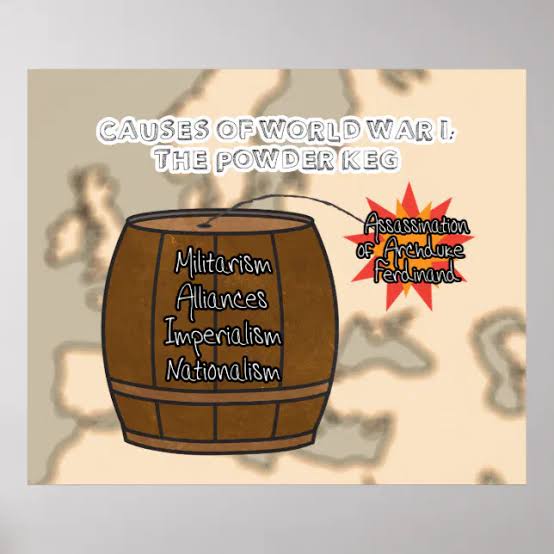
The debate between continuity and break is not merely academic. It shapes how we understand the causes of war and the responsibility of peacemakers. What is clear is that WWI set the stage for WWII by creating a world of unresolved grievances, economic turmoil, and a weak international order—a powder keg waiting for a spark.
World War I did not directly cause World War II, but it created the conditions that made it possible. The Treaty of Versailles humiliated Germany without destroying its potential for resurgence. The collapse of empires created new nations with deep ethnic tensions. The League of Nations proved too weak to enforce peace. And the Great Depression, building on the economic instability of the post-war order, radicalized politics across Europe. When Hitler rose to power, he was not a random accident—he was the culmination of these forces. The unfinished business of the Great War, left to fester for two decades, exploded again with a vengeance.
Summary
- The Treaty of Versailles imposed harsh terms on Germany, including the War Guilt Clause and massive reparations, creating deep resentment.
- The collapse of four empires led to new states with ethnic tensions and irredentist claims.
- The League of Nations was fatally weak, lacking the US, military force, and unanimous action.
- The ‘stab-in-the-back’ myth poisoned German politics, delegitimizing democracy and scapegoating Jews.
- The Great Depression, amplified by the unstable post-war economic system, radicalized Europe and empowered extremists like Hitler.
FAQ
Q: Why is the Treaty of Versailles considered a cause of WWII?
A: The treaty imposed punitive terms on Germany—war guilt, huge reparations, territorial losses, and military restrictions—creating widespread resentment and undermining the legitimacy of the Weimar Republic. This grievance was exploited by nationalist movements, including the Nazis.
Q: How did the collapse of empires contribute to WWII?
A: The collapse of the Austro-Hungarian, Ottoman, Russian, and German empires created new states with borders that did not match ethnic populations, leading to irredentist claims (e.g., Germans in the Sudetenland) and regional instability that Hitler exploited to justify aggression.
Q: What was the ‘stab-in-the-back’ myth?
A: It was a false narrative promoted by German military leaders that the army was undefeated but betrayed by civilians—especially socialists and Jews—on the home front. The Nazis used it to attack democracy and to justify extreme nationalism and anti-Semitism.
Q: How did the Great Depression lead to WWII?
A: The Depression devastated Germany’s economy, with unemployment reaching ~30% by 1932, destroying public confidence in the Weimar Republic and driving voters to extremist parties. It also weakened the international community’s ability to respond to aggression.
Q: Could WWII have been avoided?
A: Many historians argue that WWII was not inevitable. The Depression and Hitler’s rise were contingent events. But the unresolved issues of WWI—especially the Versailles treaty and the weak League of Nations—created a fertile ground for a second conflict.