In 1914, infantrymen went to war with bolt-action rifles, long bayonets, and sabers—weapons designed for open battlefields that no longer existed. By 1918, the trenches had forced a revolution in personal weaponry, giving rise to trench knives, grenades, shotguns, and even flamethrowers.
This article traces that transformation, from the improvised clubs of the first trench raids to the world’s first submachine gun, and shows how the static stalemate of the Western Front turned close-quarters combat into a brutal science.
The Problem: Long Rifles in a Short-Range War
Before 1914, infantry doctrine emphasized massed rifle fire at ranges of 500 to 800 yards. The standard-issue rifles—the British Lee-Enfield SMLE, the German Mauser Gewehr 98, and the French Lebel M1886—were accurate and powerful, but they were long, heavy, and awkward in a trench. Bayonets were even longer: the French Épée-Baïonnette measured a full 20 inches, designed for bayonet drills that never anticipated a muddy ditch 6 feet wide.
Trench warfare shattered these assumptions. By late 1914, the Western Front had congealed into a network of zigzagging trenches, and attacks across No Man’s Land meant closing with the enemy at distances under 100 yards—often less than 30. In this environment, a bolt-action rifle with a 30-inch barrel was a liability. Soldiers needed weapons that were compact, quick to deploy, and devastating at point-blank range.
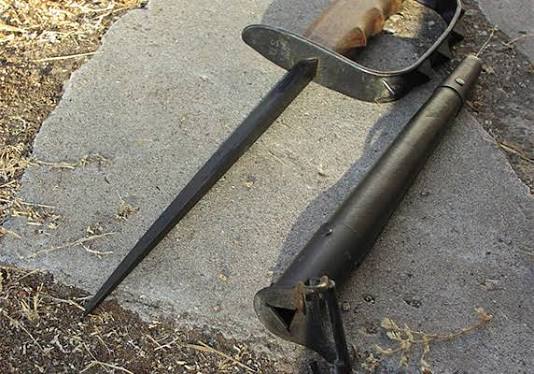
The result was a frantic period of improvisation. Troops on all sides fashioned clubs from entrenching tools, wire, and scrap metal. They lashed bayonets to wooden handles to make spears. They traded rifles for pistols and knives. By 1915, armies began issuing purpose-built trench knives, such as the French Couteau Poignard M1916 and the German Nahkampfmesser. Many featured brass knuckles on the grip, turning the knife into a dual-purpose weapon for stabbing and punching.
The Grenade: From Improvisation to Mass Production
Grenades were almost nonexistent in 1914. Pre-war armies had experimented with hand-thrown explosives, but none had standardized them. The trench experience changed that overnight. Soldiers soon discovered that a thrown explosive could clear a trench section or bunker without exposing the thrower to enemy fire.
The early war saw a flood of improvised grenades—jam tins packed with nails and gunpowder, glass bottles filled with explosives. But these were dangerous and unreliable. The first practical answer came in 1915 with the British Mills bomb, a fragmentation grenade with a serrated cast-iron body and a lever-and-pin mechanism. It could be thrown accurately and exploded into dozens of lethal fragments.
The Germans took a different approach with the Stielhandgranate, or stick grenade. Its long wooden handle allowed for longer throws and could be rolled into trenches. By 1918, Britain alone had produced roughly 75 million grenades, compared to about 500,000 in 1914. The grenade had gone from a makeshift tool to a standard infantry weapon, essential for trench raids and assaults.
The Trench Gun: America’s Controversial Addition
When the United States entered the war in 1917, it brought a weapon that no European army had used: the pump-action shotgun. The Winchester Model 1897, already a civilian hunting gun, was modified with a bayonet mount and a heat shield, earning the nickname “trench broom” or “trench sweeper.”
Its effectiveness was undeniable. Each pump-action blast fired a spread of buckshot that could hit multiple targets in a confined space. In the close quarters of a trench, it was arguably the most lethal personal weapon on the battlefield. The Germans were so outraged that they issued a formal protest in 1918, claiming the shotgun violated the Hague Conventions’ ban on inhumane weapons. The US rejected the protest, noting that shotguns were not explicitly prohibited. The controversy illustrates how desperate the war had become—and how quickly new weapons blurred the line between acceptable and barbaric.
The Flamethrower: Terror as a Weapon
The flamethrower was the most terrifying weapon introduced in the war. The Germans first used the Flammenwerfer on July 30, 1915, at Hooge, Belgium, against British troops. The effect was immediate and psychological: men fled in panic, and the weapon’s ability to clear bunkers and trenches made it a feared assault tool.
Portable models, such as the Kleinflammenwerfer, could project a stream of burning fuel up to 20 or 30 meters. Larger static versions, like the British Livens Large Gallery Flame Projector, could reach 40 meters but were effectively one-shot devices. The flamethrower’s tactical value was limited—the operator was vulnerable to snipers, and the fuel tanks were heavy—but its terror value was immense. A soldier facing a stream of fire had to break cover or burn, which made flamethrowers effective at forcing enemy troops out of strongpoints.
The weapon’s legality was murky. The Hague Conventions banned poison gas and expanding bullets but said nothing about fire. As with the shotgun, Germany used flamethrowers extensively, so the moral high ground was shaky. The weapon’s legacy was clear: future wars would see improved versions, and the psychological impact of fire would never be forgotten.
Early Machine Guns and Submachine Guns: The Seeds of Modern Firepower
Machine guns existed before the war—the Maxim gun had been in service since 1884—but they were treated as artillery, not infantry weapons. The war changed that. The British Lewis Gun, the French Chauchat, and the German MG 08/15 were all portable enough to accompany infantry, though they were heavy, prone to jamming, and required crews to operate.
The real breakthrough came in 1918 with the German MP 18. Designed for the stormtrooper units that spearheaded the Spring Offensive, the MP 18 was the world’s first practical submachine gun. It fired 9mm pistol ammunition at a rate of about 400 rounds per minute, and its short barrel and detachable magazine made it ideal for close-quarters fighting. Issued to assault troops, the MP 18 allowed a single soldier to lay down a withering volume of fire while moving. It was the direct ancestor of every modern submachine gun and a clear sign of where infantry weapons were headed.
From Static Lines to Stormtroopers
The shift in weapons reflected a shift in tactics. By 1917, the Germans had developed infiltration tactics, using small, highly trained teams of stormtroopers armed with grenades, pistols, and flamethrowers to bypass strongpoints and attack command posts and supply lines. This approach required light, portable firepower, which drove the adoption of SMGs and grenades.
The rest of the Allies followed, though more slowly. By November 1918, the infantryman’s kit was vastly different from 1914. The long bayonet was still present, but it was now a secondary weapon. Grenades were standard issue. Shotguns and submachine guns had made their debut. The flamethrower, though still niche, had proven its psychological power.
These changes were not just technological; they were cultural. The war had broken the old rules of warfare, and the new weapons reflected a brutal pragmatism. Soldiers no longer fought in lines; they fought in bursts of violence, using whatever tool could give them an edge.
The Legacy of WWI Infantry Weapons
The weapons developed between 1914 and 1918 laid the foundation for modern infantry combat. The submachine gun, the fragmentation grenade, and the portable flame weapon all became standard in subsequent conflicts. The trench shotgun, though controversial, was used again in World War II and beyond.
More importantly, the war demonstrated that infantry weapons must adapt to the realities of the battlefield. The lessons of the trenches—close-quarters lethality, portability, and psychological impact—remain central to small-arms design today. When you see a soldier with a carbine and a grenade launcher, you are seeing a descendant of the MP 18 and the Mills bomb.
The trenches of WWI were a crucible that forged a new kind of warfare. The weapons that emerged from that crucible were brutal, innovative, and often terrifying. They were also a necessary response to a war that had turned the world upside down.
World War I forced armies to abandon 19th-century weapons and embrace the close-quarters tools of modern war. From the trench knife to the flamethrower, each innovation was a pragmatic answer to the unique horror of the trenches. These weapons not only changed how wars were fought but also set the stage for the infantry arsenals of the 20th century. The stalemate of the Western Front may have been a deadlock, but it was also a forge—one that produced the tools that would define warfare for generations to come.
Summary
- Trench warfare made long rifles and bayonets obsolete, leading to the development of compact close-quarters weapons like trench knives and pistols.
- Grenades went from improvised jam tins to mass-produced Mills bombs and stick grenades, with Britain producing 75 million by 1918.
- The US shotgun, or “trench broom,” was so effective that Germany protested it as inhumane, though it was not banned.
- Flamethrowers, first used by Germany in 1915, were more about psychological terror than tactical efficiency, with ranges of 20–40 meters.
- The MP 18, the first practical submachine gun, was introduced in 1918 and directly influenced modern infantry weapons.
FAQ
Q: Why were trench knives so important in WWI?
A: Trench knives, often with brass knuckles, were essential for silent raids and close-quarters combat, where rifles were too long and noisy. They were compact, deadly, and could be used in the confined spaces of trenches.
Q: Did the shotgun really cause a diplomatic protest?
A: Yes. In 1918, Germany formally protested the US use of pump-action shotguns, claiming they violated the Hague Conventions. The US rejected the protest, and shotguns remained in use.
Q: How effective were flamethrowers in combat?
A: Their effectiveness was mixed. They were terrifying and could clear bunkers, but they had short range (20–30 meters), were heavy, and made operators vulnerable. Their main impact was psychological.
Q: What was the first submachine gun?
A: The German MP 18, introduced in 1918, is generally considered the first practical submachine gun. It was used by stormtroopers during the Spring Offensive.
Q: How did grenades change during the war?
A: Grenades went from improvised, unreliable devices to standardized, mass-produced weapons like the British Mills bomb and German stick grenade. Production increased from about 500,000 in 1914 to 75 million by 1918.