Tag: industrial revolution

  • The Accidental Rainbow: How a Teenager’s Failed Experiment Created the First Synthetic Dye

    The Accidental Rainbow: How a Teenager’s Failed Experiment Created the First Synthetic Dye

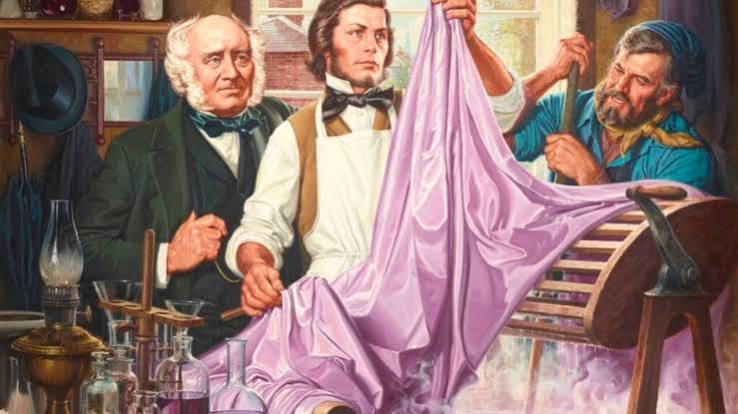
    In 1856, an 18-year-old chemist named William Henry Perkin was trying to make quinine, a malaria treatment, from coal tar in his home lab. Instead, he got a black sludge that turned alcohol a brilliant purple. That sludge would become mauveine the first synthetic dye and it didn’t just change fashion; it kicked off the entire synthetic organic chemistry industry, leading to everything from synthetic perfumes to modern pharmaceuticals. This is the story of how a failed experiment painted the world in new colors and reshaped science, industry, and society.

    The State of Color Before 1856

    Before Perkin’s discovery, every color in every fabric came from nature. Indigo came from plants, madder from roots, and Tyrian purple from sea snails so rare that a single ounce could cost a fortune—literally, it was reserved for emperors and kings. Natural dyes were expensive, faded quickly, and varied wildly in shade depending on the season or soil where the source plant grew. The booming textile industry of the Industrial Revolution desperately needed something better: a cheap, consistent, colorfast dye that could be made in bulk.

    A Teenager’s Failed Chemistry Experiment

    Perkin was a prodigy. At 15, he enrolled at the Royal College of Chemistry in London, where he studied under August Wilhelm von Hofmann, a German chemist who had discovered how to derive aniline from coal tar. Coal tar was the gooey waste product of gas lighting—a stinky nuisance that cities didn’t know what to do with. Hofmann suggested that Perkin try to synthesize quinine, an antimalarial drug that was expensive and in high demand because of British colonies in tropical regions.

    The prevailing theory—the “radical theory”—wrongly suggested that oxidizing a compound called allyltoluidine would yield quinine. Perkin followed the recipe, but instead of quinine, he got a dark, tarlike mess. Most young chemists would have tossed it out. But Perkin, curious, decided to test it in alcohol. The result was a stunning purple liquid. He immediately recognized that this color could be valuable as a dye—perhaps even more valuable than the quinine he’d been chasing.

    From Sludge to Fashion Sensation

    Perkin patented his discovery in August 1856 (British Patent No. 1984) and, with his family’s support, built a factory in Greenford Green, near London, to produce the dye at scale. By 1857, mauve was on the market. The name came from the French word for the mallow flower, which has a similar hue. At first, the dye was a hard sell—textile makers were skeptical. But in 1858, Queen Victoria wore a mauve silk gown to her daughter’s wedding, and suddenly everyone wanted mauve. “Mauve mania” swept Europe, and Perkin’s purple became a symbol of the modern age.

    The Science of Serendipity

    Perkin’s discovery is a textbook example of serendipity in science, but it wasn’t just luck. As Louis Pasteur famously said, “Chance favors the prepared mind.” Perkin had the training to understand what he was seeing and the entrepreneurial instinct to turn a mistake into a product. This accident also launched the field of synthetic organic chemistry. Perkin went on to synthesize coumarin, the first synthetic perfume, in 1868, and he developed a way to make alizarin, the red dye from madder, in 1869—a process that wiped out the natural madder industry.

    Interestingly, the exact chemical structure of mauveine wasn’t fully understood for over a century. In 1994, researchers at the University of Wales (Swansea) used modern analytical techniques to reveal that Perkin’s mauve was actually a mixture of several related compounds, not a single pure substance. That discovery doesn’t diminish his achievement—it just shows how complex his “simple” dye really was.

    The Birth of an Industry—and Its Migration to Germany

    Perkin’s success proved that chemistry could be profitable, and the synthetic dye industry was born in Britain. But it didn’t stay there long. German companies like BASF, Bayer, and Hoechst invested heavily in dye research, and by the 1880s, Germany dominated the global market. This wasn’t just about color; those dye companies later pivoted to pharmaceuticals, and many early drugs—including aspirin and sulfa drugs—were derived from dye compounds. So Perkin’s accidental purple helped birth the modern pharmaceutical industry.

    Perkin himself sold his factory in 1873 and retired from manufacturing to focus on pure research. Some historians see that as a missed opportunity for Britain, which lost its lead in chemical innovation to Germany. But Perkin’s decision also highlights a key shift: chemistry was becoming a field where academic research and industrial application were deeply intertwined.

    What Mauve Taught Us

    The accidental discovery of mauve shows how a single moment of insight, combined with hard work, can change the world. Perkin didn’t set out to revolutionize color—he was chasing a malaria cure. But his willingness to investigate the unexpected turned a failure into a triumph that democratized color, made textiles more affordable, and laid the groundwork for entire industries. The next time you see a bright, lasting color on a shirt or a bottle of perfume, you can thank the 18-year-old who saw a purple miracle in a pile of coal tar sludge.

    Perkin’s mauve was more than a fashion trend; it was a chemical key that unlocked a new world of synthetic materials. From dyes to drugs to plastics, the chain of discovery that began with that 1856 mistake still runs through our lives today. It’s a reminder that the next big breakthrough might come from a failed experiment—if you’re prepared to see it.

    Summary

    • In 1856, 18-year-old William Henry Perkin accidentally created the first synthetic dye while trying to make quinine.
    • The dye, mauveine or mauve, was made from coal tar, a waste product of gas lighting.
    • Perkin patented it and built a factory, and the color became a sensation after Queen Victoria wore it.
    • The discovery launched synthetic organic chemistry and led to synthetic perfumes, alizarin, and ultimately the German dye and pharmaceutical industries.
    • Modern analysis showed mauveine was a mixture of compounds, but its impact remains clear.

    FAQ

    Q: Why was quinine synthesis important in 1856?
    A: Quinine was the main treatment for malaria, which was a major health problem in British colonies. It was expensive and hard to get, so chemists wanted to make it synthetically.

    Q: What exactly is coal tar, and why was it relevant?
    A: Coal tar was a smelly byproduct of gas lighting. It was mostly waste, but chemists like Perkin knew it contained valuable compounds like aniline, which could be used to make new materials.

    Q: Was Perkin the first to discover a synthetic dye?
    A: He was the first to discover a synthetic dye that could be produced and sold commercially. His patent and factory made it practical, not just a laboratory curiosity.

    Q: How did mauve become so popular?
    A: Queen Victoria wore a mauve silk gown to her daughter’s wedding in 1858, sparking a fashion craze. The color was new, vibrant, and more affordable than natural purple dyes.

    Q: What happened to the synthetic dye industry after Perkin?
    A: It grew rapidly but shifted to Germany, where companies like BASF and Bayer dominated. That German lead later helped them dominate pharmaceuticals, since many early drugs came from dye research.
  • Rosie’s Rivets: How Six Million Women Built the Arsenal of Democracy

    Rosie’s Rivets: How Six Million Women Built the Arsenal of Democracy

    In 1942, a 20 year old farm girl named Rose Monroe walked into a Detroit aircraft plant and picked up a rivet gun for the first time. Within months, she was helping build B-24 bombers, part of a workforce that would change the face of American industry forever. Rose was one of millions a real-life Rosie the Riveter, though the name would later become a symbol far bigger than any single woman.

    When President Franklin D. Roosevelt promised to make America the ‘Arsenal of Democracy’ in 1940, he was talking about machines and munitions. But the arsenal needed hands to build it, and those hands were increasingly female. By 1943, women were not just a token presence in factories; they were the backbone of production, riveting fuselages, welding hulls, and loading shells. This is the story of how they got there, what they did, and what happened when the war ended.

    The Labor Crisis That Opened the Factory Gates

    Before the war, heavy industry was a man’s world. Women worked in textile mills, as domestic servants, or in offices, but the idea of a woman operating a drill press or welding a ship’s hull was considered absurd even dangerous. The Great Depression had reinforced the notion that a woman’s place was in the home, with many states passing laws that barred married women from certain jobs.

    Then the war came. Between 1941 and 1945, over 16 million men left civilian life for the military. The factories that had been retooling for war production suddenly faced a catastrophic shortage of workers. In 1942, the War Manpower Commission realized that voluntary male labor could not meet the desperate need for aircraft, ships, and ammunition. The government and industry had to swallow their prejudices.

    At first, they tried to recruit women into “light” work assembling small parts, packing supplies. But the need was too great. Soon, women were being trained for the same jobs as men: riveting, welding, operating cranes, and working in foundries. The U.S. Employment Service launched a campaign with the slogan, “The More Women at Work, the Sooner We Win!”

    6 Million Strong: The Scale of the Shift

    By the war’s end, roughly 6 million women had entered the workforce. Of those, between 2 and 3 million went directly into war industries aircraft factories like Boeing and Lockheed, shipyards like the Kaiser yards on the West Coast, and munitions plants scattered across the country. At peak, women made up 37% of the civilian labor force in war production.

    The numbers were staggering. In 1940, there were almost no women building airplanes. By 1943, women constituted nearly 40% of the aircraft industry workforce. In shipyards, they were welding hulls and installing electrical systems. One Kaiser shipyard in Richmond, California, employed over 20,000 women, many of whom had never held a job outside the home.

    These women were not all young and single. Many were married, some with children. They came from all backgrounds former waitresses, teachers, and housewives. They learned to read blueprints, use micrometers, and operate heavy machinery. They worked 48 to 60-hour weeks, often on night shifts, and then went home to cook, clean, and care for their families.

    The Icon and the Reality

    The name “Rosie the Riveter” comes from a 1942 song by Redd Evans and John Jacob Loeb, which told of a woman working on an assembly line. The song was a hit, and the name stuck. But the image we know today the bandana, the rolled-up sleeve, the flexed bicep comes from two different sources.

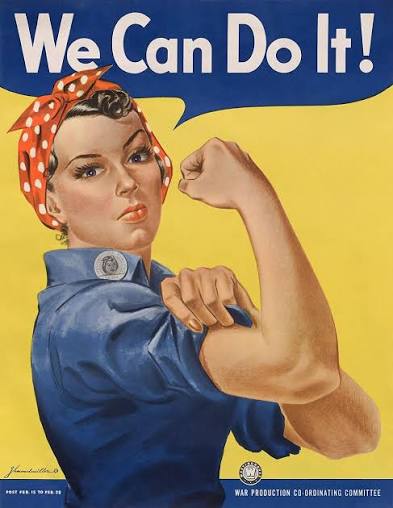
    In 1943, Norman Rockwell painted a cover for the Saturday Evening Post depicting a muscular Rosie with a rivet gun in her lap and a copy of Mein Kampf under her foot. That image, with its blend of patriotism and power, was what most Americans saw during the war. A year earlier, J. Howard Miller had created a poster for Westinghouse Electric showing a woman in a red bandana with the slogan “We Can Do It!” That poster was hung in factories for a few weeks, then largely forgotten—until the 1980s, when feminist activists rediscovered it and turned it into a symbol of women’s empowerment.

    The reality was more complicated. Women were paid significantly less than men—on average, 50 to 65% of what men earned for the same work. Some unions, like the United Auto Workers, pushed for equal pay, but it rarely happened. The government’s propaganda, meanwhile, emphasized that women were working as a “temporary” measure, a patriotic duty rather than a career.

    The Double Shift and the Struggle for Respect

    Media portrayed women as effortlessly balancing factory work and home life—”She can do it!” was a common refrain. But the truth was that many women were exhausted. They worked eight or ten-hour shifts, then came home to cook dinner, do laundry, and care for children. The federal government did fund over 3,000 childcare centers under the Lanham Act, but coverage was spotty. Many women relied on grandparents, neighbors, or older siblings to watch their kids.

    In the factories, women faced skepticism and sometimes outright hostility. Male supervisors often assumed they couldn’t handle the work and gave them the dirtiest, most dangerous jobs. African American women, who made up about 600,000 of the industrial workforce, faced segregation in many plants. They were often assigned to the most hazardous tasks, like handling explosives, and were excluded from the better-paying positions reserved for white women.

    Despite all this, women proved themselves. They learned to rivet, weld, and operate cranes. They built the B-29 bombers that would end the war. They laid the steel plates of Liberty ships, sometimes in record time. A woman named Beatrice Morales, a Mexican American from Los Angeles, worked as a welder at a shipyard and later said, “I loved it. I felt like I was doing something important.”

    When the War Ended

    The war ended in 1945, and the industrial machine slowed. Women were the first to be laid off. By 1947, the female labor force participation rate had dropped to near pre-war levels, though it never fully returned to the 1940 figure. Many women left willingly, exhausted by the double shift and eager to return to normal life. Others were pushed out—their jobs given to returning veterans.

    The government and media, which had spent four years urging women to work, now told them to go home. A 1945 article in The New York Times advised women to “return to the home” and make room for the men who had fought for their country. The “We Can Do It!” poster was retired.

    But something had changed. Millions of women had earned their own money, learned new skills, and tasted a kind of independence they had never known. They may have left the factories, but they carried that experience into the post-war world. Many returned to work within a few years, not in factories but in the growing clerical and service sectors. The Rosie the Riveter generation laid the groundwork for the women’s rights movement of the 1960s, even if they didn’t always see it themselves.

    The Legacy

    Today, Rosie the Riveter is a symbol of women’s strength and capability. The “We Can Do It!” poster is reproduced on T-shirts, coffee mugs, and posters. But the real Rosies—the millions of women who worked in the arsenal of democracy—were not just symbols. They were real people who got their hands dirty, who built the machines that won the war, and who challenged the notion of what women could do.

    In 2000, the Rosie the Riveter/World War II Home Front National Historical Park was established in Richmond, California, at the site of one of the largest Kaiser shipyards. It stands as a tribute to the women and men who worked there. But the greatest tribute is the memory: a generation of women who, when their country called, answered with their hands and their courage.

    Rosie the Riveter was never one woman, but millions. They built the planes, ships, and arms that turned the tide of World War II. They worked for less pay, faced discrimination, and carried the double burden of work and home. Yet they did it—and in doing so, they changed America forever. Their legacy is not just in the machines they built, but in the doors they opened for the women who came after them.

    Summary

    • Over 6 million women entered the workforce during WWII, with 2-3 million in war industries like aircraft, shipbuilding, and munitions.
    • At peak, women made up 37% of the civilian labor force in war production.
    • Women were paid 50-65% of men’s wages for the same work, despite equal-pay rhetoric.
    • The ‘We Can Do It!’ poster was created in 1943 but only became famous in the 1980s; Norman Rockwell’s 1943 cover was more iconic during the war.
    • Women faced a ‘double shift’ of factory work and home duties, with limited childcare support.
    • After the war, most women were laid off, but their wartime work laid the foundation for future women’s rights movements.

    FAQ

    Q: Who was the real Rosie the Riveter?
    A: Rosie is a composite icon, not a single person. Several women have been proposed as inspirations, including Rose Monroe, a riveter at Willow Run, and Geraldine Hoff Doyle, who may have been the model for the ‘We Can Do It!’ poster. But the name comes from a 1942 song, not any one individual.

    Q: What did women actually do in the war industries?
    A: They did almost everything: riveting aircraft fuselages, welding ship hulls, operating cranes, assembling ammunition, and working in steel mills. They were trained on the job and often excelled at precision work.

    Q: Were women paid the same as men?
    A: No. On average, women earned 50-65% of what men were paid for the same work. Some unions fought for equal pay, but it was rarely achieved.

    Q: How did women manage childcare while working?
    A: The federal government funded over 3,000 Lanham Act childcare centers, but they were unevenly distributed. Many women relied on family members or informal arrangements.

    Q: What happened to women workers after the war?
    A: Most were laid off to make room for returning veterans. By 1947, women’s labor force participation had dropped to near pre-war levels, though it never fully returned to 1940 rates.