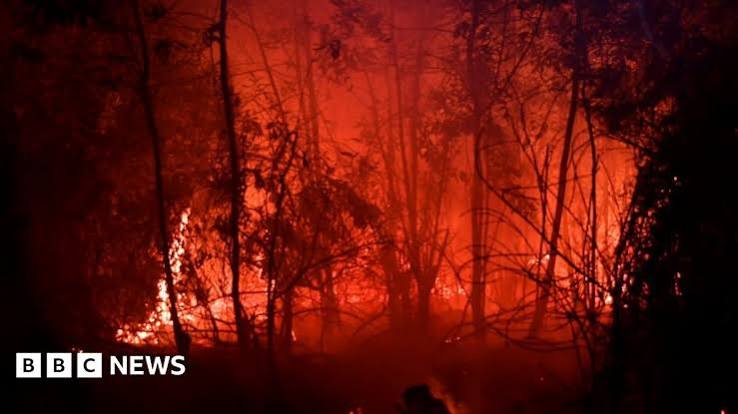
When images of orange skies and smoke-blanketed cities emerge from Indonesia, they often signal the return of a recurring crisis: peatland fires. In recent months, satellite data from NASA FIRMS has detected thousands of fire hotspots on the islands of Sumatra and Kalimantan, with provinces like Riau, South Sumatra, Central Kalimantan, and West Kalimantan particularly affected. The fires are not your typical forest blazes they burn both above and below ground, making them notoriously difficult to extinguish and capable of smoldering for weeks or even months.
This isn’t just an Indonesian problem. The resulting haze has pushed air quality to hazardous levels in cities like Palangkaraya, where PM2.5 concentrations have exceeded an AQI of 300, forcing schools to close and disrupting flights. The smoke also carries health risks across Southeast Asia, affecting millions in neighboring countries. Understanding why these fires happen, why they persist, and what can be done is essential for anyone concerned about climate change, public health, or the future of tropical ecosystems.
The Hidden Fuel Beneath the Forest
To grasp why peat fires are so severe, you need to know what peat is. Imagine a sponge made of partially decomposed leaves, wood, and other plant material, soaked in water. That’s peat. It forms over thousands of years in waterlogged areas where dead vegetation doesn’t fully rot because there’s little oxygen. Indonesia holds about 36% of the world’s tropical peatlands, which store an estimated 35 to 60 billion metric tons of carbon—that’s a massive amount of carbon locked away.
When peatlands are drained for agriculture, usually through networks of canals, the water is removed. The once-spongy peat dries out and becomes extremely flammable. It’s like turning a wet sponge into tinder. And once ignited, the fire can creep underground, burning through the peat layer itself. These ground fires are notoriously difficult to put out because water and fire retardants often can’t reach the deep layers. They can smolder for weeks, releasing enormous amounts of smoke and carbon dioxide.
Why Do These Fires Start?
The immediate cause is often human activity. In Indonesia, fire is frequently used as a cheap and quick way to clear land, especially for palm oil and pulpwood plantations. Despite many large companies adopting ‘zero-burning’ policies, smallholders and illegal land clearers still rely on burning because it’s the most cost-effective method for them. Accidental ignitions from discarded cigarettes or campfires also play a role. During the dry season, particularly when an El Niño event reduces rainfall, the dried peat becomes even more combustible. This combination—dried peat, human ignition, and drought—creates the perfect storm.
Historical patterns show that severe fire years often coincide with strong El Niño events. The 1997-98 fires were catastrophic, and the 2015 fire season was one of the worst on record, at one point emitting more CO2 daily than the entire U.S. economy. The 2015 fires were linked to over 100,000 premature deaths from smoke inhalation across Southeast Asia, according to estimates from Harvard and Columbia researchers. More recently, 2019 also saw significant fires. The current event, while still unfolding, appears to be following a similar trajectory.
Smoke That Chokes: Health and Air Quality
The most visible impact of peat fires is the thick, acrid haze that darkens skies and reduces visibility. This smoke is not just unpleasant—it’s a serious health hazard. It contains fine particulate matter, known as PM2.5, which can penetrate deep into the lungs and enter the bloodstream. When PM2.5 levels reach hazardous levels, as they have in several Indonesian cities, it triggers a range of health problems, from respiratory infections to heart disease and strokes. Children, the elderly, and those with pre-existing conditions are especially vulnerable.
During the 2015 fires, schools closed, and airports shut down due to poor visibility, disrupting travel and daily life. The economic costs are staggering: healthcare burdens, lost productivity, and damage to tourism and agriculture. In 2019, the Indonesian government estimated economic losses in the billions of dollars. The haze also has transboundary effects, regularly straining relations with Malaysia and Singapore, which have repeatedly called for action to stop the annual smoke.
Climate Consequences: A Vicious Cycle
Peat fires are a major source of greenhouse gas emissions. When peat burns, it releases not only carbon dioxide but also methane, a potent greenhouse gas. The 2015 fires alone released an estimated 1.75 billion tons of CO2 equivalent, according to the World Resources Institute. That’s more than the annual emissions of Germany or Japan. These emissions accelerate climate change, which in turn can worsen droughts, making peat fires more likely. It’s a vicious cycle: fires contribute to climate change, and climate change creates conditions that make fires worse.
Beyond carbon, peat fires destroy critical habitat for endangered species like orangutans and Sumatran tigers. The fires also degrade the peatland ecosystem, leaving it more vulnerable to future fires and flooding. The restoration process is slow—it can take decades for peat to re-accumulate and for the ecosystem to recover.
What’s Being Done About It?
The Indonesian government has taken steps to address the problem. A moratorium on new peatland development was established, and in 2016, the Peatland Restoration Agency (BRG) was set up to coordinate restoration efforts. These initiatives include blocking canals to rewet peatlands and promoting alternative farming methods that don’t rely on burning. However, enforcement is challenging. The economic pressure to expand palm oil and pulpwood plantations is strong, and many smallholder farmers have no affordable alternative to slash-and-burn.
International pressure, such as the European Union’s deforestation regulation, aims to ensure that products sold in the EU are not linked to deforestation. This could push companies to be more responsible about their supply chains. But the problem is deeply rooted in local livelihoods and governance. As the journalist and environmentalist Satrio Nuswantoro puts it, ‘You can’t just ban fire; you have to offer an alternative that makes sense economically for farmers.’
Looking Ahead: The Need for Sustainable Solutions
Addressing peatland fires requires a multi-pronged approach. On the ground, efforts to rewet drained peatlands are crucial. Restoring water levels prevents the peat from drying out and becoming flammable. For communities, providing accessible alternatives to fire—such as mechanical land clearing or agroforestry systems—can reduce intentional burning. Better enforcement and monitoring using satellite data can help catch fires early, though this is only effective if there’s the capacity to respond quickly.
Long-term, climate change mitigation is key. Reducing global emissions will lessen the severity of El Niño events and droughts, indirectly reducing fire risk. But for now, as long as peatlands remain drained and dry, the threat of fires will persist. Each fire season, we’re reminded that the health of our planet is tied to the health of these ancient, carbon-rich landscapes. Protecting them isn’t just Indonesia’s responsibility; it’s a global imperative.
Peatland fires in Indonesia are a complex disaster with roots in land use, poverty, and climate change. They burn for months because they smolder underground, releasing toxic smoke and massive amounts of carbon. While Indonesia has made efforts to restore degraded peatlands, the challenge is immense. The fires that darken skies in Sumatra and Kalimantan are also darkening the future of our climate. Solving this will require not just policy changes but also support for communities to adopt sustainable livelihoods. Otherwise, we’ll continue to see the same orange skies year after year.
Summary
- Indonesia’s peatland fires burn both above and below ground, making them extremely hard to extinguish.
- Drainage of peat for agriculture turns it into highly flammable fuel, and fires are often started by humans.
- Severe fire years are linked to El Niño-induced droughts, as seen in 2015 and 2019.
- Smoke from fires causes hazardous air quality, leading to health crises and economic losses.
- Restoration efforts and sustainable land management are key to preventing future fires.
FAQ
Q: Why do peat fires keep happening in Indonesia?nA: The underlying cause is drained peatlands, which dry out and become highly flammable. When land is cleared for agriculture, often using fire, the dried peat can ignite and burn underground for long periods. Droughts associated with El Niño make the peat even drier and more susceptible to fires.nnQ: What are the main health risks from the haze?nA: The haze contains fine particles (PM2.5) that can penetrate deep into the lungs, causing respiratory issues, heart disease, and other illnesses. Vulnerable groups like children and the elderly are particularly at risk. Long-term exposure can lead to chronic health problems.nnQ: How do peat fires affect climate change?nA: Peat fires release huge amounts of carbon dioxide and methane, which are potent greenhouse gases. For example, the 2015 fires emitted about 1.75 billion tons of CO2 equivalent, more than the annual emissions of many countries. This accelerates global warming, which in turn can make fires more likely.nnQ: What can be done to stop the fires?nA: Restoring water levels in drained peatlands is key, as wet peat won’t burn. Providing alternative livelihoods for farmers so they don’t need to clear land with fire, and enforcing regulations against illegal burning are also important. International pressure and support for sustainable palm oil production can help.nnQ: Is the current fire season worse than previous ones?nA: The severity varies each year. It’s important to check up-to-date data from sources like Indonesia’s Ministry of Environment and Forestry or NASA FIRMS. Historically, the 2015 and 2019 fires were particularly severe, but the current situation should be assessed with current data.