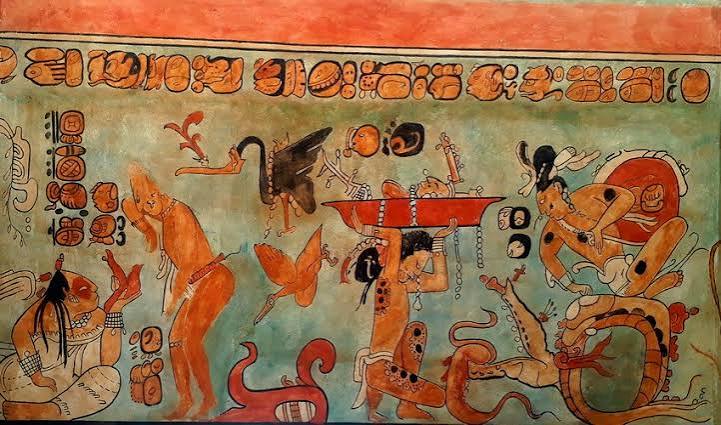
When we picture the ancient Maya, we often imagine blood-soaked altars, precise astronomical calculations, and the grim faces of priests. But dig a little deeper, and you find a culture that embraced the absurd: kings who played the fool, gods who farted, and a five-day festival where everyone deliberately acted the opposite of normal. This was not mere comic relief it was sacred technology.
For the Maya, humor was a serious business. Laughter could repel evil spirits, restore cosmic balance, and even prove a ruler’s divine right to power. Their rituals, far from being solemnly uniform, were often raucous, bawdy, and deliberately inverted. The ancient Maya had their own version of ‘Opposite Day,’ and it was woven into the very fabric of their worldview.
Ritual Inversion: Flipping the World to Save It
The Maya believed the cosmos was a fragile, cyclical system that needed constant maintenance. Ritual was not about being somber; it was about being effective. And one of the most effective tools was ritual inversion—acting opposite to normal social roles or expectations.
This took many forms: role reversals, bawdy humor, and deliberate profanity within sacred contexts. For instance, during certain ceremonies, the usual hierarchies were temporarily upended. A commoner might dress as a lord, or a priest might mock the very gods he served. This was not sacrilege; it was a way to enact the duality central to Maya thought. Life and death, order and chaos, sacred and profane—these were not opposites but complementary forces. By flipping the world on its head, the Maya reminded themselves of its contingency and kept the cosmic machinery running.
The Uayeb: Five Days of Deliberate Chaos
The most concrete evidence of a literal ‘Opposite Day’ comes from the uayeb (also spelled wayeb), the five unlucky days at the end of the 365-day solar year (haab). These days were considered dangerous: the portal between worlds opened, and evil spirits could cross over. To protect themselves, the Maya performed rituals of disorder.
People dressed in rags, acted foolishly, and deliberately broke taboos. They might walk backward, speak in riddles, or engage in crude jokes. This was a form of sympathetic magic: by making the world chaotic on a small scale, they hoped to confuse malevolent spirits and keep the larger cosmos safe. It was a calculated, communal act of chaos, designed to restore order by embracing its opposite.
Drunken Rituals: Sacred Intoxication and Laughter
Intoxication was not seen as profane in Maya ritual—it was a means of accessing the divine. The fermented honey-based beverage balché flowed freely during ceremonies, and the resulting drunkenness often produced raucous, comedic behavior that was expected rather than frowned upon.
Spanish friar Diego de Landa, writing in his Relación de las cosas de Yucatán (c. 1566), recorded these ceremonies with a mix of horror and fascination. He noted the ‘indecent’ and ‘laughable’ elements, but for the Maya, this was not a corruption of ritual—it was ritual. The laughter and loss of inhibition were part of the sacred experience, a way to break through the mundane and touch the divine.
The Popol Vuh: Trickster Twins and Underworld Comedy
The Popol Vuh, the K’iche’ Maya creation epic, is packed with comedic elements. The Hero Twins, Hunahpu and Xbalanque, use trickery, slapstick, and mockery to defeat the Lords of Xibalba, the underworld. They fart, make fools of their hosts, and turn the tables through laughter.
This is not mere comic relief—it is a theological statement. The Lords of Xibalba expect to be feared; the twins respond with mockery. Their wit is a form of power, proving that the clever can overcome the cruel. The twins’ journey is a masterclass in comedic resistance, and it encodes a deep truth: in the Maya worldview, laughter is a weapon against death itself.
Pottery, Codices, and the Dwarf of Uxmal
Maya pottery and codices are full of scenes depicting ritual humor. Figures strike exaggerated poses, animals act like humans, and deities engage in drunken or lewd antics. The Madrid Codex and Paris Codex contain scenes that scholars have interpreted as ritual burlesque. Even the ‘God of the Underworld’ (God A in the Schellhaus classification) is shown as skeletal yet dancing—terrifying yet absurd, suggesting that even death was subject to irony.
The legend of the ‘Dwarf of Uxmal’ further underscores the value of wit. According to colonial-era accounts, a dwarf—through trickery and inversion—becomes ruler. This story, which likely encodes older traditions, shows that reversal was a legitimate path to power in Maya culture. The trickster, the clown, the fool—these were not marginal figures but central to the maintenance of cosmic and social order.
Why It Matters
Understanding the Maya use of humor and irony challenges our assumptions about ancient cultures. They were not a people of grim-faced fatalism, but a civilization that embraced the absurd as a sacred duty. Their rituals remind us that humor can be a profound way of engaging with the unknown—a way to face the dark with a laugh, and in doing so, to find the light.
The ancient Maya knew something that we often forget: that laughter is not the opposite of reverence, but its partner. In their rituals, they flipped the world to keep it balanced, used mockery to disarm death, and found the sacred in the silly. The next time you hear about ‘Opposite Day,’ remember that for the Maya, it was not a childish game—it was a cosmic necessity.
Summary
- The ancient Maya used humor, parody, and inversion in their religious rituals, contrary to the usual focus on bloodletting and sacrifice.
- Ritual inversion, including role reversals and bawdy humor, was a deliberate technique to maintain cosmic balance.
- The uayeb, five unlucky days at year’s end, were marked by rituals of disorder, making it the closest analogue to a literal ‘Opposite Day.’
- Drunkenness, particularly from balché, was a sacred means of accessing the divine, often accompanied by comedic behavior.
- The Popol Vuh’s Hero Twins use slapstick and mockery to defeat the Lords of Xibalba, showing wit as a form of power.
FAQ
Q: Did the Maya have a literal ‘Opposite Day’?
A: Not exactly, but the uayeb—the five unlucky days at the end of the solar year—were a time of ritual inversion, where people deliberately acted opposite to normal behavior to confuse evil spirits and reset cosmic order.
Q: Why did the Maya use humor in sacred rituals?
A: For the Maya, humor served a cosmological function. Laughter could repel evil, ease social tension, and restore balance. It was not seen as profane but as an effective way to maintain the fragile cosmic order.
Q: What is the Popol Vuh and how does it relate to humor?
A: The Popol Vuh is the K’iche’ Maya creation epic. It features the Hero Twins, who use trickery, slapstick, and mockery to defeat the Lords of Xibalba, demonstrating that wit is a form of power.
Q: How do we know about Maya ritual humor?
A: Evidence comes from colonial accounts like Diego de Landa’s, as well as from Maya pottery, codices (like the Madrid and Paris Codices), and oral traditions such as the Dwarf of Uxmal legend.
Q: Was intoxication part of Maya ritual?
A: Yes, the Maya used balché, a fermented honey beverage, in ceremonies. Intoxication was seen as a way to access the divine, and the resulting comedic behavior was expected and accepted.