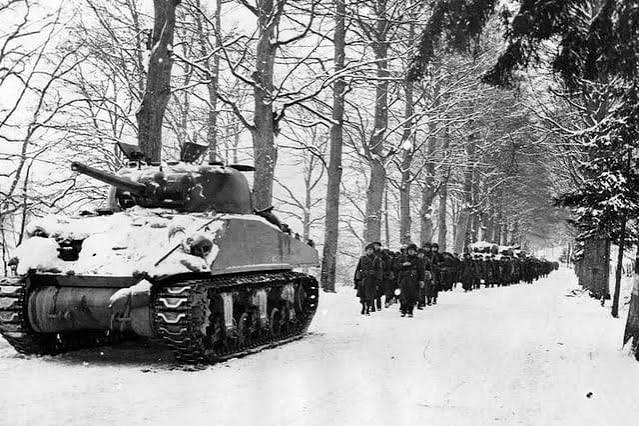
At 5:30 a.m. on December 16, 1944, the quiet of the Ardennes Forest shattered. More than 1,900 German artillery pieces opened fire along an 80-mile front, and 200,000 infantry and panzer troops surged forward into the American lines. The surprise was almost total. The U.S. forces holding that sector—about 80,000 men stretched thin across a rugged, forested region considered a ‘ghost front’—were about to be engulfed in the largest and bloodiest battle the U.S. Army fought in World War II.
The offensive was Hitler’s gamble. He called it Operation Wacht am Rhein—Watch on the Rhine—and he believed it could split the Allied armies, seize the port of Antwerp, and force the Western Allies to sue for peace. For six weeks, the fate of the Western Front hung in the balance, as American soldiers fought in freezing cold, surrounded and outnumbered, in what became known as the Battle of the Bulge.
A Quiet Sector Turned Trap
The Ardennes region had been quiet since the Allies pushed through it in September 1944. The terrain—dense woods, steep hills, and winding roads—was ideal for defense and terrible for armored warfare. Allied commanders, including General Dwight Eisenhower and General Omar Bradley, considered it a low-risk sector. So they sent battle-weary divisions there to rest and refit, alongside green divisions fresh from the States. The U.S. VIII Corps holding the line was a patchwork of units, some at half strength.
German intelligence had hidden the buildup masterfully. Troops moved only at night, radio silence was absolute, and false rumors were planted. The Allied codebreakers at Bletchley Park—Ultra—picked up hints of an impending offensive, but the reports were fragmented and contradictory. Eisenhower’s staff judged that the Wehrmacht lacked the fuel, the tanks, and the manpower for a major winter attack. They were wrong.
The attack began with a massive artillery barrage, followed by infantry and armor pouring through the American lines. The Germans had nearly 1,000 tanks and assault guns, including elite SS panzer divisions. Their objective: cross the Meuse River within 48 hours and drive northwest to Antwerp, a vital port that was not yet fully operational but was essential for the Allied supply chain. Hitler believed that splitting the British and American armies would break the coalition and free Germany to turn its full force against the Soviet Union in the East.
The American Response: Holding the Shoulders
The initial American defense was chaotic. Units were surrounded, communications cut, and commanders lost contact with their troops. Yet within days, a pattern emerged. The battle developed a distinctive shape on the maps: a westward bulge in the Allied lines, which gave the battle its name. The key was to hold the shoulders of the bulge—the northern and southern flanks—to prevent the Germans from widening the breach.
At the northern shoulder, on the Elsenborn Ridge, the U.S. 2nd and 99th Infantry Divisions held their ground against repeated assaults by the 6th Panzer Army, the strongest German force in the offensive. For days, they endured ferocious attacks, freezing weather, and shortages of ammunition. Their stand was critical: they blocked the shortest route to the Meuse and forced the German armor into a bottleneck, slowing the entire offensive.
At the southern shoulder, the city of Bastogne sat at a crossroads of seven roads—a vital hub for any armored advance. On December 20, the Germans surrounded the town, trapping the 101st Airborne Division and elements of the 10th Armored Division. When the German commander demanded surrender, Brigadier General Anthony McAuliffe responded with a terse answer that became legendary: “Nuts!” The Americans held out, repelling attack after attack, surviving on meager rations and ammunition, while the weather grounded Allied supply drops.
The Weather Turns
The offensive had been timed to exploit a forecast of heavy cloud cover, which grounded the Allied air forces. For the first week, the German armor moved under a blanket of fog and snow, protected from the fighter-bombers that had dominated the skies since D-Day. But on December 23, the skies cleared. Within hours, Allied aircraft—P-47 Thunderbolts, P-51 Mustangs, and British Typhoons—swarmed over the battlefield, attacking German columns, supply lines, and fuel depots. The Luftwaffe attempted a massive strike on Allied airfields on January 1, 1945, but it was a costly failure.
Aerial resupply also reached Bastogne, dropping ammunition, food, and medical supplies to the besieged garrison. The relief of Bastogne came on December 26, when units of General George Patton’s Third Army, having turned north from their position in France, broke through the German lines. Patton had executed a near-impossible 90-degree turn of his entire army in less than three days—a movement that remains a textbook example of battlefield agility.
The Price of the Gamble
The offensive continued into January, but the German momentum was spent. By early January, the Allies were counterattacking, pinching off the bulge from the north and south. On January 25, 1945, the U.S. Army officially declared the bulge eliminated, though fighting in the salient continued into early February.
The cost was staggering. The United States suffered roughly 89,500 casualties—about 19,000 killed, 47,500 wounded, and 23,000 captured or missing. The British, who had been called in to help hold the northern shoulder, lost about 1,400 men. German casualties are estimated between 67,000 and 125,000, with 15,000 to 25,000 killed. Germany also lost roughly 800 tanks and 1,000 aircraft—losses it could not replace. The battle consumed the last of Hitler’s strategic reserves in the West. From then on, the Wehrmacht was on its heels, retreating toward the Rhine and the eventual surrender in May.
But the battle also took a human toll that numbers alone cannot capture. American soldiers fought in freezing temperatures, often without winter coats, suffering frostbite and trench foot. In the hamlet of Malmedy, on December 17, Waffen-SS troops summarily executed 84 American prisoners of war—a war crime that fueled the determination of the troops who pushed into Germany in the months that followed.
The Battle of the Bulge was the last major German offensive on the Western Front. It was also the largest battle fought by the U.S. Army in World War II, and one of the most brutal. The German gamble failed, but it came closer than many realized. Had the weather held, had the shoulders cracked, had Bastogne fallen, the course of the war in Europe might have been different. Instead, the bulge was flattened, and the road to Berlin lay open.
The Battle of the Bulge remains a defining moment of World War II—a story of surprise, endurance, and the resilience of the American soldier against overwhelming odds. It was Hitler’s final gamble, and it failed, hastening the end of the Third Reich. For the men who fought in the freezing Ardennes, the battle was a crucible of fire and ice, a test of courage that shaped the rest of the war and the peace that followed.
Summary
- The Battle of the Bulge (December 16, 1944 – January 25, 1945) was the last major German offensive on the Western Front, launched through the Ardennes Forest.
- The attack aimed to split the Allied lines and capture the port of Antwerp, but it failed due to strong American resistance, especially at the shoulders of the bulge and at Bastogne.
- The U.S. bore the brunt of the fighting, suffering about 89,500 casualties, with German losses estimated between 67,000 and 125,000.
- The weather played a critical role: cloud cover grounded Allied air power in the first week, but a clearing on December 23 allowed devastating air attacks on German forces.
- The battle exhausted Germany’s strategic reserves and set the stage for the final Allied advance into Germany.
FAQ
Q: Why was it called the Battle of the Bulge?
A: The name came from the westward bulge that the German offensive created in the Allied front lines, as shown on wartime maps. The term was popularized by the press.
Q: What was the German plan?
A: The plan, codenamed Operation Wacht am Rhein, was to drive through the Ardennes, cross the Meuse River, and capture the port of Antwerp, splitting the Allied armies and forcing a negotiated peace.
Q: How did the Allies respond to the surprise attack?
A: Despite initial chaos, the Allies held key defensive positions, particularly at the Elsenborn Ridge and Bastogne, and then launched counterattacks once the weather cleared, allowing air power to be brought to bear.
Q: What was the significance of Bastogne?
A: Bastogne was a vital road junction. The 101st Airborne Division held the town against encirclement, and its relief on December 26 by Patton’s Third Army was a turning point in the battle.
Q: What were the casualties?
A: The U.S. suffered about 89,500 casualties, the British about 1,400, and German estimates range from 67,000 to 125,000. Germany also lost irreplaceable tanks and aircraft.