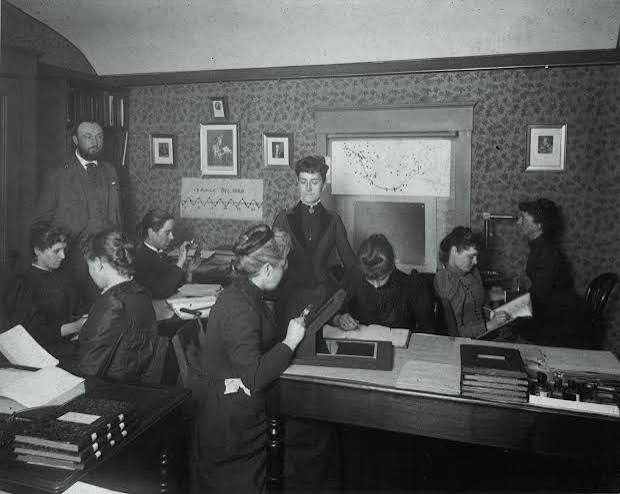
In the late 1800s, Harvard College Observatory had a problem: thousands of glass photographic plates of star spectra were piling up, and no one had the time or patience to analyze them. Director Edward Pickering was frustrated with his male assistants, who seemed more interested in their own research than in the tedious work of cataloguing. So he fired them and hired his maid, Williamina Fleming, instead. That decision set off a chain of events that would change astronomy forever, led by a group of women who became known as the ‘Harvard Computers.’
These women—many of them college graduates with no other career options—spent hours each day peering at glass plates, classifying stars by the patterns of dark lines in their light. Their work produced the Henry Draper Catalogue, the first comprehensive map of stellar spectra, and laid the foundation for modern astrophysics. Yet their names were largely forgotten until recently. This article tells their story and explains how their painstaking labor unlocked the secrets of the universe.
The Problem: Too Many Stars, Too Few Astronomers
In the 1880s, astronomy was undergoing a revolution. New instruments like the spectroscope allowed astronomers to split starlight into its component colors, revealing dark absorption lines that acted like fingerprints for each star. These lines indicated which elements were present and gave clues about temperature and composition. But collecting the data was only half the battle. Someone had to examine the glass plates, measure the lines, and classify thousands upon thousands of stars.
Harvard Observatory, under director Edward Pickering, had the most extensive collection of photographic plates in the world. Pickering had set up observing stations in Massachusetts and even in Peru to capture the southern skies. But his male assistants were not interested in the grind of routine analysis. They were astronomers, not clerks. Frustrated, Pickering is said to have fired them all and turned to his maid, Williamina Fleming, who proved to be remarkably skilled at the work. Whether that story is entirely true or a bit of lore, it captures the spirit of the time: women were often hired because they were cheap, diligent, and had few other opportunities.
Pickering soon realized that hiring women was a practical solution. They were educated—many had degrees from Wellesley or Radcliffe—but were shut out of academic positions. They were also paid far less than men, about 25 to 50 cents per hour. For the cost of one male assistant, Pickering could employ several women. Thus, the ‘Harvard Computers’ were born.
The Women Behind the Work
Williamina Fleming: From Maid to Curator
Williamina Fleming was a Scottish immigrant who had worked as Pickering’s maid. When given the chance to do astronomical work, she excelled. She developed the first classification scheme, using letters A through Q to categorize stars based on the strength of their hydrogen lines. Over her career, she catalogued over 10,000 stars and discovered hundreds of variable stars and novae. In 1899, she was appointed Curator of Astronomical Photographs, making her the first woman to hold an official position at Harvard. She was known for her meticulous eye and her insistence on accuracy.
Annie Jump Cannon: The Classifier Extraordinaire
If Fleming laid the groundwork, Annie Jump Cannon perfected the system. Cannon, who became deaf in her early 1900s, joined the staff in 1896. She refined Fleming’s classification, reducing the letters to a simpler sequence: O, B, A, F, G, K, M. (Astronomy students still remember it with the mnemonic ‘Oh, Be A Fine Girl, Kiss Me.’) Over her lifetime, Cannon personally classified over 350,000 stars by eye—an almost incomprehensible feat. Her work became the basis for the Henry Draper Catalogue, published in nine volumes between 1918 and 1924, which listed the spectral types of 225,300 stars. Cannon’s system is still used today.
Henrietta Swan Leavitt: The Key to Cosmic Distance
Henrietta Swan Leavitt joined the staff in 1901. She was assigned to study variable stars—stars that change brightness over time. Leavitt focused on Cepheid variables in the Magellanic Clouds, which are relatively close and all at roughly the same distance. In 1912, she noticed a pattern: the brighter a Cepheid, the longer its period of pulsation. This period-luminosity relationship meant that if you knew a Cepheid’s period, you could calculate its true brightness, and then compare that to its apparent brightness to find its distance. This ‘standard candle’ became the yardstick for measuring cosmic distances. Without Leavitt’s discovery, Edwin Hubble could not have proven that the universe is expanding in 1929. Yet Leavitt received little recognition in her lifetime, and her work was not fully credited until after her death in 1921.
Antonia Maury: Seeing the Light
Antonia Maury, a graduate of Radcliffe, took a different approach. She developed her own classification system that included not just temperature but also luminosity. She recognized that stars of the same temperature could be different sizes—giants versus dwarfs—and that this affected their spectral lines. Her work was ahead of its time, and while Pickering did not always welcome her independent thinking, her insights influenced Annie Cannon’s later system. Maury’s attention to detail helped lay the groundwork for understanding stellar evolution.
Cecilia Payne-Gaposchkin: The Final Piece
Cecilia Payne-Gaposchkin was not strictly a ‘computer,’ but her work relied entirely on the Harvard plate collection. In her 1925 PhD thesis, she used the spectra to argue that stars are composed primarily of hydrogen and helium, not elements similar to Earth’s crust. This was a radical claim at the time. The astronomer Henry Norris Russell initially dismissed her findings, but he later confirmed them and published his own paper, acknowledging her work. Payne-Gaposchkin went on to become a professor at Harvard and a leading astrophysicist, but her early contributions were often downplayed because of her gender.
The Henry Draper Catalogue: A Monument of Perseverance
The Henry Draper Catalogue was named after a wealthy amateur astronomer who had died in 1882. His widow, Anna Palmer Draper, funded the project in his memory, ensuring that the work could continue. The catalogue was a massive undertaking: it required examining hundreds of thousands of spectra, measuring the positions of absorption lines, and assigning each star a classification. The women did this work by eye, comparing each plate to standard patterns. It was tedious, demanding, and required extraordinary concentration. Yet they did it with remarkable accuracy.
The catalogue was published in nine volumes from 1918 to 1924, listing 225,300 stars. It became the standard reference for stellar classification and remains the basis for the Morgan–Keenan system used today. The Harvard plate collection, which contains over 500,000 glass plates, is still a valuable resource for astronomers, who now use digital scans to study how stars have changed over a century.
The Social Context: Why Women Were Hired
To understand this story, you need to understand the era. In the late 19th century, women were largely excluded from scientific institutions. Harvard did not grant degrees to women (Radcliffe was separate), and observatories rarely hired women for research roles. The prevailing view was that women were suited for routine, meticulous work, not for intellectual leadership. Pickering’s decision to hire women was not an act of feminism; it was an act of pragmatism. Women were educated, careful, and willing to work for less money.
But the women themselves were not passive victims. They took advantage of the opportunity to do meaningful scientific work, even if they were underpaid and underrecognized. Many of them were passionate about astronomy and dedicated their lives to it. They formed a community of scholars who supported each other, even as they faced discrimination from the male establishment.
The term ‘computer’ originally referred to a person who performed calculations, not a machine. The Harvard Computers were literally human calculators, doing work that today would be done by software. But they were also more than that: they were scientists who made discoveries that shaped our understanding of the universe.
The Intellectual Impact: From Classification to Cosmology
The women’s work was not just about organizing data. It was about understanding the stars. By classifying spectra, they created a framework that revealed patterns: stars of different spectral types had different temperatures, colors, and sizes. This led to the understanding that stars evolve, changing their spectra over time. The classification system became a tool for studying stellar life cycles, from hot, blue O-type stars to cool, red M-type stars.
Leavitt’s period-luminosity relationship was a game-changer for cosmology. It allowed astronomers to measure distances to faraway galaxies, which led to the discovery that the universe is expanding. Edwin Hubble used Leavitt’s work to show that galaxies are moving away from us, and the rate of that expansion is now known as Hubble’s Law. Without Leavitt, this would have been impossible.
Payne-Gaposchkin’s thesis established that stars are mostly hydrogen and helium, which is now a fundamental fact of astrophysics. But at the time, it was controversial because it contradicted the assumption that stars had compositions similar to Earth’s. Her work was initially dismissed, but she was eventually vindicated.
Legacy: Recognition Comes Late
For many years, the contributions of the Harvard Computers were overlooked. They were often referred to as ‘Pickering’s harem,’ a dismissive term that reduced them to their gender. It wasn’t until the late 20th century that historians began to reassess their work and give credit where it was due. Today, the women are celebrated as pioneers who overcame systemic barriers to make fundamental contributions to science.
Annie Jump Cannon received numerous honors, including an honorary doctorate from Oxford and the first honorary degree from Harvard to a woman. Henrietta Swan Leavitt’s name is now attached to the Leavitt’s Law, and she has been the subject of books and plays. Cecilia Payne-Gaposchkin was the first woman to become a full professor at Harvard’s Faculty of Arts and Sciences. The story of the Harvard Computers has inspired a new generation of women in science, and it serves as a reminder that great discoveries often come from unexpected places.
Lessons for Today
The story of the Harvard Computers is not just a historical curiosity. It offers lessons about the nature of scientific work and the importance of diverse perspectives. The women were hired because they were cheap and diligent, but they turned out to be brilliant and creative. Their contributions were essential, and their exclusion from formal recognition was a loss to science and society.
It also reminds us that scientific progress often depends on the labor of many people, not just a few famous names. The Harvard Computers did the unglamorous work that made the glamorous discoveries possible. They were the invisible hands that measured the stars, and their legacy is written in every astronomical catalogue and every cosmic distance measurement.
The Harvard Computers transformed astronomy from a discipline focused on cataloguing star positions to one that understood the physical nature of stars and the scale of the universe. Their work, though undervalued at the time, remains a cornerstone of modern astrophysics. Their story is a testament to the power of curiosity, determination, and the pursuit of knowledge against the odds. As we look up at the stars, we owe a debt to the women who, with nothing but patience and keen eyes, unlocked the secrets of the cosmos.
Summary
- The Harvard ‘Computers’ were a group of women hired in the late 19th century to analyze stellar spectra, producing the Henry Draper Catalogue.
- Williamina Fleming developed the first classification system; Annie Jump Cannon refined it into the OBAFGKM sequence used today.
- Henrietta Swan Leavitt discovered the period-luminosity relationship for Cepheid variables, the key to measuring cosmic distances.
- The women were underpaid and underrecognized but made fundamental contributions to astrophysics.
- Their work laid the foundation for modern understanding of stellar composition, evolution, and the expanding universe.
FAQ
Q: What was the Harvard College Observatory’s ‘computer’ program?nA: It was a program that hired women to perform routine astronomical calculations and classifications, examining glass photographic plates of star spectra. The women were called ‘computers’ because they did the work that computers do today.
Q: Who were some of the most notable Harvard Computers?nA: Williamina Fleming, Annie Jump Cannon, Henrietta Swan Leavitt, and Antonia Maury were among the most prominent. Cecilia Payne-Gaposchkin, though not a ‘computer,’ built on their work.
Q: Why was the Henry Draper Catalogue important?nA: It was the first comprehensive catalogue of stellar spectra, classifying over 225,000 stars. It provided the foundation for modern stellar classification and helped astronomers understand the diversity of stars.
Q: How did Henrietta Swan Leavitt’s discovery shape astronomy?nA: Her period-luminosity relationship for Cepheid variables allowed astronomers to measure distances to distant galaxies, leading directly to Edwin Hubble’s discovery of the expanding universe.
Q: Why were women hired for this work?nA: They were educated but had few career options, and they could be paid less than men. Pickering needed meticulous workers, and women filled that role, even though they were often not given proper credit.