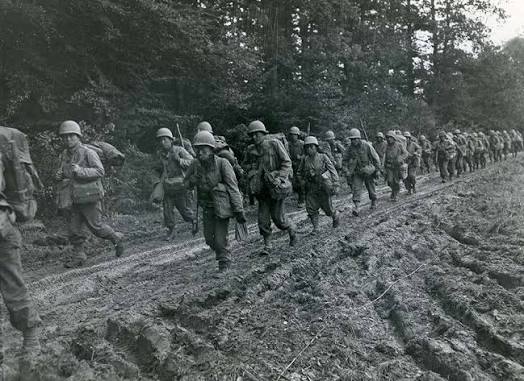
In the fall of 1944, deep in the Vosges Mountains of eastern France, a battalion of Texans was surrounded by German forces. They were low on ammunition, food, and hope. The unit sent to rescue them was not composed of the usual infantry it was a regiment of Japanese Americans, many of whose families were locked in internment camps back home. The 442nd Regimental Combat Team would suffer hundreds of casualties to save 211 men. Their motto, ‘Go for Broke,’ meant risking everything. For the Nisei soldiers, that risk was doubly profound: they were fighting for a country that had stripped them of their rights, yet they believed that proving their valor on the battlefield was the only way to reclaim their place as Americans.
The Paradox of Service
On February 1, 1943, the U.S. Army activated the 442nd Regimental Combat Team at Camp Shelby, Mississippi. The unit was composed almost entirely of second-generation Japanese Americans—Nisei—who had volunteered to fight. But here’s the catch: many of their parents and siblings were behind barbed wire in remote camps like Manzanar and Heart Mountain, imprisoned under Executive Order 9066. Over 110,000 Japanese Americans had been forcibly removed from the West Coast, two-thirds of them U.S. citizens. The government called the camps ‘relocation centers,’ but they were prisons in all but name.
Despite this, more than 14,000 men would serve in the 442nd over the course of the war. The initial call for volunteers in Hawaii drew over 10,000 responses for just 1,500 slots. In the mainland camps, the response was more complicated—some resisted the draft, facing prison sentences. But thousands still volunteered, driven by a painful logic: if they died for America, maybe America would finally see them as loyal.
The Purple Heart Battalion
Before the 442nd was even formed, a separate unit of Hawaiian Nisei—the 100th Infantry Battalion—was already training. Activated in June 1942, the 100th was sent to Italy in September 1943 and quickly earned a brutal nickname: the ‘Purple Heart Battalion.’ In one battle at Monte Cassino, the unit suffered over 50% casualties. Their ferocity and sacrifice became legend, but it came at a staggering cost.
When the 100th was attached to the 442nd in Italy in 1944, it became the regiment’s 1st Battalion. The combined unit then fought through the Rome-Arno Campaign, pushing against the Gothic Line—a formidable German defensive line in the northern Apennines. The fighting was vicious, with soldiers battling not only the enemy but also mud, mines, and mountain cold.
The Rescue of the Lost Battalion
It was in France, however, that the 442nd would cement its place in military history. In October 1944, the 1st Battalion of the 141st Infantry Regiment—a Texas National Guard unit—was cut off by German forces in the Vosges Mountains. For days, the ‘Lost Battalion’ held out, but they were running out of time. The 442nd was ordered to break through.
The rescue was a nightmare. The terrain was steep, forested, and heavily fortified. The Germans had dug in with machine guns and artillery. Over five days, the 442nd launched repeated frontal assaults, suffering enormous losses. In one company, only a handful of men survived. In total, the unit lost over 800 men—killed, wounded, or missing—to save 211. It was a Pyrrhic victory that some called a ‘suicide mission.’ But the 442nd did it, and the image of Japanese American soldiers hauling wounded Texans to safety became a powerful symbol.
The cost was so high that the 442nd’s casualties over the entire war exceeded 9,000—a casualty rate of over 300% of its original strength. That number reflects the constant flow of replacements, many of whom were killed or wounded within days of arriving.
The Most Decorated Unit in U.S. History
For its size and length of service, the 442nd became the most decorated unit in U.S. military history. Its members earned over 4,000 Purple Hearts, 560 Silver Stars, 52 Distinguished Service Crosses, and, after a 2000 review that upgraded many awards, 21 Medals of Honor. The original tally was just one Medal of Honor, but a congressional investigation found that many had been denied due to racial prejudice.
Among the heroes was Daniel Inouye, a future U.S. Senator from Hawaii, who lost his right arm to a German grenade in Italy. Despite the wound, he continued to lead his platoon until he collapsed. Another notable figure, Spark Matsunaga, would also become a Senator. Their post-war political careers were as much a continuation of the fight for equality as their military service.
The 522nd Field Artillery Battalion, part of the 442nd, also played a role in liberating a subcamp of Dachau in 1945—an often-overlooked chapter of the unit’s history.
The Complicated Story of Resistance
The story of the 442nd is often told as a simple triumph of loyalty over prejudice. But that narrative obscures a crucial counterpoint: the draft resistance within the camps. The Heart Mountain Fair Play Committee, led by Frank Emi, organized a movement among incarcerated Nisei who refused to report for the draft. Their argument was stark: it was unconstitutional to demand military service from people whose families were imprisoned without trial. They were convicted and sent to federal prison, branded as traitors. It took decades for their records to be cleared—they were pardoned posthumously in 2002.
This tension—between those who served and those who resisted—isn’t a contradiction. Both were responses to an impossible situation. The volunteers risked death to prove their citizenship; the resisters risked prison to assert their rights. Together, they complicate the heroic myth and remind us that loyalty isn’t always simple.
Legacy and Reckoning
The 442nd’s legacy is not just about medals. It forced the nation to confront its own hypocrisy. When the war ended, the survivors returned to a country that had treated them as enemies, yet they had fought and died as Americans. Their sacrifice helped pave the way for the eventual apology and reparations for internment in 1988, when President Ronald Reagan signed the Civil Liberties Act.
Today, the unit is remembered at the National Japanese American Memorial in Washington, D.C., and in countless books and documentaries. But the most profound memorial is the story itself—a story of men who refused to let their country’s injustice define their loyalty. They went for broke, and in doing so, they broke the back of prejudice, one battle at a time.
The 442nd Regimental Combat Team was a paradox made of flesh and blood: soldiers fighting for a flag that had been raised over their families’ prison camps. Their courage did not erase the injustice of internment, but it forced a reckoning. They proved that citizenship is not a gift granted by the state, but a claim staked through sacrifice. And in the end, their ‘Go for Broke’ spirit—risking everything for a country that had risked nothing for them—became a founding story for Japanese Americans and a challenge to America itself.
Summary
- The 442nd RCT was composed of Japanese American Nisei volunteers, many whose families were interned under Executive Order 9066.
- The unit fought in Italy and France, including the rescue of the ‘Lost Battalion’ in the Vosges Mountains, suffering over 800 casualties to save 211 Texans.
- It became the most decorated unit for its size in U.S. history, with 21 Medals of Honor and over 4,000 Purple Hearts.
- The 100th Infantry Battalion, the ‘Purple Heart Battalion,’ was a predecessor that suffered heavy losses in Italy.
- Not all Japanese Americans supported the war effort; the Heart Mountain draft resisters challenged the draft as unconstitutional and were later pardoned.
FAQ
Q: What does ‘Go for Broke’ mean?
A: It’s a Hawaiian pidgin phrase meaning to risk everything, to go all-in. It became the motto of the 442nd, reflecting their willingness to sacrifice all for their country.
Q: Were the soldiers of the 442nd volunteers?
A: Yes, the unit was composed of volunteers, many from Hawaii and mainland internment camps. However, there was also draft resistance among some incarcerated Nisei, who refused to serve while their families were imprisoned.
Q: What was the ‘Lost Battalion’ rescue?
A: In October 1944, the 442nd was ordered to rescue the 1st Battalion of the 141st Infantry Regiment, which was surrounded by Germans in the Vosges Mountains. The rescue succeeded but cost over 800 casualties.
Q: How many Medals of Honor did the 442nd receive?
A: Originally one, but after a 2000 review, many awards were upgraded, and the unit now has 21 Medal of Honor recipients.
Q: How did the 442nd’s service affect Japanese Americans after the war?
A: Their sacrifice helped shift public opinion, contributing to the eventual apology and reparations for internment in 1988. Many survivors went on to prominent careers, including Senators Daniel Inouye and Spark Matsunaga.