Tag: Google

  • Google’s Ad Tech Breakup Blocked: What the Ruling Means for Publishers and Advertisers

    Google’s Ad Tech Breakup Blocked: What the Ruling Means for Publishers and Advertisers

    On September 2, 2026, a U.S. District Court rejected the Department of Justice’s request to force Google to sell off parts of its advertising technology business. The ruling means Google will keep its publisher ad server and ad exchange, preserving its control over the digital ad supply chain.

    This decision is the latest chapter in a long-running antitrust battle. In 2024, the same court found Google liable for monopolizing ad tech, but now it has declined to impose the most severe remedy. Instead, the court may opt for less drastic behavioral fixes, or none at all. Here’s what happened, why it matters, and what to expect next.

    The Case: From Liability to Remedy

    The U.S. Department of Justice filed its antitrust lawsuit against Google’s ad tech business in October 2023. The government alleged that Google held monopolies in three layers of the ad tech stack: the publisher ad server, the ad exchange, and the advertiser ad network. Together, these tools let websites sell ad space and advertisers buy it, and the DOJ argued that Google’s control of both sides created a conflict of interest.

    After a trial in late 2024, the court found Google liable for illegal monopolization. But the case didn’t end there. The next phase was to determine the remedy—what penalty or structural change, if any, should be imposed. The DOJ pushed for a breakup, demanding that Google divest its publisher ad server (DoubleClick for Publishers, now part of Google Ad Manager) and its ad exchange (AdX). If granted, it would have been the most aggressive structural remedy against a tech company since the AT&T breakup in 1982.

    Why the Breakup Was Denied

    The court’s reasoning hasn’t been fully released yet, but the decision suggests the judge was not convinced that divestiture was the right fix. A breakup is a blunt instrument. It can disrupt markets, harm smaller players who rely on integrated tools, and create logistical nightmares. The DOJ had to prove that a breakup would actually restore competition without causing collateral damage—apparently, it failed to do so.

    Instead, the court may impose behavioral remedies. These could include requirements for Google to make its ad tools interoperable with competitors, prohibit self-preferencing of its own exchange, or mandate transparent auction rules. Behavioral remedies are less drastic than a breakup, but they require ongoing oversight to be effective.

    What the Ruling Means for Publishers and Advertisers

    Publishers have long complained about Google’s dominance. For large publishers, Google’s ad server market share is estimated at over 90%, and its exchange handles a significant chunk of programmatic ad sales. The ruling is likely a disappointment for those who hoped a breakup would level the playing field. They fear Google will entrench its position further, with little to stop it from adjusting auction mechanics or terms in its favor.

    Advertisers, on the other hand, may see little immediate change. They already have access to multiple demand-side platforms, and the ruling doesn’t directly affect their buying options. However, if behavioral remedies are imposed, they could bring more transparency to how ad prices are set, potentially lowering costs.

    The Legal Context: A Separate Case from Search

    This ad tech case is distinct from the separate antitrust case against Google’s search business. In August 2024, Judge Amit Mehta ruled that Google illegally maintained a search monopoly. That case is in its own remedy phase, with the DOJ proposing measures like forcing Google to sell its Chrome browser. The ad tech ruling doesn’t affect that case, but it could influence how courts approach remedies in tech antitrust cases more broadly.

    Global Implications and Next Steps

    The U.S. ruling comes amid similar investigations in the UK and the European Union. The UK’s Competition and Markets Authority and the European Commission have both looked into Google’s ad practices. While the U.S. court has rejected a breakup, regulators abroad could still impose their own remedies. Google argues that the market has shifted—toward retail media, connected TV, and AI-driven ad placement—so its position is no longer as dominant as it once was. Critics counter that these shifts don’t erase Google’s control over the core ad tech infrastructure.

    The DOJ is likely to appeal the decision. An appeals court could overturn the ruling or send it back for reconsideration. That process could take years, prolonging the uncertainty for publishers and advertisers. For now, Google retains its ad tech empire, but the legal battle is far from over.

    The court’s decision is a major win for Google, but it’s not the end of the story. Publishers and advertisers should monitor the remedy phase for any behavioral conditions, and watch for the DOJ’s appeal. The case highlights the difficulty of imposing structural remedies in fast-moving tech markets. For now, Google’s ad tech remains intact, but the pressure from regulators isn’t going away.

    Summary

    • The U.S. District Court rejected the DOJ’s request to force Google to sell its ad tech business on September 2, 2026.
    • The ruling comes after a 2024 liability finding that Google monopolized the ad tech market.
    • Google will keep its publisher ad server and ad exchange, but may face behavioral remedies like interoperability requirements.
    • Publishers are concerned about Google’s continued dominance, while advertisers may see little immediate change.
    • The case is separate from the Google Search antitrust case, but could influence tech antitrust remedies.
    • The DOJ is expected to appeal, and regulators in the UK and EU are also investigating similar issues.

    FAQ

    Q: What did the DOJ want in the ad tech case?
    A: The DOJ wanted the court to force Google to sell off its publisher ad server (DoubleClick for Publishers) and its ad exchange (AdX), effectively breaking up its ad tech business.

    Q: Why did the court deny the breakup?
    A: The court likely found that a breakup was too drastic a remedy, potentially harming publishers and advertisers who rely on integrated tools. The DOJ failed to prove that a breakup would restore competition without significant collateral damage.

    Q: What happens next in the case?
    A: The court may impose behavioral remedies, such as requiring interoperability or banning self-preferencing. The DOJ is also likely to appeal the decision, which could prolong the legal battle.

    Q: Is this case related to the Google Search antitrust case?
    A: No, it’s a separate case. The search case, where Google was found to have a monopoly in search, is still in its remedy phase and is not affected by this ruling.

    Q: How does this affect publishers and advertisers?
    A: Publishers may see little change and remain concerned about Google’s dominance. Advertisers might benefit from any behavioral remedies that increase transparency, but the immediate impact is minimal.
  • The Search Engine Shake-Up: How AI, Antitrust, and New Rivals Are Redrawing the Map

    The Search Engine Shake-Up: How AI, Antitrust, and New Rivals Are Redrawing the Map

    For two decades, Google has been the front door to the internet. Type a query, get ten blue links, click, done. But that door is now creaking under the weight of generative AI, antitrust rulings, and a generation that would rather ask TikTok for a restaurant recommendation than Google. The search engine is no longer a static utility; it’s a battlefield where the next decade of information access is being decided.

    The numbers tell the story. Google still handles over 8.5 billion searches a day, but its market share has slipped below 90% for the first time in years. Meanwhile, ChatGPT reached 100 million weekly users in two years, and Perplexity an AI-native answer engine—has carved out 10 million monthly users. The queries aren’t disappearing; they’re just going elsewhere. And when they do stay, they often don’t lead to a click at all. Zero-click searches are on the rise, and that has publishers and advertisers alike scrambling.

    The End of the Ten Blue Links

    For most of search’s history, the goal was to send you to a website. Google’s PageRank, launched in 1998, was a clever way to rank pages by their backlinks, and it worked beautifully—so well that it made Google the default gateway to the web. But over the years, the search engine has been slowly answering more questions itself. Featured snippets, knowledge panels, and ‘people also ask’ boxes were early steps toward keeping you on the page.

    Generative AI is the logical endpoint. Instead of a list of links, you get a synthesized paragraph, assembled from multiple sources and written in natural language. Google’s AI Overviews, Microsoft’s Copilot, and Perplexity’s cited answers all do this. The shift is profound: search is no longer about finding a website; it’s about getting an answer. That’s a better experience for many queries, but it’s a nightmare for the publishers who relied on referral traffic to fund their work.

    The Economic Engine Under Stress

    Search engines are, at their core, advertising businesses. Google’s search ads generate over $175 billion annually. That revenue subsidizes the free access we all enjoy. But AI answers threaten the model. If a user gets their answer directly on the search results page, they never click on an ad, and they never visit the website that might have shown them an ad. The click-through rate on organic results has already declined to under 50% for many query types, and AI integration accelerates that trend.

    Microsoft, which partnered with OpenAI to make Bing’s AI search a reality, is betting that the future is conversational and ad-supported in new ways. But the tension is real: every AI-generated answer is a potential ad impression lost. The economic model that funded the internet’s index for two decades is being pulled in two directions—user experience and revenue. How that resolves will shape everything from content creation to the survival of independent media.

    The Antitrust Hammer Falls

    Google’s dominance hasn’t just been a matter of superior algorithms. In August 2024, a federal judge ruled that Google illegally maintained a monopoly in search and text advertising. The remedies are still being determined, but the implications are enormous. If Google is forced to change its default search deals—like the one that makes it the default on iPhones—then Bing, DuckDuckGo, or even a newcomer could gain ground.

    The EU has already acted. The Digital Markets Act designates Google as a ‘gatekeeper,’ requiring choice screens and prohibiting self-preferencing. These regulations are designed to crack open the market, but they also create uncertainty. Will they fragment the search landscape into regional silos? Or will they foster a new wave of innovation?

    Either way, the era of Google as the unchallenged monarch is over. The question is who benefits from the power vacuum: Microsoft, a privacy-focused upstart, or an AI-native answer engine we haven’t met yet.

    The New Rivals: Vertical and Niche

    Google isn’t just losing ground to AI chatbots. It’s losing ground to specialized search engines that do one thing better. For product searches, people go to Amazon. For video, they go to YouTube. For authentic community answers, Reddit has become the default, so much so that Google now pays Reddit to license its data for AI training. For younger demographics, TikTok has replaced Google entirely as the discovery engine for restaurants, fashion, and even news.

    These vertical players don’t aim to replace Google wholesale; they just siphon off the most lucrative and frequent queries. And then there’s the niche players: DuckDuckGo and Brave Search for privacy, Kagi for a paid, ad-free experience. They’re small—Kagi has maybe 50,000 users—but they represent a growing demand for alternatives to the surveillance economy.

    The Trust Problem: Hallucinations and the Black Box

    AI search engines have a problem: they make things up. Large language models are prone to hallucination—presenting false information with complete confidence. Google’s AI Overviews famously recommended putting glue on pizza and cited satirical sources as fact. These are edge cases, but they illustrate the deeper issue: users can’t audit how an answer is generated. With a list of links, you can see the source and judge its credibility. With an AI paragraph, you get an opaque synthesis.

    Proponents argue that AI can be more accurate because it can synthesize across languages and formats, and that it can attribute sources, as Perplexity does. But the ‘black box’ problem remains. When a model is trained on biased or incorrect data, it amplifies those biases. And when the incentives are to keep you on the page, there’s a risk that AI answers will be optimized for engagement rather than accuracy.

    The Publisher’s Dilemma: Adapt or Die

    For websites, the rise of AI search is an existential threat. If Google’s AI Overviews answer your query, you’ll never see the click. Small and independent publishers are most vulnerable—they don’t have the bargaining power to strike licensing deals with AI companies. Large media companies are racing to sign agreements, like the one between OpenAI and The Associated Press, to ensure their content is used in AI training and cited in outputs.

    But there’s a counterargument: AI search could drive more queries overall, because it lowers the friction of asking a question. And it could surface long-tail content that users would never have found through a traditional search. The problem is that these benefits are speculative, while the loss of referral traffic is immediate. Publishers are being forced to adapt—focusing on newsletters, subscriptions, and direct traffic—or face extinction.

    The Privacy Tightrope

    Personalized AI search requires data—lots of it. The more the AI knows about you, the better it can answer your questions. But that’s a privacy nightmare. The trade-off between convenience and surveillance is intensifying. Privacy-focused engines like DuckDuckGo and Brave are growing, but they’re a tiny fraction of the market. And the AI era may only widen the gap: if you want the best AI answers, you might have to let the AI into your life.

    The EU AI Act and other regulations are trying to set boundaries, but the technology is moving faster than the law. The core question is whether we can have the benefits of personalized, conversational search without surrendering our privacy. The answer, so far, is unclear.

    The search engine is not dying; it’s mutating. The next decade will see a multi-front war: Google fighting to keep its ad empire, AI startups pushing for a post-link world, verticals carving out their niches, and regulators reshaping the battlefield. The winners will be those who can balance the demand for fast, accurate answers with the need to sustain the web’s open ecosystem. But the web that emerges may look nothing like the one we know. Search’s future is not a single product—it’s a fragmented, personalized, and increasingly AI-driven landscape.

    Summary

    • Google still dominates with 8.5 billion searches a day, but its share is eroding due to AI, antitrust, and vertical rivals.
    • AI search engines like Perplexity and Google’s AI Overviews shift from links to synthesized answers, threatening the ad-based economic model.
    • The August 2024 antitrust ruling against Google could force changes in default search deals, opening the door for competitors.
    • Vertical searches (Amazon, TikTok, Reddit) siphon off high-value queries, while privacy-focused alternatives gain niche followings.
    • Trust and accuracy are major challenges: LLM hallucinations and black-box algorithms undermine confidence in AI answers.

    FAQ

    Q: Will Google be replaced by AI search engines?
    A: Not overnight. Google still holds ~90% market share and has deep pockets, but AI-native engines like Perplexity are growing. The more likely outcome is a hybrid: Google and Bing integrate AI, while niche players carve out specific use cases.

    Q: How will AI search affect website traffic?
    A: It could reduce referral traffic significantly because AI answers often keep users on the search page. Publishers may need to diversify traffic sources, build direct audiences, or strike licensing deals with AI companies.

    Q: What is a ‘zero-click search’?
    A: A search where the user finds the answer directly on the search results page—via a featured snippet, knowledge panel, or AI overview—without clicking any organic result. This is increasingly common and is a major concern for publishers.

    Q: Are AI search engines accurate?
    A: They can be, but they are prone to hallucination—confidently giving false information. They also lack transparency in how answers are generated. Users should verify critical information from primary sources.

    Q: What can I do to protect my privacy in the age of AI search?
    A: Use privacy-focused engines like DuckDuckGo or Brave, consider paid options like Kagi, and be mindful of the data you share with AI assistants. Remember that personalized AI often requires more personal data.

  • AI Search Market Share: What Business Intelligence Teams Need to Know

    AI Search Market Share: What Business Intelligence Teams Need to Know

    The search landscape is shifting under the feet of every business. Traditional link-list search the familiar ’10 blue links’ is being supplemented, and in some cases replaced, by AI-powered answer engines that synthesize information directly. For business intelligence (BI) teams, this isn’t just a tech trend; it’s a fundamental change in how customers find information, how advertising works, and how brand authority is measured.

    As of early 2025, Google still commands roughly 90% of the global search market, but AI-native search engines like Perplexity and ChatGPT Search are carving out a small but rapidly growing niche. More importantly, AI is being embedded into the incumbent’s product itself: Google AI Overviews now appear on a significant share of search results. This article breaks down the current market share data, the strategic positions of key players, and the practical implications for businesses that rely on search for growth and intelligence.

    Defining AI Search: More Than Just a New Engine

    AI search refers to search experiences that leverage large language models (LLMs), generative AI, and retrieval-augmented generation (RAG) to answer queries directly, synthesize information from multiple sources, and provide conversational results. This is distinct from traditional search engines like Google, Bing, or DuckDuckGo, which primarily deliver a list of links ranked by relevance.

    Key players in the AI search space include:

    • ChatGPT Search (OpenAI), launched in October 2024, which integrates real-time web access into the ChatGPT interface.
    • Perplexity, a purpose-built ‘answer engine’ that provides cited, conversational responses.
    • Google AI Overviews and Gemini, which embed AI-generated answers directly into Google’s search results.
    • Microsoft Bing Copilot, which uses GPT-4 to power conversational search on Bing.
    • You.com, Brave Search AI, and emerging entrants like Meta AI search and Amazon Rufus for shopping.

    Market Share: The Numbers Behind the Hype

    Despite the buzz, AI-native search engines still hold a tiny slice of the overall search pie. Perplexity, ChatGPT Search, and You.com collectively account for less than 1–2% of global search queries. Google remains the dominant force at ~90%, with Bing at 3–4%, and a long tail of others making up the remainder.

    Yet that small percentage masks significant momentum in specific segments. Perplexity, the leading standalone AI search engine, has grown to an estimated 15–20 million monthly active users, with reported annualized revenue of ~$50 million in late 2024. ChatGPT Search, leveraging OpenAI’s existing base of over 200 million weekly active users, has seen rapid adoption, though OpenAI does not disclose search-specific usage figures.

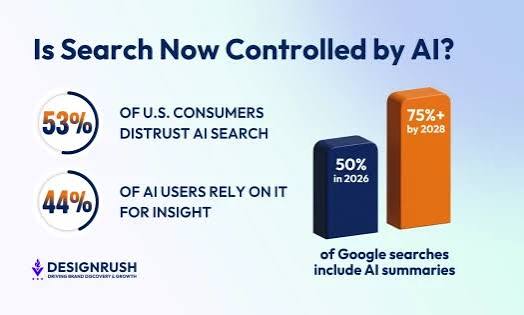
    Perhaps the most impactful shift is within Google itself. AI Overviews are now estimated to appear on 30–80% of Google search results pages, depending on geography and query type. This means AI is not just a separate market—it’s becoming the default experience for many users on the world’s most-used search engine.

    Why Business Intelligence Teams Should Care

    The rise of AI search has profound implications for how businesses track, attribute, and optimize their online presence.

    1. Ad Spend and the Zero-Click Problem

    If AI search answers a query directly, users may never click through to a website. This ‘zero-click’ behavior breaks traditional pay-per-click (PPC) economics, where advertisers pay for each visit. Marketers need to understand where these zero-click answers dominate and adjust their strategies accordingly. For example, if a user asks ‘best CRM for small business’ and gets a synthesized answer from ChatGPT Search, the opportunity for a traditional ad impression may vanish.

    2. Data and Attribution Shifts

    AI search engines cite sources differently than traditional link lists, and referral traffic patterns are changing. BI teams must develop new tracking methods—such as AI-specific UTM parameters and server-side tracking—to accurately measure the impact of AI search on their web traffic. Monitoring which AI engines surface a brand (or a competitor) first is becoming a key performance indicator.

    3. Competitive Intelligence

    Tracking your brand’s visibility in AI search results—and your competitors’—is a new frontier for competitive intelligence. Are you cited as a source in Perplexity’s answers? Does ChatGPT Search mention your product in a comparison? These metrics can serve as leading indicators of brand authority in the AI era.

    4. Enterprise Search as a Related Market

    Internal AI search tools like Glean and Microsoft Copilot for M365 are a separate but related market, growing at over 30% CAGR. Businesses are deploying these tools to help employees find information faster, and BI teams may need to integrate data from these platforms into their analytics.

    The Incumbent’s View: Google’s Defense

    Google argues that AI Overviews are an enhancement, not a replacement, and points to high user satisfaction metrics. The company’s counter-strategy includes deep integration of its Gemini model, an AI Mode for search, and maintaining default search deals (like the one with Apple) that keep its market share locked in.

    However, Google faces a real risk: AI Overviews reduce click-through rates to publishers, potentially undermining the open web ecosystem that feeds its index. If publishers see less traffic, they may produce less content, which could degrade the quality of Google’s search results over time. Antitrust remedies from the U.S. DOJ case could also force changes to Google’s default search deals, opening distribution windows for competitors.

    The Challenger’s View: Perplexity and OpenAI

    Perplexity positions itself as an ‘answer engine’ with citation transparency, appealing to researchers and business professionals who need verifiable sources. It was the first to launch a standalone AI search product and has built a loyal following among tech-savvy users.

    OpenAI, on the other hand, sees search as a feature within a broader assistant ecosystem, not a standalone product. Its distribution advantage is enormous: over 200 million people already use ChatGPT. The company is also exploring advertising, which would directly compete with Google’s core ad business.

    Both challengers face high compute costs, and their monetization models—subscriptions and nascent ads—are unproven at scale. Perplexity launched ads in 2024, and OpenAI is testing advertising in ChatGPT, but it’s unclear how much revenue these can generate.

    The Publisher’s Dilemma: To Block or to License

    AI search reduces referral traffic to publishers, prompting many to block AI crawlers (e.g., The New York Times, Reuters) or negotiate licensing deals. However, there’s a counter-narrative: AI search can drive high-intent traffic if a brand is cited as a source. In this new paradigm, ‘being the answer’ is the new SEO. For BI teams, tracking AI-citation share can be a leading indicator of brand authority and future organic traffic.

    What This Means for Your BI Strategy

    1. Monitor AI search visibility: Set up tracking to see how often your brand appears in AI search results and from which engines.
    2. Adjust attribution models: Incorporate AI search referrals into your analytics, using custom parameters and server-side tracking to capture data accurately.
    3. Re-evaluate SEO: Traditional keyword optimization is still relevant, but focus on creating content that AI engines are likely to cite as authoritative sources.
    4. Track ad performance: Understand where zero-click answers dominate and adjust your PPC campaigns accordingly.
    5. Stay agile: The market is evolving rapidly—what’s true today may change next quarter. Keep an eye on new entrants and shifts in user behavior.

    AI search is not a distant future—it’s happening now. While AI-native engines still hold a small market share, the integration of AI into Google’s core product means that AI-generated answers are already a significant part of the search experience. For business intelligence teams, the imperative is clear: adapt your tracking, re-evaluate your strategies, and start treating AI search visibility as a critical metric. The search landscape is changing, and those who understand the shift will be better positioned to thrive in it.

    Summary

    • AI-native search engines (Perplexity, ChatGPT Search, You.com) hold <1–2% of global search queries, but Google AI Overviews appear on 30–80% of search results pages.
    • Perplexity leads standalone AI search with 15–20 million monthly active users and ~$50M annualized revenue.
    • ChatGPT Search leverages OpenAI’s 200M+ weekly users, but search-specific usage is undisclosed.
    • AI search disrupts traditional PPC models due to zero-click answers, requiring new tracking and attribution methods.
    • Businesses should monitor AI-citation share as a leading indicator of brand authority.

    FAQ

    Q: What is AI search?
    A: AI search uses large language models and generative AI to answer queries directly with synthesized, conversational results, rather than just providing a list of links.

    Q: How big is the AI search market?
    A: AI-native search engines currently hold less than 1–2% of global search queries, but Google AI Overviews—which are AI-generated—appear on a significant share of Google’s results pages.

    Q: Who are the main players in AI search?
    A: Key players include Perplexity, ChatGPT Search (OpenAI), Google AI Overviews/Gemini, Microsoft Bing Copilot, and You.com.

    Q: How does AI search affect advertising?
    A: AI search can lead to zero-click answers, where users don’t click through to websites, which disrupts traditional pay-per-click advertising models.

    Q: How can businesses track their performance in AI search?
    A: Businesses can use AI-specific UTM parameters, server-side tracking, and monitor AI-citation share to measure visibility and referral traffic from AI search engines.

  • Google AI Mode vs. ChatGPT Search: Which AI Search Tool Actually Helps?

    Google AI Mode vs. ChatGPT Search: Which AI Search Tool Actually Helps?

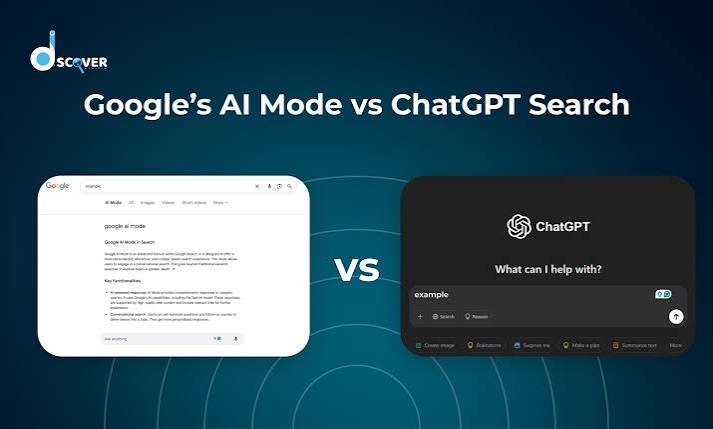
    Two of the biggest names in tech are now fighting over the future of search. Google has rolled out AI Mode, a conversational layer on top of its classic search engine, while OpenAI has turned ChatGPT into a full-fledged search tool. Both promise to replace the old list of blue links with direct, reasoned answers. But they go about it in very different ways.

    One is a search engine with a chatbot grafted on. The other is a chatbot with a search engine tucked inside. That difference shapes everything: how you ask questions, how you follow up, and how much you trust the answers. Here’s a side-by-side look at what each tool actually does, where they stumble, and which one might suit the way you work.

    The Short Version: What Each Tool Is

    Google AI Mode is an opt-in feature inside Google Search, available through Search Labs since March 2025. It uses a custom Gemini 2.0 model to answer complex, multi-step questions directly on the search results page. You type a query like “compare the best OLED TVs for gaming under $1,000,” and instead of links, you get a synthesized comparison with sources cited.

    ChatGPT Search is a built-in feature in ChatGPT, available to all users since late 2024. It uses a fine-tuned GPT-4o (or GPT-4.1) model with a browsing tool that queries Bing’s index and other sources. You ask a question in the chat window, and it responds conversationally with footnoted sources. You can ask follow-up questions in the same thread, refining your search iteratively.

    The core distinction: AI Mode is a search engine that talks; ChatGPT Search is a talker that searches.

    Search Index: The Foundation of Everything

    Google’s index is the largest and most comprehensive in the world, covering billions of pages with real-time updates. AI Mode taps directly into that index, pulling live prices, stock quotes, local inventory, and other fresh data. ChatGPT Search, by contrast, relies primarily on Bing’s index, which is smaller and sometimes less current. OpenAI has been building its own web crawler (GPTBot), but for now, Bing remains the backbone.

    This matters for queries that depend on the latest information. If you ask about a breaking news event or a rapidly changing product price, Google AI Mode has the edge because its index is simply bigger and fresher. ChatGPT Search can still access real-time data through partnerships with news providers like the Associated Press and Reuters, but the underlying index is not as deep.

    Interface: Familiar vs. Conversational

    Google AI Mode lives in a dedicated tab within the Google app or search page. The layout feels familiar—a search bar, a results page—but the answer appears as a paragraph or bulleted list at the top, with links to sources alongside. There’s also a “show thinking” toggle that displays the model’s reasoning steps, a transparency feature that can be illuminating or overwhelming, depending on your patience.

    ChatGPT Search is integrated into the chat interface itself. You don’t need to switch tabs or modes; just ask a question and the model decides whether to search. The answer comes back in a chat bubble with numbered footnotes. You can then ask follow-up questions like “What about the Samsung S90D?” and the model remembers the context. This conversational flow is a major advantage for complex, multi-turn research.

    Follow-Up Questions: The Biggest Practical Difference

    The ability to refine a query is where these tools diverge most. With ChatGPT Search, you can have a back-and-forth dialogue. Ask about OLED TVs, then narrow down by budget, then ask about a specific brand, and the model keeps the thread. This is how real research works—you start broad and drill down.

    Google AI Mode, at least in its current form, is more rigid. Each query is treated as a new search. You can’t say “actually, just the ones under $800” and expect it to remember the previous context. You have to start over or rephrase the entire question. The “show thinking” toggle does reveal the model’s internal reasoning, which can help you understand why it gave a particular answer, but it doesn’t allow for iterative refinement in the same way.

    For a single, complex query, AI Mode shines. For an ongoing research session, ChatGPT Search is far more practical.

    Source Presentation and Trust

    Both tools cite their sources, but they do it differently. Google AI Mode shows inline links within the answer and a separate source panel on the side. This makes it easy to click through and verify claims. ChatGPT Search uses footnote citations—small numbers that you can hover over or click to see the source. It’s unobtrusive but requires an extra step to check.

    Trust is a bigger issue for AI-generated answers than for traditional links. Google has the advantage of brand familiarity and a long track record of search quality. ChatGPT, on the other hand, is a newer entrant but has built trust through its conversational accuracy and transparency about sources. Both are susceptible to hallucination, but the underlying model’s reliability matters more than the interface.

    Pricing and Access

    Google AI Mode is free but requires opting in via Search Labs. It’s not available to everyone by default. ChatGPT Search is free for all users, with rate limits for the free tier; Plus and Pro subscribers get higher limits and priority access. So, out of the box, ChatGPT Search is more accessible—you just open ChatGPT and start asking.

    Business Models and Future Direction

    Google’s AI Mode is ad-free for now, but Google has tested ads in AI Overviews, its earlier AI feature. It’s likely that AI Mode will eventually include sponsored answers or product listings, which could affect the neutrality of results. OpenAI, meanwhile, has no plans for ads in ChatGPT Search. Its revenue comes from subscriptions and API usage, so the priority is keeping users engaged and paying.

    This difference shapes the long-term experience. Google has a financial incentive to push ads, while OpenAI has an incentive to provide the best possible answer to retain subscribers. That’s not to say Google will sacrifice quality, but the ad model is a fundamental part of its business.

    Which One Should You Use?

    There’s no single winner—it depends on how you search.

    • For one-off, complex queries: Google AI Mode is excellent. Ask it to compare products, explain a nuanced topic, or synthesize multiple sources, and you’ll get a well-cited answer fast.
    • For ongoing research projects: ChatGPT Search is the better companion. The ability to ask follow-up questions in the same thread is a game-changer for deep dives.
    • For the freshest data: Google AI Mode, thanks to its larger index.
    • For accessibility: ChatGPT Search, because it’s free and always available.

    Try both. You’ll likely find that each has a place in your workflow. The AI search war is just beginning, and the winners will be the ones who make it easiest to find accurate information—whether that’s through a search box or a chat window.

    Google AI Mode and ChatGPT Search represent two philosophies of AI search: one that enhances the traditional search experience, and one that reimagines it as a conversation. For now, Google AI Mode offers deeper and fresher data, while ChatGPT Search offers a more flexible and interactive way to get answers. As both products evolve—and as OpenAI builds its own index and Google refines its conversational abilities—the gap will likely narrow. But for your daily research needs, the choice comes down to a simple question: do you want to search, or do you want to chat?

    Summary

    • Google AI Mode is an opt-in feature in Google Search that uses Gemini 2.0 to provide conversational, multi-step answers with a “show thinking” toggle.
    • ChatGPT Search is a built-in feature in ChatGPT using GPT-4o with browsing, offering conversational answers with footnote citations and full follow-up context.
    • Key difference: AI Mode uses Google’s massive index; ChatGPT Search relies on Bing’s index (smaller but with news partnerships).
    • User experience: AI Mode is a search engine that talks; ChatGPT Search is a chatbot that searches, allowing iterative refinement.
    • Access: Both are free, but AI Mode is opt-in via Search Labs, while ChatGPT Search is available to all users by default.

    FAQ

    Q: Is Google AI Mode free?
    A: Yes, Google AI Mode is free, but it requires opting in via Search Labs. It’s not available to everyone by default.

    Q: Can I use ChatGPT Search for free?
    A: Yes, ChatGPT Search is free for all users, though free tier has rate limits. Plus and Pro subscribers get higher limits and priority access.

    Q: Which one has fresher data?
    A: Google AI Mode uses Google’s proprietary index, which is larger and updated more frequently. ChatGPT Search relies primarily on Bing’s index, though it has partnerships with news providers for real-time data.

    Q: Can I ask follow-up questions in Google AI Mode?
    A: Not really. Each query is treated as a new search. ChatGPT Search allows full conversational follow-ups in the same thread.

    Q: Does Google AI Mode show ads?
    A: Currently, AI Mode is ad-free, but Google has tested ads in AI Overviews, so ads may come later. ChatGPT Search has no ads and no plans to add them.

  • How AI Search Personalization Works and Why It Decides What You See

    How AI Search Personalization Works and Why It Decides What You See

    Every time you type a query into Google or Bing, the results you see are not the same as what your neighbor sees. That’s because search engines now use artificial intelligence to tailor results to you based on your past behavior, your location, even the time of day. This process, called AI search personalization, has quietly transformed how we find information online.

    Understanding how it works is not just a technical curiosity. It affects what news you read, which products you buy, and how you form opinions. This article breaks down the mechanics, the data behind it, and the trade-offs so you can be a more informed searcher in an age of personalized answers.

    The Engine: Machine Learning and Natural Language Processing

    At its core, AI search personalization uses two key technologies: machine learning (ML) and natural language processing (NLP). ML is a type of AI that learns from data to make predictions. NLP is a branch of AI that helps computers understand human language.

    Together, they let a search engine do more than match keywords. They allow it to interpret the meaning of your query based on context. For example, if you search for “apple,” the engine must decide: do you mean the fruit or the tech company? It looks at your search history, your location, and other signals. If you’ve recently visited tech sites, it assumes you mean the company. If you’ve been reading recipes, it shows the fruit. That’s query understanding in action.

    Beyond Ranking: How Results Are Reordered for You

    Once the engine understands your intent, it re-ranks the general search index to match your predicted preferences. The index contains billions of web pages, but the order you see them is not universal. The algorithm predicts which pages you’re most likely to click, based on models trained on past behavior of millions of users.

    For instance, if you frequently click on cooking blogs, a search for “chicken recipes” might list those blogs higher than a generic food site. If you never click on video results, the engine might demote YouTube links. This re-ranking is invisible you just see a list of links that feels “right.”

    Contextual Signals: Location, Device, and Time

    Personalization isn’t just about your history. It’s also about your immediate context. Search engines use your IP address or GPS to know your city. Search for “pizza” at 7 PM on a Friday, and you’ll get local pizzerias with delivery options. Search at 7 AM, and you might get breakfast spots instead. The device you’re using matters too mobile users get more local and app-related results, while desktop users see more long-form content.

    These signals are combined to make real-time decisions. The algorithm asks: “What does this person want right now, in this moment?” The answer changes constantly.

    The Rise of AI-Generated Answers

    The biggest shift in recent years is the move from “10 blue links” to AI-generated answers. Google’s AI Overviews, Bing’s Copilot, and Perplexity AI all use large language models to synthesize information directly into a response. Instead of clicking through websites, you get a paragraph that answers your question.

    This makes personalization even more critical. The AI must not only understand your query but also generate content that matches your implied intent. For example, if you ask “How to fix a leaky faucet,” the AI might give a detailed guide for a homeowner, but a plumber might get a more technical answer about valve types. The AI infers your level of expertise from your search history and phrasing.

    Major Players: Who Does It Best?

    • Google uses models like RankBrain, BERT, and MUM. It personalizes results based on your Search History, Location History, and Web & App Activity. Google processes over 8.5 billion searches a day (as of 2024), so even small personalization tweaks have massive scale.
    • Microsoft Bing / Copilot integrates GPT-4 to offer a chat-based search experience. It uses conversational context your follow-up questions to refine results in real time.
    • Perplexity AI takes a privacy-forward approach. It focuses on answer generation with cited sources but uses minimal profile-based personalization. It’s a deliberate contrast to the tracking-heavy approach of Google and Bing.
    • Amazon personalizes product search based on your purchase history and browsing patterns. If you buy diapers, a search for “wipes” shows baby wipes, not cleaning wipes.
    • Social platforms like TikTok, YouTube, and Instagram aren’t web search engines, but they use heavily personalized discovery algorithms. They’ve trained users to expect content that feels tailor-made.

    The Business Driver: Why Personalization Exists

    Personalization isn’t just for user convenience—it’s a revenue engine. When results are more relevant, users click more, stay longer, and engage more. That engagement attracts advertisers, who pay more for highly targeted placements. Google’s core revenue model is ads, and personalization makes those ads more effective. A user who searches “running shoes” and sees a local store’s ad is more likely to buy than one who sees a generic banner.

    This creates a feedback loop: the better the personalization, the more data the engine collects, which improves the personalization further. It’s a virtuous cycle for the company, but it raises questions about privacy and control.

    Privacy Concerns: The Surveillance Economy

    All this personalization comes at a cost: your data. Search engines track your clicks, dwell time, and even your cursor movements. They build a detailed profile of your interests, habits, and beliefs. This data is used not just to personalize results but also to sell targeted ads.

    Regulations like GDPR in Europe and CCPA in California give you some rights. You can request access to your data or ask for it to be deleted. GDPR also includes a “right to explanation” for automated decisions that significantly affect you, though search ranking often escapes that requirement. Still, many users are unaware of how much data is collected. A 2019 study found that most people underestimate the amount of personal information Google holds.

    The Filter Bubble Problem

    Eli Pariser, in his 2011 book The Filter Bubble, warned that personalization can isolate us in echo chambers. If you only click on left-leaning news, you’ll see more left-leaning results. If you never click on conservative sites, they may disappear from your results entirely. This can polarize society by hiding opposing viewpoints.

    Search engines are aware of this criticism. They’ve introduced features like “diversity” signals to show a broader range of perspectives. But the tension remains: personalization by definition filters out content you’re less likely to engage with, which can include content that challenges you.

    The Cold Start Problem

    Personalization isn’t equally applied to everyone. New users, or those using incognito mode, get generic results because the engine has no history to work with. This is called the “cold start” problem. It reveals that personalization is a spectrum, not a binary. The more data you provide, the more personalized your results become—for better or worse.

    The Future: Calibration and Transparency

    Researchers are studying how to “calibrate” personalization—balancing relevance with diversity. Some propose giving users control over how much personalization they want. Others suggest showing why a result was chosen, with explanations like “Based on your search history.”

    As AI answers become more prevalent, the stakes rise. A wrong personalized answer could mislead someone in a critical situation, like a medical query. The technology must evolve to be both accurate and respectful of user agency.

    In the end, AI search personalization is a double-edged sword. It makes search faster and more convenient, but it also shapes your worldview and collects your data in the process. The next time you search, remember: the results aren’t just the web’s answer—they’re your answer, computed by invisible algorithms.

    AI search personalization has transformed search from a one-size-fits-all tool into a deeply individual experience. It’s powered by machine learning and natural language processing, and it uses your data to decide what you see. The trade-offs are real: convenience and relevance come at the cost of privacy and potential echo chambers. By understanding how it works, you can make more informed choices about your searches—and maybe even adjust your privacy settings.

    Summary

    • AI search personalization uses machine learning and natural language processing to tailor results to each user.
    • Key mechanisms include query understanding, result re-ranking, contextual signals, and AI-generated answers.
    • Major players include Google, Bing/Copilot, Perplexity AI, Amazon, and social platforms.
    • Personalization is driven by business incentives—it increases engagement and ad revenue.
    • Concerns include privacy erosion, filter bubbles, and the cold start problem.

    FAQ

    Q: Does Google personalize the same search for everyone?
    A: No. Google personalizes results based on your search history, location, device, and other signals. Two users can search the same term and get different results.

    Q: How can I reduce personalization in my search results?
    A: You can use incognito/private mode, turn off search history tracking in your Google account settings, or use a privacy-focused search engine like DuckDuckGo or Perplexity AI.

    Q: What is a filter bubble?
    A: A filter bubble is a situation where a search algorithm isolates you from content that disagrees with your existing beliefs, showing you only content that reinforces your views. This was popularized by Eli Pariser in 2011.

    Q: Is AI search personalization legal?
    A: Yes, but it’s regulated. In the EU, GDPR requires explicit consent for tracking and gives you the right to access and delete your data. In California, CCPA provides similar rights.

    Q: How do AI-generated answers like Google’s AI Overviews personalize content?
    A: AI Overviews use your search context—such as your history and the phrasing of your query—to generate a tailored answer. For example, a beginner might get a simplified explanation, while an expert might get technical details.

  • SEO in 2026: The Complete Guide to Ranking in the Age of AI

    SEO in 2026: The Complete Guide to Ranking in the Age of AI

    Search engine optimization (SEO) has changed more in the last three years than in the previous decade. If you’re still obsessing over keyword density and backlink counts, you’re fighting the last war. In 2026, Google’s search results are dominated by AI-generated summaries, zero-click searches are the norm, and the algorithms are smarter than ever at detecting content created just to game the system.

    This guide will walk you through the new reality of SEO. We’ll explain what’s changed, what still works, and what you need to do to get your website seen—and cited—in the age of AI. Whether you’re a marketer, a business owner, or a curious webmaster, you’ll leave with a clear, actionable playbook for ranking in 2026.

    The New Search Landscape: AI Overviews and Zero-Click Queries

    Remember when the goal of SEO was to get your website to appear at the top of the search results? In 2026, that’s only half the battle. Google’s AI Overviews (AIO) now appear above the traditional blue links for a significant portion of queries. These AI-generated summaries pull information from multiple sources and present it directly on the search results page. As a result, over 60% of mobile searches end without a single click to an external website.

    This is called the “zero-click” phenomenon, and it’s not a bug—it’s the new normal. For SEO, this means your goal is no longer just to rank #1; it’s to be cited within the AI Overview. When a user asks a question, Google’s AI looks for the most authoritative, relevant sources to synthesize an answer. If your content is the one it pulls from, you win—even if the user never clicks through to your site.

    So how do you get cited? You need to create content that is clear, concise, and directly answers the question. Structured data (schema.org markup) helps Google understand your content’s context. And most importantly, you need to establish your site as an authority—because AI Overviews don’t cite random blogs; they cite trusted sources.

    The Helpful Content System: Quality Over Quantity

    In 2023 and 2024, Google rolled out a series of updates collectively known as the Helpful Content System (HCS). By 2026, this system is fully integrated into the core algorithm. Its message is simple: content created primarily for search engines, rather than for people, will be penalized. This was a direct response to the explosion of AI-generated content that flooded the web with generic, unhelpful articles.

    The HCS uses a site-wide quality signal. That means one bad page can drag down your entire site’s rankings. The days of churning out hundreds of thin, keyword-stuffed posts are over. Instead, Google rewards sites that demonstrate expertise, experience, authoritativeness, and trustworthiness—collectively known as E-E-A-T.

    What does E-E-A-T look like in practice? It means having real author bios with credentials, citing original research, including first-hand experience (like product testing or case studies), and earning mentions from reputable sources. In 2026, if you’re writing about a topic, you need to show that you actually know what you’re talking about—not just that you can string together keywords.

    Core Web Vitals: Speed and Interactivity Matter More Than Ever

    Technical SEO isn’t just about crawlability anymore; it’s about user experience. Google’s Core Web Vitals (CWV) have evolved, with a new focus on Interaction to Next Paint (INP) as the primary responsiveness metric. INP measures how quickly a page responds to user interactions, like clicking a button or tapping a link. A slow, laggy page will hurt your rankings.

    In 2026, the thresholds for “good” performance are stricter, and mobile performance is the baseline. Google indexes mobile-first, so if your site is slow on a phone, you’re in trouble. The good news is that improving CWV is a well-understood process: optimize images, minimize JavaScript, use a content delivery network (CDN), and ensure your server responds quickly.

    But there’s a new twist: AI crawlers. Bots like GPTBot, ClaudeBot, and Google-Extended are constantly scraping the web to train AI models. They consume massive bandwidth, which can slow down your site for real users. Managing your crawl budget—deciding which bots are allowed to crawl and how often—is now a critical part of technical SEO. You can use your robots.txt file to block or limit AI crawlers, but be careful: if you block Google’s crawlers, you’ll hurt your indexing.

    The Shift from Keywords to Entities and Intent

    Keywords aren’t dead, but they’re no longer the primary focus. Google’s algorithms, powered by neural matching (BERT, MUM, and their successors), understand the relationships between concepts, not just the words themselves. This is called entity-based SEO. Instead of targeting the exact phrase “best running shoes for flat feet,” you need to cover the topic comprehensively: the anatomy of flat feet, how to choose running shoes, reviews of specific models, and expert advice.

    This shift means that SEO is now about satisfying user intent. There are four main types of intent: informational (“how to tie a tie”), navigational (“Facebook login”), transactional (“buy Nike Air Max”), and commercial investigation (“best laptops for programming”). Your content should match the intent behind the query. If someone is looking for a product, a blog post won’t cut it—you need a product page with reviews and a clear call-to-action.

    The Rise of Alternative Search Engines and LLMO

    Google isn’t the only game in town anymore. Users are increasingly turning to AI chatbots like ChatGPT, Perplexity, and Meta AI for answers. These platforms are “answer engines,” and they have their own way of sourcing information. This has given rise to a new discipline: Large Language Model Optimization (LLMO).

    LLMO involves making your content easily citable by AI models. This means using clear, structured data (schema.org), creating content that directly answers common questions, and ensuring your site is technically accessible to AI crawlers. It also means building a strong brand presence across the web, because AI models often cite well-known sources.

    But it’s not just about AI chatbots. Search has become platformized. Amazon is the search engine for products, YouTube for video, TikTok for discovery, and Reddit for community validation. Each platform has its own ranking algorithm. For a comprehensive SEO strategy, you need to consider all of them. For example, optimizing your YouTube videos for search (using keywords in titles and descriptions) is just as important as optimizing your website.

    The Death of Third-Party Cookies: Measuring What Matters

    By 2026, third-party cookies are fully deprecated or heavily restricted. This has upended how we measure conversions from organic traffic. Without cookies, you can’t track users across the web. The solution is to rely on first-party data (data you collect directly from your users), server-side tracking, and modeled data.

    What does this mean for SEO? You need to be more thoughtful about your analytics. Instead of relying on click-through rates and bounce rates (which are now less reliable), focus on engagement metrics like time on page, scroll depth, and form submissions. Use tools like Google Analytics 4 (GA4) which uses machine learning to fill in the gaps. And most importantly, build a direct relationship with your audience through email newsletters and community building—so you’re not dependent on a search engine to reach them.

    The Brand-First Approach: SEO as PR

    In a world of AI-generated noise, brand recognition is the only sustainable moat. If people search for your brand name, you win. This is why many experts now view SEO as a form of public relations. Your goal is to get your brand mentioned in reputable publications, on podcasts, and in social media conversations.

    Digital PR involves creating shareable content (like original studies or infographics), reaching out to journalists, and building relationships with influencers. When your brand becomes a recognized authority, Google’s algorithms take notice. Brand mentions act as powerful trust signals, even if they don’t include a link.

    The Skeptic’s View: Is SEO Dead?

    With all these changes, some argue that SEO is a dying industry. They point to the volatility of AI updates, the difficulty of predicting rankings, and the dominance of zero-click searches. It’s true that the “golden age” of SEO—where you could guarantee a #1 ranking with the right keywords and backlinks—is over.

    But SEO is not dead; it’s evolved. The fundamentals of creating great content, building a fast and accessible website, and earning trust from users and search engines are more important than ever. The difference is that the tactics have changed. You can’t game the system anymore; you have to earn your place.

    Practical Steps for SEO in 2026

    Now that we’ve covered the landscape, here’s a practical checklist to get you started:

    1. Audit your content: Remove or rewrite any thin, unhelpful pages. Focus on creating comprehensive, original content that demonstrates E-E-A-T.
    2. Implement structured data: Use schema.org markup to help search engines understand your content. This increases your chances of being cited in AI Overviews.
    3. Optimize for Core Web Vitals: Use tools like PageSpeed Insights to identify and fix performance issues. Aim for an INP of under 200 milliseconds.
    4. Manage your crawl budget: Review your robots.txt and server logs to see which bots are crawling your site. Block any that are wasting resources.
    5. Build your brand: Invest in digital PR and social media to earn mentions and links from reputable sources.
    6. Diversify your traffic sources: Don’t rely solely on Google. Optimize for YouTube, Amazon, and even AI chatbots.
    7. Focus on user intent: Create content that answers the question immediately, then provides additional value. Use clear headings, bullet points, and concise paragraphs.
    8. Track the right metrics: Move beyond clicks and impressions. Monitor your visibility in AI Overviews, brand mentions, and engagement metrics.

    SEO in 2026 is a holistic discipline that combines technical expertise, content quality, and brand building. It’s more challenging than ever, but the rewards are greater for those who adapt.

    SEO in 2026 is not about tricking algorithms; it’s about being genuinely useful. The rise of AI Overviews and zero-click searches means that your content must be good enough to be cited, not just clicked. By focusing on E-E-A-T, technical excellence, and brand authority, you can thrive in this new landscape. The future belongs to those who create content that people—and AI—find valuable.

    Summary

    • AI Overviews and zero-click searches mean SEO is now about being cited, not just ranked.
    • The Helpful Content System penalizes content made for search engines, rewarding E-E-A-T.
    • Core Web Vitals now prioritize Interaction to Next Paint (INP) and mobile performance.
    • Entity-based SEO and user intent have replaced keyword stuffing.
    • Diversify beyond Google: optimize for AI chatbots, YouTube, Amazon, and other platforms.

    FAQ

    Q: Is AI-generated content bad for SEO?
    A: Not necessarily. Google penalizes useless content, regardless of whether it’s written by a human or AI. If you use AI to generate content but heavily edit it, fact-check it, and add original data or experience, it can rank well.

    Q: What is LLMO?
    A: Large Language Model Optimization (LLMO) is the practice of making your content easily citable by AI models like ChatGPT. This involves using structured data, creating clear answers to common questions, and building a strong brand presence.

    Q: How do I get cited in AI Overviews?
    A: To be cited in AI Overviews, you need to create authoritative, well-structured content that directly answers questions. Use schema markup, earn backlinks from reputable sites, and ensure your site is technically accessible to Google’s crawlers.

    Q: Do I still need backlinks in 2026?
    A: Yes, but quality matters more than quantity. A few links from authoritative, relevant sites are far more valuable than hundreds of low-quality links. Focus on earning links through digital PR and creating shareable content.

    Q: How can I measure SEO success without third-party cookies?
    A: Rely on first-party data (like user accounts and email sign-ups), server-side tracking, and modeled data in tools like GA4. Focus on engagement metrics like time on page, scroll depth, and conversions rather than click-through rates.

  • Is Google News a Zombie Product? The Decline of a Once-Pioneering Aggregator

    Is Google News a Zombie Product? The Decline of a Once-Pioneering Aggregator

    Remember when Google News was the go-to place to catch up on the day’s headlines? Launched in 2002, it was a revolutionary idea: an algorithm that gathered stories from thousands of sources and presented them in a clean, organized way. For years, it was a beloved tool for news junkies and a significant traffic driver for publishers. But today, if you open the Google News app or visit the website, you might notice something: it feels stuck in time. The interface hasn’t changed much in years, features have been quietly removed, and Google seems far more interested in showing you AI-written summaries in its main search results than in maintaining this standalone news hub.

    So, has Google abandoned Google News? The short answer is no—the product still exists and still has hundreds of millions of users. But the long answer is more complicated. Google has clearly shifted its priorities, and Google News appears to be running on autopilot, a ‘zombie product’ that’s technically alive but no longer a strategic focus. This article explores the evidence behind that claim, the reasons for Google’s pivot, and what it means for publishers and readers alike.

    The Glory Days: When Google News Was a Star

    To understand what’s happened, it helps to look back at Google News’s heyday. When it launched in 2002, it was a marvel. Instead of relying on human editors, Google used algorithms to crawl thousands of news sites, cluster related stories, and present them in a single, easy-to-scan page. It was like having a personal newsstand that updated every few minutes, and it quickly became a favorite for people who wanted a broad view of the day’s events.

    For publishers, Google News was a valuable source of referral traffic. At its peak, it accounted for anywhere from 5% to 10% of a typical news site’s visits. That might not sound like a lot, but for many outlets, it was a meaningful chunk of their audience. Google News also introduced features like ‘Full Coverage,’ which used AI to group all the articles about a major story into one timeline, and ‘Fact Check’ labels to help readers spot misinformation. It felt like Google was investing in the future of news.

    The Slow Fade: Signs of Neglect

    Fast forward to today, and the picture looks very different. The most obvious sign of neglect is the lack of updates. The Google News mobile app hasn’t had a major redesign since around 2020. The web version still has the same basic layout it’s had for years, which is a stark contrast to other Google products like Gmail or Google Maps, which get regular facelifts.

    But it’s not just about looks. Google has quietly removed or scaled back several features that were once central to the Google News experience:

    • Newsstand: This was a magazine subscription service that Google folded into Google News in 2018, only to discontinue it entirely in 2020. If you used to read magazines through Google, that option is gone.
    • Full Coverage: This AI-powered feature was supposed to give you a comprehensive view of a story, with timelines, key players, and related articles. It’s been de-emphasized in many regions, and its prominence in the app has been reduced.
    • Fact Check labels: These were once a prominent way to flag misinformation. They’re now much less visible, which is ironic given Google’s stated commitment to fighting fake news.
    • News Archive search: This was a tool for finding old newspaper articles, going back decades. It’s been effectively deprecated, meaning it’s no longer actively maintained or promoted.

    These changes might seem small individually, but together they paint a picture of a product that’s being slowly hollowed out. It’s like a museum piece: it looks like Google News from the outside, but many of the interactive exhibits have been removed.

    The Numbers Don’t Lie: Traffic Is Down

    The decline isn’t just anecdotal. Multiple industry reports, including data from Press Gazette and SimilarWeb, show that Google News referrals to publishers have dropped significantly year over year. Some publishers report declines of 30% to 50% since 2020. That’s a massive loss for outlets that relied on Google News for a chunk of their audience.

    To be fair, Google News still claims to have around 1.5 billion monthly active users. But that number hasn’t been updated recently, and it likely includes news surfaces within Google Search, not just the standalone Google News app. The actual number of people actively using the dedicated Google News product is probably much lower.

    Why Did Google Turn Away? The Strategic Pivot

    So why would Google let a once-popular product wither? The answer lies in a fundamental shift in Google’s strategy. In the early days, Google News was designed to send traffic to publishers. The idea was that Google would help people find news, and then they’d click through to the publisher’s website. That model worked well for both sides.

    But over the past few years, Google has moved in the opposite direction: it wants to keep users on Google. Instead of sending you to a publisher’s site, Google now shows you AI-generated summaries, snippets, and answer boxes directly in its search results. This is part of a company-wide pivot toward AI-first products, with tools like Gemini and AI Overviews taking center stage.

    In this new model, a standalone news aggregator like Google News is almost redundant. Why maintain a separate app when Google can deliver news directly in Search, Discover, and even through voice assistants? For Google, Google News has become a ‘legacy surface’—a product that still exists but is no longer a priority. It’s like the old version of a website that’s still up but no longer updated because all the action has moved to a new platform.

    The Regulatory Headache

    Another major factor is regulation. In recent years, countries like Canada, Australia, and parts of Europe have passed laws requiring Google to pay publishers for linking to their content. Google has fought these laws tooth and nail, and one of its key negotiating tactics has been to threaten to remove or reduce Google News in those countries.

    In Canada, for example, Google threatened to block news links in response to the Online News Act, before eventually reaching a last-minute deal. In Australia, it made a similar threat before backing down. These threats send a clear signal: Google sees Google News as a liability, not an asset. If it can avoid paying publishers by making the product less prominent, it will.

    This regulatory pressure has likely accelerated Google’s de-emphasis of Google News. By keeping the product low-key and not investing in it, Google reduces its legal exposure and makes it easier to walk away if the laws become too costly.

    The Human Factor: Internal Neglect

    There’s also the human side of the story. Reports from outlets like The Verge and Platformer suggest that Google News has become a ‘skunkworks’ project with high turnover and reduced headcount. Many of the engineers who once worked on Google News have been reassigned to AI projects like Gemini. The team that remains is small and focused on maintenance, not innovation.

    This internal neglect is a classic sign of a product that’s been deprioritized. When a company really cares about a product, it invests in people and resources. When it doesn’t, it leaves a skeleton crew to keep the lights on. That’s exactly what’s happened with Google News.

    What Does This Mean for Publishers and Readers?

    For publishers, the decline of Google News is a symptom of a larger problem: Google’s shift away from sending traffic to external websites. Even if Google News itself wasn’t a huge source of referrals for most outlets, it was part of an ecosystem that included Google Search and Discover. As Google increasingly keeps users on its own pages with AI summaries, publishers are seeing their traffic drop across the board. This is a major concern for the news industry, which relies on web traffic for advertising and subscriptions.

    For readers, the impact is more subtle. Google News still works as a basic aggregator—you can still get headlines from a variety of sources. But the quality has declined. Users report more duplicate content, lower-quality sources, and less personalized recommendations. The algorithms that once seemed so smart now feel less tuned, perhaps because they’re not being actively improved.

    There’s also the loss of features like Full Coverage, which was genuinely useful for understanding complex stories. Without it, readers have to do more legwork to piece together a full picture of an event.

    Is There Hope for Google News?

    It’s hard to see a future where Google News makes a comeback. The company’s focus is firmly on AI, and news aggregation is not a strategic priority. The regulatory environment is hostile, and the internal team has been gutted. All signs point to Google News continuing to exist as a low-maintenance product that’s kept alive for legacy users, but not actively developed.

    That said, nothing is impossible. If Google faced a major public backlash, or if regulators forced it to invest in news products, things could change. But as of now, the most likely scenario is that Google News will continue to fade into the background, a relic of an earlier internet era where Google was a gateway to the web, not the destination itself.

    In the end, Google News isn’t dead, but it’s certainly not thriving. It’s a product that’s been left to run on autopilot while Google pours its energy into AI and search. For those of us who remember its early days, it’s a sad decline. But it’s also a reflection of how the internet has evolved—and how Google’s priorities have shifted from sending users away to keeping them close. Whether that’s good for the news industry or for readers is a question that goes far beyond Google News itself.

    Summary

    • Google News is not shut down, but it has seen minimal updates and feature removals, indicating reduced investment.
    • Traffic from Google News to publishers has dropped 30-50% since 2020, according to industry reports.
    • Google’s strategic pivot to AI-generated summaries in Search has made the standalone aggregator less important.
    • Regulatory pressures, like link-payment laws, have made Google News a liability, prompting Google to de-emphasize it.
    • Internal reports suggest the Google News team has been downsized, with engineers reassigned to AI projects.

    FAQ

    Q: Is Google News being shut down?
    A: No, Google News is not being shut down. It still exists at news.google.com and in mobile apps. However, it has been significantly de-prioritized, with fewer updates and features being removed.

    Q: Why did Google remove features like Newsstand and Full Coverage?
    A: Google has been scaling back Google News as part of a broader strategic shift toward AI-driven news delivery in Search and Discover. Features like Newsstand (magazine subscriptions) and Full Coverage (AI story grouping) were either folded into other products or quietly discontinued because they no longer fit the company’s priorities.

    Q: Has Google News traffic to publishers really declined?
    A: Yes, multiple industry reports, including data from Press Gazette and SimilarWeb, show that Google News referrals have dropped significantly year-over-year, with some publishers seeing declines of 30-50% since 2020.

    Q: Why is Google de-emphasizing Google News?
    A: There are several reasons: a strategic pivot to AI-first products that keep users on Google, regulatory pressures from link-payment laws that make news a liability, and internal neglect with reduced team size and resources.

    Q: Should publishers worry about the decline of Google News?
    A: Yes, but not just about Google News itself. The decline is a symptom of Google’s broader shift away from sending traffic to external websites. As Google increasingly uses AI summaries in Search, publishers are seeing overall referral traffic drop, which is a major concern for the news industry.