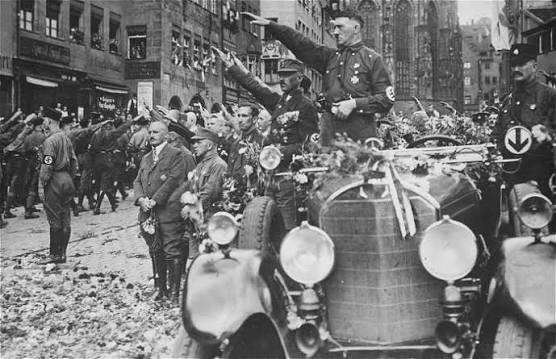
On the morning of February 28, 1933, the Reichstag building in Berlin smoldered. Within hours, President Hindenburg signed the Reichstag Fire Decree, suspending civil liberties across Germany. It was the first of many legal instruments that would dismantle the Weimar Republic and reshape daily life under Nazi rule. The decree allowed the regime to arrest political opponents without trial, search homes without warrants, and confiscate property all in the name of protecting the state from a Communist threat.
But the Nazis’ control went far beyond legal repression. They aimed to orchestrate every aspect of existence: what people read, listened to, learned, and even how they spent their leisure time. Through a process they called Gleichschaltung coordination all institutions were aligned under Nazi ideology, creating a society where private life and public duty merged. This article explores how the regime penetrated the everyday, using a mix of terror, propaganda, and material incentives to bind ordinary Germans to the state.
The Intensification of Control During War
When World War II began in September 1939, control tightened further. Rationing of food, clothing, and consumer goods was introduced, and the regime planned the economy through the Four Year Plan, which prioritized rearmament and autarky. The war also brought new forms of mobilization: women were conscripted into factories, children were evacuated to the countryside, and forced laborers from occupied territories were brought in to work in German industry.
Dissent was met with increasing brutality. The Gestapo and SD became more aggressive, and concentration camps expanded. The regime also executed thousands of Germans for “defeatist” remarks or resistance, including the members of the White Rose movement in 1943. Everyday life under war became a balancing act: survival, loyalty, and the need to avoid suspicion.
The Nazis’ control of everyday life was neither purely coercive nor purely voluntary. It was a combination of terror, propaganda, and tangible benefits that created a society where many Germans were complicit in the regime’s crimes. The block warden, the denouncer, and the enthusiastic Hitler Youth member were as much a part of the system as the Gestapo officer. Understanding this coordination how a modern state can infiltrate the most intimate aspects of life remains a sobering lesson about the fragility of democracy and the dangers of totalitarian ambition.
Summary
- The Nazi regime used legal decrees like the Reichstag Fire Decree and the Enabling Act to dismantle democracy and establish a dictatorship.
- Propaganda, led by Goebbels, controlled all media and culture, shaping public opinion through radio, film, and press.
- Mass organizations like the Hitler Youth and Strength Through Joy provided benefits and indoctrination, fostering loyalty among the “racially valuable” population.
- Everyday surveillance relied on block wardens and voluntary denunciations, making the Gestapo effective despite its small size.
- Control intensified during WWII, with rationing, total mobilization, and brutal repression of dissent.
FAQ
Q: What was Gleichschaltung?
A: Gleichschaltung, or “coordination,” was the Nazi process of aligning all political, social, and cultural institutions under Nazi control. It involved banning other political parties, replacing trade unions with the German Labor Front, and bringing media, education, and religion in line with Nazi ideology.
Q: How did the Gestapo operate if it was so small?
A: The Gestapo relied heavily on voluntary denunciations from ordinary Germans. Citizens reported neighbors, coworkers, and even family members for political crimes. This system of surveillance was so effective that the Gestapo could focus on the most serious cases, while the threat of denunciation kept the population in line.
Q: Were there any benefits for ordinary Germans under Nazi rule?
A: Yes, many Germans received material benefits, such as employment through rearmament and public works programs, leisure activities through the Strength Through Joy program, and welfare from the NSV, but only if they were considered “racially worthy.” These benefits helped secure loyalty and a sense of belonging.
Q: How did Nazi control of everyday life change during World War II?
A: During the war, control intensified. Rationing was introduced, women were mobilized for factory work, children were evacuated, and dissent was brutally suppressed. The regime also used forced labor from occupied territories, and the threat of execution for even minor criticism increased.
Q: What was the role of block wardens?
A: Block wardens were Nazi party officials assigned to apartment blocks. They monitored households for political loyalty, flag displays, and compliance with regulations, and reported any suspicious behavior to the party or police. They were a key part of the everyday surveillance system.