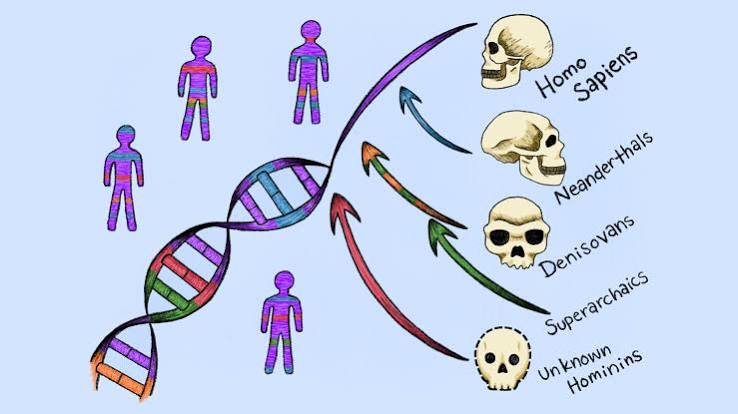
For decades, the story of human evolution was written in fossils. But a new chapter is being written in our own genomes. Researchers have identified two previously unknown ‘ghost’ hominin lineages—extinct human relatives that left no fossil trace—yet they interbred with our ancestors and left a lasting mark in our DNA.
This discovery, made possible by a novel computational method that scans modern genomes for unexpected DNA segments, reveals that our family tree is far more tangled than we thought. It suggests that interbreeding with archaic populations was not a rare exception but a recurring theme in human evolution, shaping who we are today.
The Discovery: Ghosts in Our Genes
Scientists have long known that modern humans carry DNA from Neanderthals and Denisovans, thanks to interbreeding events tens of thousands of years ago. But these were not the only archaic hominins to contribute to our genetic makeup. Using a new computational approach, researchers have now identified two additional ‘ghost’ lineages—populations that are invisible in the fossil record but whose genetic signatures are present in modern humans.
The method, developed by an international team of geneticists, does not rely on ancient DNA from fossils. Instead, it scans modern human genomes for segments that do not match the expected patterns of Homo sapiens ancestry. These unusual segments, characterized by distinct mutation patterns and recombination histories, point to admixture from archaic populations that have no known fossil remains.
What Are ‘Ghost’ Lineages?
The term ‘ghost’ might sound supernatural, but it simply refers to populations known only through genetic evidence. They are inferred when modern DNA contains segments that do not match any known archaic hominin—like Neanderthals or Denisovans—or modern human reference. These lineages are ‘ghosts’ because they left no identifiable fossils, not because they were rare or mysterious in their time.
In this case, the two new lineages contributed an estimated 1–3% of the genome in some non-African populations, with variations across regions. The interbreeding events are estimated to have occurred between 30,000 and 80,000 years ago, overlapping with known encounters with Neanderthals and Denisovans.
A New Window into Human Evolution
Traditional methods for detecting archaic admixture rely on comparing modern DNA to ancient DNA extracted from fossils. This new method is ‘reference-free’—it identifies archaic segments by their unusual patterns alone, without needing a fossil match. This is a game-changer because it allows researchers to detect lineages that left no fossil record or whose fossils have not yet been found.
The study analyzed thousands of modern human genomes from Africa, Asia, Europe, and Oceania. The two new lineages appear to have contributed to different regional populations, suggesting separate interbreeding events in different parts of the world. This geographic and temporal diversity paints a picture of a highly interconnected hominin world, where migration and interbreeding were common.
Why This Matters: Interbreeding as a Force in Evolution
This discovery underscores that interbreeding was a major force in human evolution, not just a rare footnote. It raises intriguing questions: What made Homo sapiens successful? Was it the genetic diversity gained from admixture, or something else? And how many other ghost lineages are waiting to be discovered?
The findings also have implications for paleoanthropology. Fossil hunters may use these genetic clues to target specific regions and time periods for excavation, hoping to find physical evidence of these elusive populations. This could lead to a more complete picture of the hominin family tree.
Avoiding Misunderstandings
It’s important to clarify what these ghost lineages are not. They are not ‘new species’ in the traditional sense—they may be deeply divergent populations of Homo sapiens or separate species, but the paper may not resolve this definitively. They are also not ‘more human’ or ‘less human’ than us; all these lineages were human in the broad sense, and the term ‘archaic’ is a technical descriptor, not a value judgment.
Moreover, the narrative of ‘pure’ vs. ‘mixed’ ancestry is scientifically flawed. All modern humans are products of complex admixture, and this study reinforces that our genetic heritage is a mosaic of many contributions.
The discovery of these two ghost lineages is a testament to the power of computational biology in uncovering hidden chapters of our past. As the method is refined and applied to more genomes, we are likely to find even more ghost lineages, each adding a new branch to our intricate family tree. This research not only deepens our understanding of human evolution but also reminds us that our ancestry is far more interconnected—and fascinating—than we ever imagined.
Summary
- Two previously unknown ‘ghost’ hominin lineages have been identified in modern human DNA, contributing 1–3% of the genome in some non-African populations.
- The discovery was made using a new computational method that scans modern genomes for DNA segments that don’t match expected Homo sapiens patterns, without needing fossil evidence.
- Interbreeding with these lineages occurred between 30,000 and 80,000 years ago, overlapping with known Neanderthal and Denisovan admixture.
- The lineages contributed to different regional populations, suggesting separate interbreeding events in different parts of the world.
- This research highlights that interbreeding was a major force in human evolution and opens the door to discovering more ghost lineages in the future.
FAQ
Q: What is a ‘ghost’ lineage?
A: A ghost lineage is a population known only through genetic evidence, not fossils. It is inferred when modern human DNA contains segments that don’t match any known archaic hominin or modern human reference.
Q: How were these new lineages discovered?
A: Researchers used a new computational method that scans modern human genomes for DNA segments with unusual mutation patterns and recombination histories, indicating admixture from archaic populations without needing fossil DNA.
Q: Are these ghost lineages new species?
A: Not necessarily. They may be deeply divergent populations of Homo sapiens or separate species, but the study may not definitively resolve this. The term ‘archaic’ is a technical descriptor, not a value judgment.
Q: How much DNA did these lineages contribute to modern humans?
A: They contributed an estimated 1–3% of the genome in some non-African populations, with variations across regions.
Q: When did interbreeding with these lineages occur?
A: The admixture events are estimated to have occurred between 30,000 and 80,000 years ago, overlapping with known interbreeding with Neanderthals and Denisovans.