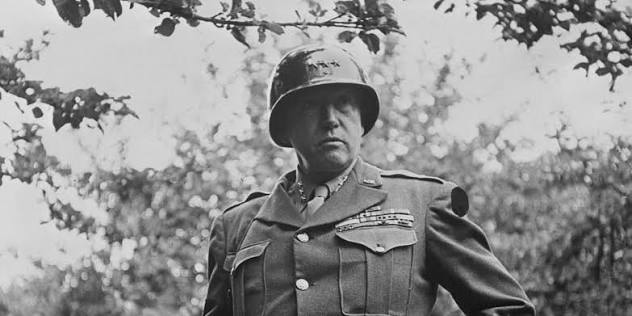
George S. Patton Jr. was not a man who believed in half measures. He wore ivory-handled revolvers into battle, prayed daily, and was convinced he had lived past lives as a Roman legionnaire and a Napoleonic cavalryman. His troops nicknamed him ‘Old Blood and Guts’ a moniker that captured both his ferocious aggression and his tendency to get his own blood spilled. But Patton’s real legacy is not the bravado; it’s the cold, calculated military genius that made him one of the most effective field commanders of World War II.
From the sands of North Africa to the frozen roads of the Ardennes, Patton’s Third Army covered more ground, took more prisoners, and broke more enemy lines than any other Allied force. Yet his career nearly ended not by a German bullet, but by his own hand a slap that almost cost him everything. Understanding Patton means reconciling the contradictions: a deeply religious man who swore like a sailor, a history buff who believed in reincarnation, and a battlefield genius who fought his own demons as fiercely as he fought the Axis.
The Making of a Warrior
George Smith Patton Jr. was born on November 11, 1885, on a ranch in San Gabriel, California. His family had a long military lineage his great-uncle had been a Confederate colonel killed at Gettysburg. Growing up, Patton was an avid horseman and hunter, but it was his intellectual obsession with military history that set him apart. He devoured the works of Julius Caesar and Napoleon, and he came to believe in reincarnation, feeling that he had been a warrior in previous lives. This belief wasn’t a passing fancy; it shaped his entire worldview. He saw war as a noble, almost sacred calling, and himself as a man chosen by fate and by God to lead.
Patton’s academic path was rocky. He entered West Point in 1904 but had to repeat his plebe year after failing mathematics a humbling start for someone so confident. He graduated in 1909, married Beatrice Ayer in 1910, and then pursued a career as a cavalry officer. His athleticism and skill with a sword earned him a spot in the 1912 Stockholm Olympics, where he competed in the modern pentathlon. He finished fifth overall, but his aggressive style left a mark. Even then, Patton was not content to simply participate; he wanted to win.
Patton died on December 21, 1945, in Heidelberg, Germany, from injuries sustained in a car accident twelve days earlier. He was buried at Luxembourg American Cemetery, not at West Point, because he wanted to lie with his men. His legacy is a paradox: a man who loved war but hated its cost, who demanded discipline yet broke the rules, who believed in fate but fought every battle as if his will alone could bend history. In the end, Patton’s greatest contribution was not just the victories he won, but the way he won them with speed, audacity, and an unshakable belief that the offensive spirit could overcome any obstacle. He remains a figure of controversy and admiration, a reminder that even the most brilliant leaders are flawed, and that sometimes the ghosts we carry are the ones that push us forward.
Summary
- Patton commanded the U.S. Third Army in Europe, executing the rapid breakout from Normandy and covering more ground than any other Allied force.
- In the Battle of the Bulge, he turned his army 90 degrees north in under 48 hours to relieve Bastogne—a masterclass in operational flexibility.
- His career nearly ended in 1943 after he slapped two soldiers hospitalized for battle fatigue; he was sidelined for nearly a year.
- Patton believed in reincarnation and considered himself a warrior from past lives, which shaped his aggressive, fatalistic approach to war.
- He died in December 1945 from injuries in a car accident and was buried at Luxembourg American Cemetery, among his troops.
FAQ
Q: Why was Patton called ‘Old Blood and Guts’?
A: The nickname came from his troops, who saw his aggressive style and his willingness to lead from the front. Some joked that it was ‘his blood and our guts,’ but Patton embraced the image.
Q: What was the slapping incident?
A: In August 1943, during the Sicily campaign, Patton slapped and verbally abused two soldiers who were hospitalized for battle fatigue. He called them cowards and ordered them out of the hospital. The incident nearly ended his career; he was forced to apologize and was sidelined for almost a year.
Q: How did Patton turn the Third Army around so quickly at the Battle of the Bulge?
A: When the Germans attacked in the Ardennes, Patton ordered his staff to begin planning a 90-degree turn north even before he got official approval. Within 48 hours, his army was moving toward Bastogne, a feat of logistics and staff work that surprised even the Germans.
Q: Did Patton really believe in reincarnation?
A: Yes. He wrote about it, and his close friends and family confirmed it. He believed he had fought as a Roman legionnaire and a Napoleonic cavalryman in past lives, which he felt explained his natural instinct for war.
Q: Why was Patton not buried at West Point?
A: Patton requested to be buried with his men at Luxembourg American Cemetery, where many of his Third Army soldiers were laid to rest. He felt that was where he belonged, with the troops he led in battle.