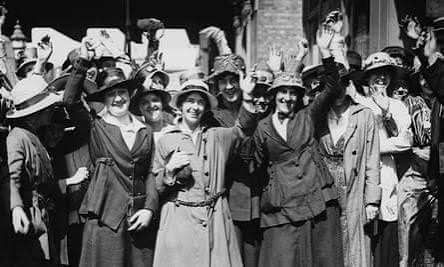
In 1914, a British woman’s place was presumed to be the home. By 1918, over a million of them were making artillery shells, driving trams, and serving in uniform. The war did not just empty the factories of men—it filled them with women, and in doing so, it cracked the ideological foundation of separate spheres. But the story of gender after the war is not a simple tale of progress. It is a story of temporary disruption, political reward, and stubborn continuity.
The Manpower Crisis That Opened the Doors
In 1915, Britain’s army was bleeding. By the end of that year, over half a million soldiers had been killed or wounded. The Somme, in 1916, would add another 400,000 casualties in a single battle. With conscription introduced in 1916, nearly six million men were eventually mobilized. The factories, farms, and offices they left behind needed workers. The government, which had initially resisted women’s labor, began actively recruiting them.
The numbers are stark. In 1914, about 5.9 million women were employed in Britain. By 1918, that figure had risen to 7.3 million. But the nature of the work mattered more than the count. Women moved into jobs that had been coded as masculine: heavy engineering, transport, and munitions. In the munitions factories alone, over one million women worked, producing 80% of the UK’s artillery shells. They were nicknamed ‘canary girls’ because TNT exposure turned their skin yellow. It was dangerous, dirty, and essential work.
The Uniformed Woman: Auxiliary Forces and the Eastern Front
Women also served closer to the front lines, though not in combat roles. Britain’s Women’s Army Auxiliary Corps (WAAC), Women’s Royal Naval Service (WRNS), and Women’s Royal Air Force (WRAF) attracted over 80,000 women. They worked as clerks, cooks, and drivers, freeing men for the trenches. Russia went further, fielding the Women’s Battalion of Death in 1917, a combat unit that fought in the chaos of the Revolution. These uniformed women were visible symbols of a world turned upside down.
The war also created a demographic catastrophe. Britain ended the conflict with an estimated 1.7 to 2 million more women than men—the ‘surplus women’ problem. Millions of women became widows, and many more became sole breadwinners with no state support. The ‘lost generation’ was not a metaphor; it was a statistical reality that reshaped marriage patterns and public discourse.
The Vote: A Reward or a Limited Concession?
The most famous political change came with the Representation of the People Act in 1918. It gave the vote to women over 30 who met property qualifications—about 8.5 million women. Prime Minister Lloyd George framed it as gratitude for women’s war work. But the act was deliberately restrictive. It excluded women under 30 and most working-class women. Full equal suffrage did not arrive until 1928. In the United States, the 19th Amendment followed in 1920, and Germany granted women the vote in 1919. But France and Italy, despite their own massive wars, did not. France waited until 1944, Italy until 1945.
The war also broke down legal barriers. Britain’s Sex Disqualification (Removal) Act of 1919 opened professions like law, civil service, and accountancy to women. But these were symbolic victories for a minority.
The Backlash: Restoration of Pre-War Practices
The revisionist view holds that the war’s impact was temporary. In 1919, the Restoration of Pre-War Practices Act forced women out of ‘men’s jobs’ in munitions and transport. By 1921, women’s employment rates had largely returned to pre-war levels. The interwar years saw a glorification of domesticity, a ‘cult of motherhood,’ and a cultural push for women to return home. The gender division of labor was reasserted, but the justification was weakened. Women had proven they could do the work; the argument that they were biologically incapable no longer held.
The Cultural Shift: Fashion, Freedom, and the Flapper
What did change irreversibly was culture. The war demanded practicality. Women wore shorter skirts and shed corsets for factory work. They bobbed their hair. They smoked, drank, and dated unchaperoned. The ‘flapper’ of the 1920s was a direct descendant of the munitionette. The war did not overturn the structures of patriarchy, but it undermined the myths that supported it. The separate spheres ideology—that women belonged in the home—was never fully restored. Even as women were pushed back into domestic roles, the memory of their wartime service lingered. It became a reference point for future feminist movements.
The Verdict: A Disruption, Not a Revolution
The First World War was not a clean break. It was a violent rupture that opened new possibilities and then slammed many doors shut. Women gained the vote in some countries, but not others. They entered new professions, but were pushed out after the war. They proved their capability, but were told to go home. The most lasting change was cognitive: the idea that women’s place was solely in the home was dealt a blow from which it never fully recovered. The war changed perceptions more than structures, but perceptions matter. They set the stage for the slow, grinding progress of the twentieth century.
The First World War did not ‘give’ women equality, nor did it permanently erase gender divisions. It was a cataclysm that forced societies to reconsider what women could do. The vote came, but it was limited. Jobs opened, but they closed again. The war’s greatest legacy was not a law or a policy, but a shift in the collective imagination. Once women had built shells and driven trains, the old arguments about their fragility rang hollow. The door did not swing fully open, but it was never again locked shut.
Summary
- Women’s employment in Britain rose from 5.9 million (1914) to 7.3 million (1918), with over a million in munitions.
- Over 80,000 women served in British auxiliary forces; Russia fielded an all-female combat unit.
- Suffrage breakthroughs came in Britain (1918, partial), the US (1920), and Germany (1919), but France and Italy held out for decades.
- The Restoration of Pre-War Practices Act (1919) pushed women out of wartime jobs, but cultural shifts—like shorter skirts and bobbed hair—persisted.
- The war changed perceptions of women’s capabilities more than it changed economic structures, laying groundwork for future feminist advances.
FAQ
Q: Did all women get the vote in Britain after WWI?
A: No. The 1918 Representation of the People Act gave the vote only to women over 30 who met property qualifications—about 8.5 million women. Full equal suffrage came in 1928.
Q: Why didn’t France and Italy grant women the vote after WWI?
A: Despite women’s significant war contributions, both countries delayed suffrage—France until 1944, Italy until 1945. The reasons varied, including fears of conservative women’s voting patterns and political instability.
Q: What were ‘canary girls’?
A: Women munitions workers whose skin turned yellow from TNT exposure. They produced 80% of the UK’s artillery shells during the war.
Q: Did women’s employment remain high after the war?
A: No. The Restoration of Pre-War Practices Act (1919) forced women out of ‘men’s jobs,’ and by 1921 employment rates had largely returned to pre-war levels.
Q: What was the ‘surplus women’ problem?
A: Britain had 1.7–2 million more women than men after the war, leading to public debate about unmarried women and their societal role.