Tag: galaxy evolution

  • Hubble’s Epic Mosaic of Andromeda Reveals a Galaxy in Decline

    Hubble’s Epic Mosaic of Andromeda Reveals a Galaxy in Decline

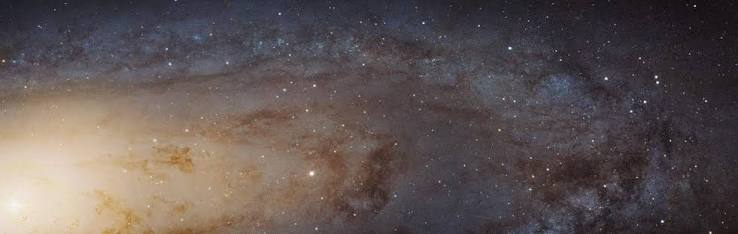
    When you look at the Andromeda Galaxy on a clear night, it appears as a faint, fuzzy smudge—a distant island of stars. But the Hubble Space Telescope has now peeled back that cosmic veil, delivering one of the most detailed portraits of our nearest large galactic neighbor ever captured. The new mosaic, composed of over 600 individual images, resolves more than 100 million individual stars in Andromeda, offering an unprecedented glimpse into the galaxy’s structure and history.

    Yet this stunning visual feast comes with a surprising twist: Andromeda is not the vibrant ‘star factory’ we once thought. The data reveal a galaxy whose star-forming glory days are largely over, with its stellar birthrate plummeting to about a tenth of its peak. This cosmic slowdown challenges our assumptions about spiral galaxies and sets the stage for the next generation of space telescopes.

    A Mosaic of Epic Proportions

    The new Andromeda image is a masterpiece of astronomical stitching. It combines roughly 600 separate Hubble fields of view into a seamless panorama spanning about 600 million pixels—one of the largest and most detailed images of a galaxy ever produced. To put that in perspective, you’d need a wall of high-definition TVs to display it at full resolution.

    This mosaic is the fruit of the Panchromatic Hubble Andromeda Treasury (PHAT) program, which imaged the galaxy in ultraviolet, visible, and near-infrared light. The survey focused on about one-third of Andromeda’s disk, zeroing in on regions of active star formation, dusty lanes, and the galaxy’s central bulge. The result is a treasure trove of data that astronomers will mine for years.

    A Galaxy’s Midlife Crisis

    One of the most striking findings from the PHAT survey is that Andromeda’s star formation has slowed dramatically. The galaxy is now producing stars at a rate roughly 10 times lower than its peak, which occurred about 4–5 billion years ago. In astronomical terms, Andromeda has become ‘quiescent’—a galaxy that has largely stopped making new stars.

    This decline may be linked to a major merger Andromeda experienced 2–3 billion years ago. Such a collision would have triggered a burst of star formation, followed by a long, slow fade as the galaxy consumed its available gas. The presence of a supermassive black hole and a massive central bulge may have also played a role, heating or expelling gas that would otherwise fuel new stars.

    This narrative stands in contrast to our own Milky Way, which continues to form stars at a moderate rate. By comparing the two galaxies, astronomers can better understand the diverse paths spiral galaxies can take over cosmic time.

    Why Hubble’s View Matters

    Hubble’s ability to resolve individual stars in a galaxy 2.5 million light-years away is a testament to the power of space-based observatories. From the ground, atmospheric blurring smears starlight, making such detailed resolution impossible. Hubble’s vantage point above the atmosphere allows it to capture crisp images across a wide range of wavelengths.

    The PHAT mosaic is not just a pretty picture; it’s a scientific goldmine. By cataloging over 100 million stars, astronomers can study Andromeda’s stellar populations, trace its star formation history, and even map the distribution of dark matter.

    The Next Giant Leap: Roman Space Telescope

    The release of this mosaic is timely, as NASA prepares for its next flagship astrophysics mission: the Nancy Grace Roman Space Telescope, set to launch in the mid-2020s. Roman’s field of view is 100 times larger than Hubble’s infrared camera, meaning it can survey the entire Andromeda disk in a fraction of the time Hubble took.

    Roman will provide a complete census of Andromeda’s stellar population, allowing astronomers to map the galaxy’s star formation history, stellar motions, and dark matter distribution in unprecedented detail. It will build on Hubble’s legacy, turning a painstaking mosaic into a wide-angle survey that could rewrite our understanding of galactic evolution.

    A Poetic Reminder

    For amateur astronomers, Andromeda is a beloved object—the most distant thing visible to the naked eye. The new imagery offers a profound connection: those faint smudges of light are actually billions of individual stars, each one now resolvable in Hubble’s view. But the story of a galaxy ‘slowing down’ also serves as a poetic reminder of cosmic timescales. Galaxies, like living things, have life cycles. Andromeda’s star-forming days may be waning, but its future is still bright—it’s on a collision course with the Milky Way, and in about 4.5 billion years, the two will merge, potentially sparking a new era of star birth.

    Hubble’s Andromeda mosaic is more than a technical achievement; it’s a window into the life of a galaxy. It shows us a neighbor that has passed its fiery youth and settled into a quieter middle age. As we await the Roman Space Telescope, this image stands as a testament to human curiosity and our relentless drive to understand the cosmos—and our place within it.

    Summary

    • Hubble has captured one of the most detailed images of the Andromeda Galaxy, a 600-million-pixel mosaic of over 600 individual images.
    • The survey, part of the PHAT program, resolves over 100 million individual stars in Andromeda.
    • Key finding: Andromeda’s star formation rate has declined dramatically, now 10 times lower than its peak 4–5 billion years ago.
    • The decline may be linked to a past merger and the influence of its central black hole and bulge.
    • The upcoming Nancy Grace Roman Space Telescope will build on this work, surveying the entire galaxy with a field of view 100 times larger than Hubble’s.

    FAQ

    Q: How many images were combined to create the Andromeda mosaic?
    A: The mosaic is composed of approximately 600 individual Hubble fields of view, stitched together into a panorama spanning roughly 600 million pixels.

    Q: What is the PHAT program?
    A: PHAT stands for Panchromatic Hubble Andromeda Treasury, a survey that imaged Andromeda in ultraviolet, visible, and near-infrared wavelengths to study its stellar populations and star formation history.

    Q: Why is Andromeda’s star formation declining?
    A: The decline is likely due to a major merger 2–3 billion years ago that triggered a burst of star formation, followed by a long decline as gas was consumed. The central black hole and bulge may also heat or expel gas, suppressing new star formation.

    Q: How does the upcoming Roman Space Telescope compare to Hubble?
    A: Roman has a field of view 100 times larger than Hubble’s infrared camera, allowing it to survey the entire Andromeda disk in a fraction of the time, providing a complete census of its stars.

    Q: When will Andromeda collide with the Milky Way?
    A: Andromeda is on a collision course with our galaxy, expected to merge in about 4.5 billion years, potentially triggering a new burst of star formation.
  • Centaurus A: The Galaxy That Hosts a Monster Black Hole and a Star Factory

    Centaurus A: The Galaxy That Hosts a Monster Black Hole and a Star Factory

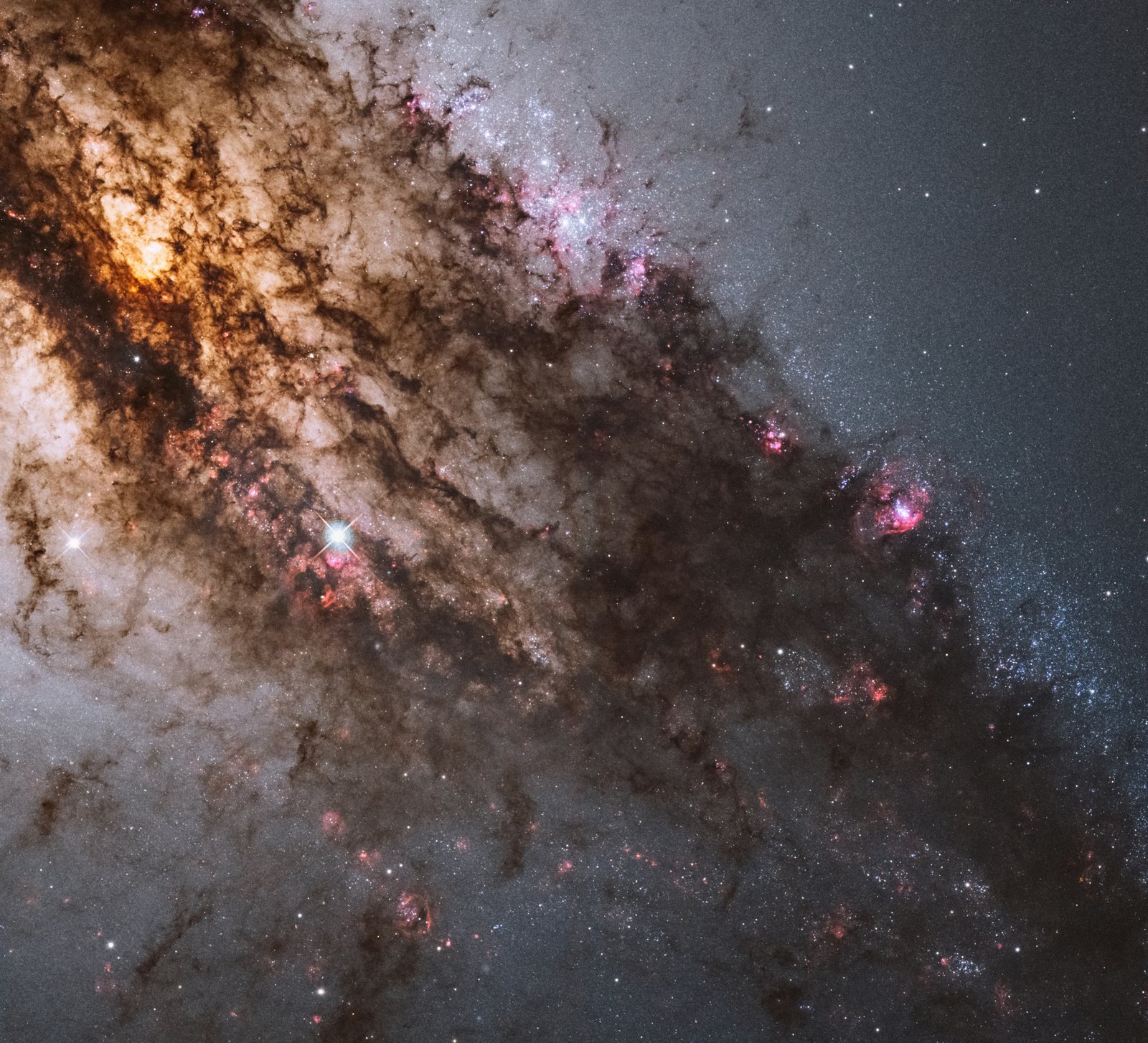
    In the southern constellation of Centaurus, about 12 million light-years away, lies a galaxy that defies easy description. Centaurus A, also known as NGC 5128, is a cosmic oddity: a giant elliptical galaxy split by a dark, dusty lane, with jets of energy blasting from its core and a ring of furious star formation encircling a supermassive black hole. It’s one of the closest active galaxies to Earth, making it a natural laboratory for understanding some of the most violent processes in the universe.

    For decades, astronomers have studied Centaurus A across the electromagnetic spectrum, from radio waves to gamma rays. But a recent image from the James Webb Space Telescope (JWST) has peeled back the veil of dust, revealing the galaxy’s hidden heart in unprecedented detail. This new view is not just a pretty picture; it’s a window into how galaxies evolve, how black holes shape their surroundings, and how stars are born in the most extreme environments.

    What Makes Centaurus A So Special?

    Centaurus A is a starburst galaxy and an active galaxy at the same time. These two labels describe different phenomena, and Centaurus A is one of the few places where we can study both in detail.

    A starburst galaxy is one that is forming stars at an unusually high rate. In Centaurus A, this activity is concentrated in a ring around the galactic center, called the starburst ring. This ring is about 5,000 light-years across and is packed with dense clouds of gas and dust, the raw material for new stars. The rate of star formation here is estimated at 1–2 solar masses per year—that’s one to two times the mass of our Sun in new stars every year. While that might not sound like a lot compared to some extreme starbursts in the distant universe, it’s significant for a galaxy so close to us, and it’s a sign that something dramatic happened recently in this galaxy’s history.

    An active galaxy (or active galactic nucleus, AGN) is one where the central supermassive black hole is actively consuming matter. As gas and dust spiral into the black hole, they heat up and emit enormous amounts of energy across the spectrum. Centaurus A’s black hole has a mass of about 55 million times that of our Sun. It’s not the most massive black hole known, but it’s actively feeding, and it produces powerful jets of particles moving at nearly the speed of light. These jets extend for over a million light-years into intergalactic space, making Centaurus A one of the brightest radio sources in the sky.

    So, Centaurus A is both a star factory and a black hole powerhouse. The two are connected: the same event that triggered the starburst also fed the black hole.

    A Galaxy Shaped by a Cosmic Collision

    The most striking feature of Centaurus A, visible even in small telescopes, is the dark dust lane that cuts across the galaxy’s bright center. This is not a shadow or a crack; it’s a dense band of interstellar dust that absorbs visible light. In infrared images, like those from JWST, this dust glows brightly as it’s heated by nearby stars and the AGN.

    The dust lane is a clue to the galaxy’s past. Astronomers believe that Centaurus A is the result of a major merger—a collision between a large elliptical galaxy and a smaller spiral galaxy. This event likely happened between 100 and 500 million years ago. The spiral galaxy’s gas and dust were pulled into the larger galaxy, forming a warped disk and the distinctive dust lane. The merger also funneled gas toward the center, triggering both the starburst and the black hole’s feeding frenzy.

    This merger scenario explains many of Centaurus A’s peculiarities: the unusual shape, the tidal streams of stars, and the burst of star formation. It also makes Centaurus A a prime example of how galaxies grow and change through collisions—a process that is thought to be a key driver of galaxy evolution in the universe.

    The JWST View: Seeing Through the Dust

    The James Webb Space Telescope’s Mid-Infrared Instrument (MIRI) captured a stunning new image of Centaurus A on July 6, 2026. Mid-infrared light is perfect for peering through dust because the dust itself glows at these wavelengths. This allows astronomers to see structures that are hidden in visible light.

    The JWST image reveals the starburst ring in exquisite detail, showing clumps of warm dust heated by young, massive stars. It also shows the outflow from the black hole, which appears as a bright, jet-like feature. The image traces the distribution of complex molecules called polycyclic aromatic hydrocarbons (PAHs), which are often associated with star-forming regions. By mapping these molecules, astronomers can pinpoint where new stars are being born and how the AGN is affecting its surroundings.

    One of the key questions that JWST data can help answer is: does the black hole’s activity suppress or trigger star formation? This is a central question in astrophysics, and Centaurus A is an ideal place to study it because we can see both the AGN and the starburst ring in detail. The new observations will help astronomers understand the feedback mechanisms that regulate galaxy growth.

    Why Centaurus A Matters

    Centaurus A is not just a beautiful object; it’s a scientific treasure trove. Because it’s so close (only 11–13 million light-years away), we can study it in far greater detail than more distant galaxies. It’s one of the few galaxies where we can resolve the region around the black hole and the starburst ring, allowing us to test theories of black hole accretion, jet formation, and star formation in extreme environments.

    Centaurus A is also a key target for high-energy astronomy. It’s one of the few galaxies detected in very-high-energy gamma rays, which are produced by particles accelerated in the jets. Understanding how these jets accelerate particles to such extreme energies is a major goal in astrophysics, and Centaurus A provides a nearby example to study.

    Finally, Centaurus A is a reminder that the universe is dynamic and violent. Galaxies are not static islands; they collide, merge, and transform. The dust lane, the starburst ring, and the jets are all evidence of a galaxy in the midst of a major upheaval. By studying Centaurus A, we learn not only about this particular galaxy but also about the processes that shape all galaxies, including our own Milky Way, which has likely experienced mergers in its past and will merge with the Andromeda galaxy in a few billion years.

    A Multi-Wavelength Marvel

    To fully understand Centaurus A, astronomers combine observations from many telescopes. The Hubble Space Telescope shows the optical light, revealing the dust lane and the stars. The Chandra X-ray Observatory captures the high-energy emission from the jets and the black hole’s vicinity. The Atacama Large Millimeter/submillimeter Array (ALMA) sees the cold gas and dust that fuel star formation. And now JWST adds the mid-infrared view, showing the warm dust and complex molecules.

    Each wavelength tells a different part of the story. The radio jets show how the black hole’s energy is transported far into space. The X-rays reveal the hottest, most energetic regions. The infrared shows the hidden nurseries of new stars. Together, these observations paint a complete picture of a galaxy in action.

    For amateur astronomers, Centaurus A is a treat. With a magnitude of about 6.8, it’s visible with binoculars under dark skies, and a small telescope reveals its distinctive dust lane. It’s one of the brightest active galaxies in the sky, a testament to its proximity and the intensity of its activity.

    Centaurus A is a cosmic laboratory where we can witness the interplay between a supermassive black hole, a burst of star formation, and the aftermath of a galactic collision. The new JWST image adds a crucial piece to the puzzle, revealing hidden details that will keep astronomers busy for years. As we continue to study this remarkable galaxy, we gain insights into the fundamental processes that govern the universe—from the birth of stars to the growth of black holes.

    Summary

    • Centaurus A is a starburst galaxy and an active galaxy, located about 12 million light-years away.
    • It contains a supermassive black hole (~55 million solar masses) that produces powerful jets and a ring of intense star formation.
    • The galaxy’s distinctive dust lane is evidence of a past merger with a spiral galaxy.
    • JWST’s MIRI image reveals hidden structures in the starburst ring and the AGN’s outflow.
    • Studying Centaurus A helps astronomers understand galaxy mergers, black hole feedback, and star formation.

    FAQ

    Q: What is a starburst galaxy?
    A: A starburst galaxy is one that is forming stars at an unusually high rate. In Centaurus A, this is happening in a ring around the center, with new stars being born at a rate of 1–2 solar masses per year.

    Q: What is an active galactic nucleus (AGN)?
    A: An AGN is the region around a supermassive black hole that is actively consuming matter, emitting huge amounts of energy. Centaurus A’s AGN produces jets that extend over a million light-years.

    Q: Why is the dust lane important?
    A: The dust lane is a dense band of dust that absorbs visible light, creating a dark stripe across the galaxy. It’s evidence of a merger with a spiral galaxy and is a site of intense star formation.

    Q: How does JWST help study Centaurus A?
    A: JWST observes in infrared, which can penetrate dust. Its MIRI instrument reveals warm dust, star-forming regions, and the outflow from the black hole, providing a clearer view of the galaxy’s hidden activity.

    Q: Can I see Centaurus A with a telescope?
    A: Yes, Centaurus A is visible with binoculars or a small telescope under dark skies. It appears as a bright oval with a dark dust lane, and it’s one of the brightest active galaxies in the sky.