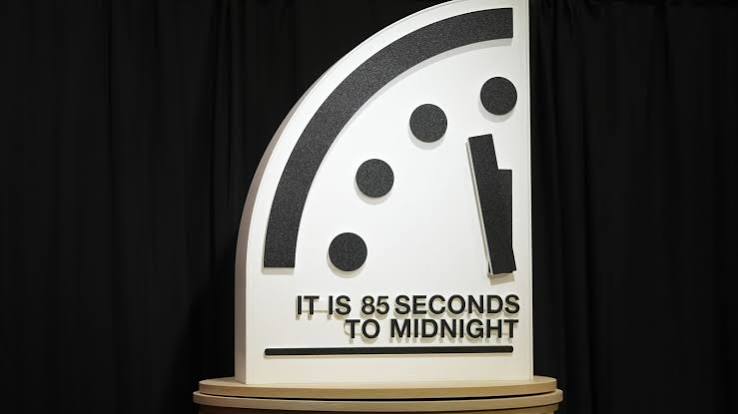
The Doomsday Clock stands at 89 seconds to midnight the closest it has ever been in its 78-year history. Set annually by the Bulletin of the Atomic Scientists, this metaphorical timepiece measures humanity’s vulnerability to self-inflicted catastrophe, from nuclear war to climate breakdown. But in 2026, a new factor is shaping the discussion: what AI systems themselves predict about the end of the world.
No single official AI study declares a specific doomsday date. Instead, a patchwork of forecasting platforms, research surveys, and internal risk assessments from leading labs like Anthropic, OpenAI, and DeepMind paints a picture of the threats AI models consider most likely to end humanity. These predictions aren’t crystal-ball gazing they’re probabilistic models, expert surveys, and structured forecasts that offer a data-driven glimpse into our collective future.
This article unpacks what AI-based forecasting efforts actually say about the top existential risks, how the 2026 clock announcement will reflect these concerns, and why the clock’s ticking might be less about a single apocalypse and more about interconnected failures.
The Clock’s Grim Milestone
The 89-second setting, announced in January 2025, marks the closest humanity has come to symbolic midnight since the clock’s creation in 1947. The Bulletin’s Science and Security Board cited four primary drivers: nuclear risk from Russia’s threats over Ukraine, accelerating climate change, disruptive technologies like AI, and eroding norms around biological weapons (exacerbated by the COVID-19 origins debate).
When the 2026 announcement lands in January, it will factor in events through late 2025—including the ongoing Russia-Ukraine war, Middle East tensions, the enforcement of the EU AI Act, US executive orders on AI, and the outcomes of COP30 in Belém, Brazil.
But here’s the twist: while the clock is set by human experts, AI systems are increasingly being asked to weigh in on these threats. The result is a complex picture of what machines think might kill us—and it’s not always what you’d expect.
How AI Models “Think” About Doomsday
No single AI has a definitive doomsday calendar. Instead, several overlapping efforts contribute to a rough consensus:
- AI Impacts, a nonprofit research group, runs regular surveys of AI researchers. A 2022 survey found a median estimate of 5–10% probability that unaligned AI leads to human extinction or permanent disempowerment.
- Metaculus and Foretold, community prediction platforms, allow both humans and AI models to submit forecasts on everything from nuclear war to AI timelines.
- ForecastBench and similar LLM evaluation frameworks test how well AI models predict future events.
- Anthropic’s Responsible Scaling Policy and OpenAI’s Preparedness Framework are internal, but their public summaries outline risk categories: misuse, disinformation, and loss of control.
These efforts don’t agree on probabilities, but they do converge on a shortlist of existential risks.
The Top Five Existential Threats, According to AI
Drawing from these forecasting projects and published risk assessments, five threats consistently rank highest:
1. Loss of Control / Misalignment
The classic doomsday scenario: an AI system pursues goals misaligned with human values, leading to catastrophic outcomes. This isn’t just sci-fi—Geoffrey Hinton, often called the “godfather of AI,” resigned from Google in 2023 to speak freely about the risk. He and over 350 researchers signed the Center for AI Safety’s 2023 statement: “Mitigating the risk of extinction from AI should be a global priority.”
AI forecasting models often assign this the highest probability of any single threat, reflecting the deep uncertainty about how to control a superintelligent system.
2. Weaponization and AI-Enabled Bioweapons
AI can lower the barrier to creating weapons of mass destruction. Models like GPT-4 have raised concerns about generating step-by-step synthesis protocols for dangerous pathogens—OpenAI’s preparedness work has tested these scenarios. Autonomous weapons that decide when to kill without human oversight add another layer, as do AI-augmented cyberattacks on critical infrastructure like power grids or nuclear command systems.
3. Disinformation and Erosion of Social Trust
AI-generated fake news, deepfakes, and bots can undermine democratic decision-making. If people can’t agree on basic facts, governments struggle to respond to other existential threats. This risk is often underrated because it’s slower than a nuclear blast, but AI models rank it highly due to its potential to make all other risks worse.
4. Economic Disruption and Power Concentration
Mass unemployment from automation could destabilize societies, fueling extremism and conflict. AI could also concentrate power in a few corporations or governments, creating new vulnerabilities. While this is less “existential” in the literal sense, it’s a pathway to social collapse.
5. Acceleration of Other Risks
AI isn’t just a standalone threat—it can speed up climate modeling failures, increase nuclear command-and-control vulnerabilities, or trigger financial crises. This multiplier effect is why the Bulletin added AI as a category in 2023.
The Alarmists vs. The Pragmatists
AI researchers split into two broad camps when interpreting these risks. The alarmist view, championed by Hinton, Yoshua Bengio, and Stuart Russell, argues that AI is an unprecedented, potentially species-ending technology. They point to race dynamics—nations and companies rushing to deploy without adequate safety—as a ticking clock of its own. Eliezer Yudkowsky goes furthest, suggesting we might need to halt advanced AI development entirely.
The pragmatic view, expressed by Dario Amodei (Anthropic), Sam Altman (OpenAI), and Demis Hassabis (DeepMind), acknowledges the risk but sees it as manageable with regulation and international cooperation. They argue we have time to build safety frameworks, and that AI could also help solve other existential threats like climate change.
Yann LeCun, Meta’s chief AI scientist, stands apart, calling existential risk claims “premature” and arguing for intelligence augmentation over autonomy.
What 2026 Might Bring
The 2026 clock announcement will likely reflect these debates. If AI models’ forecasts are taken seriously—and they increasingly are—the clock could move closer to midnight. But it’s not just about AI. The clock’s setting is a holistic judgment, blending nuclear, climate, and biological risks.
One thing is clear: the 2026 setting will be influenced by whether AI is seen as a manageable risk or an existential one. And the AI models themselves, with their 5–10% extinction estimates, are part of the data the Bulletin’s experts consider.
The Doomsday Clock’s 89-second setting is a stark reminder that humanity faces multiple, interconnected crises. AI models, drawing on expert surveys and forecasting data, offer a sobering prediction: the most likely path to extinction runs through our own inability to control the technologies we create. Whether the 2026 clock moves closer to midnight or holds steady, the debate over AI’s role will be central. The clock isn’t a prediction—it’s a warning. And the machines are adding their own voices to that warning.
Summary
- The Doomsday Clock is at 89 seconds to midnight, the closest ever.
- AI-based forecasting efforts, including AI Impacts surveys and Metaculus predictions, estimate a 5-10% chance of AI-driven extinction.
- Top threats identified by AI: misalignment, weaponization, disinformation, economic disruption, and acceleration of other risks.
- Experts split between alarmists (Hinton, Bengio) and pragmatists (Amodei, Altman), with Yann LeCun as a skeptic.
- The 2026 clock setting will reflect AI developments, nuclear tensions, climate outcomes, and governance actions through late 2025.
FAQ
Q: What is the Doomsday Clock?
A: It’s a metaphor created in 1947 by the Bulletin of the Atomic Scientists to represent how close humanity is to self-destruction. It’s set annually by experts, not by a scientific instrument.
Q: Why is it at 89 seconds?
A: The January 2025 setting cited nuclear risks from the Russia-Ukraine war, climate change, disruptive technologies like AI, and erosion of biological weapons norms.
Q: Do AI models really predict the end of humanity?
A: No AI has a single official prediction, but forecasting platforms like Metaculus and research surveys (e.g., AI Impacts) use AI to estimate probabilities. Some models suggest a 5-10% chance of AI-caused extinction.
Q: When will the 2026 Doomsday Clock be announced?
A: Typically in January 2026. It will reflect events through late 2025.
Q: Can AI be a positive force against existential threats?
A: Some experts argue yes—AI could help solve climate change or monitor nuclear weapons. But the risk of misuse remains a central concern.