Every free kick is a battle of wits. The striker plans, the wall jumps, and the goalkeeper dives—but sometimes the ball seems to have its own ideas. It curls around the wall, dips at the last second, or flutters like a confused bird. These aren’t just tricks; they’re physics in action. Two phenomena the Magnus effect and the knuckleball turn a simple kick into a nightmare for goalkeepers.
Understanding these effects isn’t just for scientists. For players, it’s about technique. For fans, it’s about appreciating the genius of a perfectly placed shot. And for goalkeepers, it’s about knowing that sometimes, no matter how fast you react, the physics just isn’t on your side.
The Magnus Effect: Making the Ball Curve
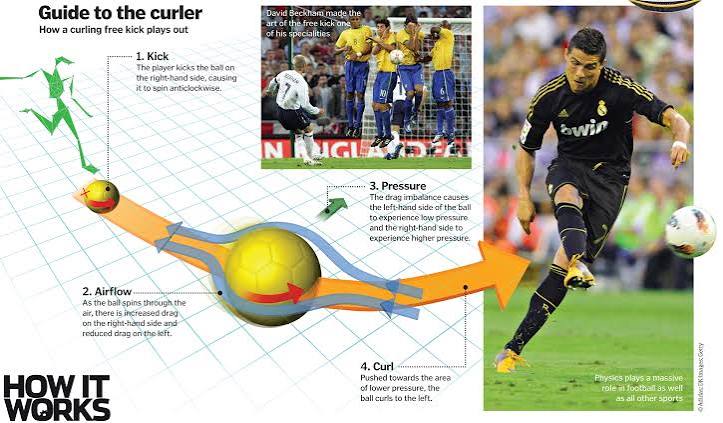
When a football spins through the air, it doesn’t just travel in a straight line. It curves. This is the Magnus effect, named after German physicist Heinrich Gustav Magnus, who described it in 1852—though Isaac Newton noticed it after a tennis match back in 1671.
Here’s how it works: A spinning ball drags a thin layer of air around it, called the boundary layer. On one side, the ball’s surface motion and the airflow move in the same direction, speeding up the air. On the opposite side, they oppose each other, slowing the air down. Faster air means lower pressure, so the ball is pushed from the high-pressure side toward the low-pressure side. The result? A curve.
The force depends on spin rate, ball speed, air density, and the ball’s cross-sectional area. For a typical free kick with heavy spin, the ball can curve by 1 to 3 meters over a 20 to 30-meter flight. That’s enough to bend around a wall and into the top corner.
Types of Spin
- Topspin: The Magnus force pushes the ball downward, keeping it low and adding pace.
- Backspin: Pushes the ball upward, helping it stay high and dip late.
- Sidespin: Curves the ball left or right—the classic “bending” free kick.
Roberto Carlos’s famous 1997 free kick against France is a legendary example. Struck from about 35 meters, the ball seemed to be heading wide, then swerved dramatically into the net. Analysis suggests heavy sidespin and high speed delayed the Magnus effect until the ball slowed enough, causing a sudden, late curve. That kick made football aerodynamics a hot topic.
The Knuckleball: When the Ball Goes Wild
If spin creates predictable curves, no spin creates chaos. A knuckleball free kick is struck with minimal or no spin, causing the ball to flutter erratically. The ball’s surface—especially the seams and panels—creates asymmetric airflow separation. Small variations in the boundary layer cause the wake to oscillate, producing random lateral forces that change direction mid-flight.
Knuckleball shots are typically struck at 80–110 km/h (50–70 mph) with spin rates below 1–2 revolutions per second. Compare that to 8–10 rev/s for a heavily curved kick. The lack of spin means the ball doesn’t have a stable aerodynamic profile, so it can dart left, then right, then dip—all within a fraction of a second.
The Goalkeeper’s Nightmare
A goalkeeper needs about 0.3–0.5 seconds to recognize the ball’s direction and start a dive. A free kick from 20–25 meters at 100 km/h reaches the goal in 0.7–0.9 seconds. That leaves a narrow window. With a knuckleball, the ball can change direction 2–3 times in the last 0.3 seconds of flight—often after the keeper has already committed to a dive. It’s no wonder these kicks fool even the best.
The Science of Ball Design
Modern footballs aren’t smooth spheres. They’re covered with textured panels and seams that trip the boundary layer from laminar to turbulent flow at lower speeds. Turbulent boundary layers “stick” to the ball longer, reducing drag and making the ball faster and more predictable in straight flight. But those same seams create asymmetric drag when the ball isn’t spinning, which is what causes the knuckleball effect.
Ball design has a huge impact. The 2010 World Cup ball, the Adidas Jabulani, was notoriously “too smooth” and produced exaggerated knuckleball effects, confusing everyone. The 2014 Brazuca and 2018 Telstar 18 had more pronounced texturing, restoring some predictability—but knuckleball shots remain a threat.
The panel count and seam depth matter too. A traditional 32-panel stitched ball behaves differently from a 6-panel thermally bonded ball. Designers walk a fine line: too smooth and the ball is unpredictable; too textured and it’s hard to get a good knuckleball.
How Players Do It
Knuckleball Technique
To hit a knuckleball, strike the ball with your laces (instep) through the center, following through without wrapping your foot around the ball. Keep your ankle locked and contact the ball slightly below center to avoid spin. The goal is minimal spin, so the ball can flutter.
Curved Free Kick Technique
For a curved kick, strike with the inside or outside of your foot, brushing across the ball to impart spin. The follow-through is crucial—it determines the spin rate and direction. Players like David Beckham mastered this, using the inside of the foot to curl the ball over walls and into corners.
The Evolution of the Free Kick
Free kicks have become a science. Players study ball behavior, practice specific techniques, and even use wind tunnels to understand aerodynamics. Coaches analyze data on spin rates and launch angles. But at the end of the day, it’s still a human skill. Juninho Pernambucano, Cristiano Ronaldo, Andrea Pirlo, and Gareth Bale are celebrated for their knuckleball mastery. Their ability to execute such precise strikes under pressure is what makes them legends.
The physics of football isn’t just about equations; it’s about the magic moments that leave fans speechless and goalkeepers grasping at air. Whether it’s the predictable curve of a Magnus-driven free kick or the chaotic flutter of a knuckleball, understanding the science adds a new layer of appreciation for the beautiful game. Next time you watch a free kick, remember: it’s not just skill—it’s physics in action.
Summary
- The Magnus effect causes a spinning ball to curve due to air pressure differences created by the spin.
- A knuckleball is struck with minimal spin, causing erratic movement due to asymmetric airflow over the ball’s seams.
- Goalkeepers need 0.3–0.5 seconds to react, but knuckleballs can change direction in the last 0.3 seconds, making them nearly impossible to save.
- Modern football design, like the textured panels on the Brazuca, balances predictability with the ability to knuckleball.
- Players use specific techniques—striking through the center for a knuckleball, brushing across for a curve—to control the ball’s flight.
FAQ
Q: What is the Magnus effect in football?
A: The Magnus effect is when a spinning ball curves because the spin creates a pressure difference on opposite sides of the ball. The ball is pushed toward the side with lower pressure, causing it to bend.
Q: How does a knuckleball free kick work?
A: A knuckleball is struck with very little spin, so the ball’s seams cause irregular airflow. This leads to unpredictable, fluttering movement as the ball travels, making it hard for goalkeepers to judge.
Q: Why are knuckleball free kicks so hard for goalkeepers to save?
A: The ball changes direction multiple times in the last fraction of a second, often after the keeper has already committed to a dive. The erratic movement is due to the lack of spin and the ball’s surface design.
Q: How do players avoid spinning the ball when hitting a knuckleball?
A: They strike the ball with the laces through the center, keeping the ankle locked and following through straight. This minimizes spin and allows the ball’s seams to create turbulent airflow.
Q: Has football design changed the knuckleball effect?
A: Yes. The 2010 Jabulani was too smooth, causing exaggerated knuckleball effects. Later balls like the Brazuca had more texture, making them more predictable, but knuckleball shots still work with proper technique.