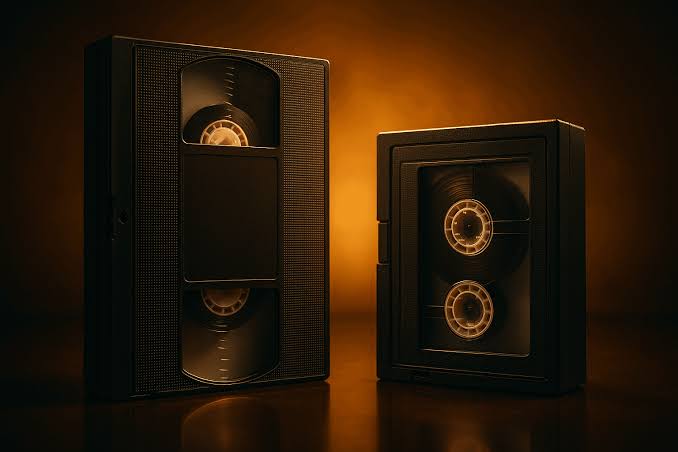
In 1975, Sony introduced the Betamax, a home video recording system that delivered sharper pictures and more compact cassettes than anything else on the market. It seemed destined to dominate. Yet within a decade, Betamax was a footnote, while its rival VHS became the standard for home video.
The story of Betamax’s fall is not a simple tale of inferior technology triumphing over superior engineering. It’s a case study in how business strategy, consumer behavior, and network effects can outweigh raw technical excellence. The lessons from the format war resonate far beyond the world of obsolete tape formats, offering timeless insights into competition and innovation.
The Superiority of Betamax
Sony’s engineers, led by Nobutoshi Kihara, began developing a home video recorder in 1969. The result was Betamax, launched in Japan in November 1975 and in the US shortly after at a price of $1,295. Its cassette was small—156 × 96 × 25 mm—and the picture quality was objectively better than VHS, offering around 250-280 horizontal lines of resolution compared to VHS’s 240-250, with lower noise and better audio fidelity.
The name itself reflects careful design: “beta” comes from the Japanese word for the shape of the tape path, which resembles the Greek letter β, and “max” for maximum. Sony positioned Betamax as a premium product for discerning consumers.
Yet Betamax had a critical flaw: it initially recorded only one hour of video, while VHS offered two. For consumers wanting to record a feature-length film or a sports event, that hour was a dealbreaker.
The VHS Counter-Strategy
JVC, partly owned by Matsushita (now Panasonic), launched VHS in October 1976. Rather than guarding the technology, JVC licensed it openly to other manufacturers like RCA, Zenith, Sharp, and Mitsubishi. This created a consortium that produced a flood of machines at various price points, saturating retail shelves.
Sony, by contrast, initially refused to license Betamax. The company’s founders believed in creating proprietary “Sony standards,” as they had with the Walkman and later with the 3.5-inch floppy disk. They saw Betamax as a premium product, not a commodity.
This strategic choice had immediate consequences. More VHS machines meant more VHS rental tapes. Video rental stores stocked VHS because that’s what customers had. And customers bought VHS because the rental selection was vast. By 1979, VHS had overtaken Betamax in worldwide sales.
The Hollywood Lawsuit and Its Ironies
In 1976, Universal and Disney sued Sony, claiming Betamax enabled copyright infringement. The case, Sony v. Universal City Studios, dragged on for years, finally reaching the Supreme Court, which ruled in Sony’s favor in January 1984. The decision established the “Betamax defense,” which later protected VCRs and DVRs.
But the lawsuit had a chilling effect: Sony’s marketing efforts were frozen during Betamax’s crucial early years. The case also made “Betamax” a household name—but for litigation, not for innovation.
The Tipping Point
By 1984, VHS held about 60% of the US market; Betamax had fallen below 25%. By 1985, VHS reached roughly 75% globally. The network effects were self-reinforcing: more VHS machines meant more rental tapes, which meant more reason to buy VHS.
The adult film industry also standardized on VHS early, further cementing its dominance in rental stores—a factor often mentioned but rarely quantified.
Sony finally conceded in 1988, beginning to manufacture VHS machines. It stopped producing Betamax recorders in 1993, ceased Betamax cassettes in 2002, and ended professional tape production in 2015.
The Lessons
Betamax’s fall offers three enduring lessons:
- Technology alone doesn’t win. Consumers chose the format that recorded longer, had more movies available, and was sold everywhere. Superior picture quality wasn’t enough.
- Open standards beat closed ones. JVC’s licensing created a price war and ubiquity that Sony couldn’t match. Sony’s insistence on a proprietary standard delayed the ecosystem’s growth.
- Network effects matter. The more VHS machines in homes, the more rental tapes stores stocked, and the more reason for consumers to buy VHS. This self-reinforcing loop is a classic example of a tipping point.
Some observers note that by the mid-1980s, VHS quality had largely caught up, eroding Betamax’s advantage. But the decisive factor was not technical—it was strategic.
The Betamax story is often told as a tragedy of the best product losing. More accurately, it’s a story of how business decisions, not engineering, determine winners in a format war. Sony’s refusal to license, its focus on a premium product, and its failure to recognize consumer demand for recording time all contributed to its defeat. The lesson for today’s tech giants is clear: the best technology doesn’t always win—the best ecosystem does.
Summary
- Betamax offered superior picture quality and smaller cassettes than VHS, but it recorded only 1 hour initially, while VHS recorded 2.
- JVC licensed VHS to multiple manufacturers, creating a price war and retail ubiquity, while Sony initially kept Betamax proprietary.
- Network effects drove the market: more VHS machines led to more rental tapes, which led to more VHS sales.
- The Sony v. Universal lawsuit froze Sony’s marketing efforts during critical early years.
- By 1988, Sony conceded and began making VHS machines; Betamax production ended by 1993.
FAQ
Q: Was Betamax truly superior to VHS?
A: Yes, in many technical aspects—better horizontal resolution (250-280 lines vs. 240-250), lower noise, and better audio. However, it had a major drawback: shorter recording time (1 hour initially vs. VHS’s 2 hours).
Q: Why did VHS win despite being technically inferior?
A: VHS won due to a combination of factors: longer recording time, open licensing, wider availability of machines and tapes, and network effects that favored the format with more market share.
Q: What was the “Betamax defense”?
A: The Supreme Court ruling in Sony v. Universal City Studios (1984) held that Sony was not liable for copyright infringement because the Betamax had substantial non-infringing uses. This defense later protected VCRs and DVRs.
Q: When did Sony finally give up on Betamax?
A: Sony began manufacturing VHS machines in 1988, stopped producing Betamax recorders in 1993, and ceased Betamax cassette production in 2002. Professional broadcast Betamax tapes continued until 2015.
Q: What are the key business lessons from the Betamax story?
A: The lessons include: technology alone doesn’t guarantee success; open standards can beat proprietary ones; network effects are powerful; and understanding consumer needs (like recording time) is crucial.