
Tag: food technology

  • How AI Is Designing the Next Generation of Food Ingredients

    How AI Is Designing the Next Generation of Food Ingredients

    Every day, your body relies on proteins, peptides, and small molecules from food to regulate blood pressure, support digestion, and provide energy. Most of these compounds were discovered through centuries of trial and error—chewing on bark, fermenting grains, or screening thousands of plant extracts. Now, artificial intelligence is flipping that process on its head.

    Instead of testing nature’s existing library, AI systems can generate millions of novel molecular structures in silico, predicting which ones might taste sweet, fight inflammation, or gel into a convincing plant-based burger. This isn’t science fiction; it’s happening in labs and startups right now. From egg proteins made without chickens to bioactive compounds hidden in black pepper, AI-assisted design is reshaping what we eat and how it’s produced.

    But the field is young, and the gap between prediction and reality is still wide. Understanding how this technology works—and where it stumbles—matters for anyone who eats, regulates, or invests in food.

    From Serendipity to Systematic Search

    For most of history, discovering a new functional food ingredient was like finding a needle in a haystack—if the haystack were the size of a planet. Traditional screening meant testing thousands of natural compounds one by one, hoping for a hit. Ethnobotanists might hear about a plant used in traditional medicine, then spend years isolating the active molecule. The process was slow, expensive, and limited to compounds that already existed in nature.

    In the 2000s, computational tools like molecular docking and QSAR models started to change that. Researchers could simulate how a molecule might bind to a target enzyme, filtering out obvious duds before wet-lab testing. But these early methods relied on hand-crafted features and small datasets, so their predictive power was limited.

    The real shift came with deep learning. Around 2015, neural networks began learning directly from raw data, without manual feature engineering. Then in 2020, AlphaFold cracked protein structure prediction—a problem that had stumped biologists for 50 years. Suddenly, researchers could predict the 3D shape of any protein from its amino acid sequence, opening the door to rational design.

    The AI-Driven Workflow

    Designing a functional ingredient with AI follows a structured pipeline:

    1. Define the target. A company might specify, “Find a peptide that inhibits the ACE enzyme, which regulates blood pressure.”
    2. Collect data. Curate training sets from scientific literature, patents, and databases like UniProt or FooDB.
    3. Train the model. Deep learning models learn structure-function relationships from thousands of known examples.
    4. Generate candidates. Generative models propose novel sequences or molecules that don’t exist in nature.
    5. Screen in silico. Filter candidates for predicted efficacy, toxicity, and stability.
    6. Validate in the lab. Synthesize the top candidates and test them in vitro or in vivo.
    7. Scale up. Produce the winner via fermentation or chemical synthesis.
    8. Get regulatory approval. Achieve GRAS status or novel food approval.

    This workflow is already producing results. Brightseed’s Forager AI platform, for instance, scanned the plant kingdom and identified a bioactive compound in black pepper that modulates gut health—something humans had missed despite eating pepper for millennia. NotCo’s Giuseppe AI matches plant-based ingredients to the functional properties of animal products, helping create vegan mayonnaise and milk that mimic the originals.

    Where AI Is Making Inroads

    Peptide Discovery

    Peptides are short chains of amino acids, and they’re the most mature application of AI in food. Models trained on peptide databases can predict which sequences will have antihypertensive, antioxidant, or anti-inflammatory activity. The search space is vast—theoretically 20^20 possible peptides—but AI narrows it down to a handful of promising candidates.

    Protein Design for Alternative Proteins

    Creating plant-based meat that actually cooks and tastes like beef requires proteins with specific functional properties: gelation, emulsification, water retention. Tools like AlphaFold and RFdiffusion help engineers design proteins from scratch or tweak existing plant proteins to perform these roles. Every Company (formerly Clara Foods) uses AI to design egg proteins without the chicken, while Arzeda designs enzymes that improve food processing.

    Small Molecules for Taste

    Generative chemistry models, such as variational autoencoders and GANs, can invent new sweeteners or flavor enhancers. These models are trained on databases of known flavor chemicals and their sensory properties. The goal isn’t just to replicate sugar—it’s to create compounds that are intensely sweet, zero-calorie, and stable under heat, all at once.

    The Skeptic’s View

    Not everything emerging from an AI model makes it to your plate. The validation gap is real: many AI-designed candidates fail in wet-lab tests because prediction accuracy for bioactivity is still modest. A model might predict a peptide will inhibit an enzyme, but in a test tube, it flops due to solubility issues or off-target effects.

    There’s also a tendency for companies to oversell AI’s role. Some startups use “AI” as a buzzword to attract investors, even when the technology is just a minor part of their process. Regulatory hurdles remain—novel ingredients must prove safety, which takes years and millions of dollars. And consumer acceptance is uncertain; will people eat ingredients designed by algorithms?

    Still, the potential is enormous. Nature has explored only a fraction of the possible protein universe. AI can explore millions of candidates in silico, at a fraction of the cost of wet-lab screening. That’s not hype—it’s a fundamental shift in how we discover and design the molecules that feed us.

    AI-assisted design of functional food ingredients is not a distant future; it’s happening in labs and products today. The technology has already uncovered compounds humans missed for centuries and created proteins that could reduce our reliance on animal agriculture. But it’s not a magic wand—it’s a tool that still needs wet-lab validation, regulatory oversight, and consumer trust. As the field matures, the winners will be those who combine cutting-edge computation with rigorous experimental testing, and who use AI not as a marketing buzzword but as a genuine engine for innovation.

    Summary

    • AI-assisted design uses machine learning to generate novel food ingredients with targeted health, taste, or sustainability benefits.
    • The workflow involves defining a target, training models on existing data, generating candidates, screening in silico, and validating in the lab.
    • Peptide discovery is the most advanced application, while protein design and small molecule discovery are growing rapidly.
    • The validation gap is a major challenge—many AI-designed candidates fail in wet-lab tests, and prediction accuracy remains modest.
    • Despite hype, real progress is being made by companies like Brightseed, NotCo, and Every Company, who combine AI with rigorous experimental validation.

    FAQ

    Q: How does AI actually design a new food ingredient?
    A: AI models learn from existing data on food compounds, then generate new molecular structures that don’t exist in nature. These candidates are screened in silico for predicted function and safety, then the top hits are synthesized and tested in the lab.

    Q: Is AI-designed food safe to eat?
    A: Any new ingredient must pass regulatory approval, such as FDA GRAS status in the US or novel food authorization in the EU. The AI-generated candidates are just starting points; they undergo rigorous safety testing before reaching the market.

    Q: Can AI create ingredients that are better than natural ones?
    A: In some cases, yes. For example, AI can design sweeteners that are zero-calorie and have no glycemic impact, or proteins with improved amino acid profiles. But “better” depends on the goal—taste, cost, sustainability—and each design must be evaluated against those criteria.

    Q: What’s the biggest challenge facing AI-assisted food ingredient design today?
    A: The validation gap. AI predictions often don’t hold up in wet-lab testing, so the process still requires significant experimental work. Improving prediction accuracy is a key area of research.

    Q: Will AI replace food scientists?
    A: No. AI is a tool that expands the search space and speeds up discovery, but experienced food scientists are still needed to define targets, interpret results, and guide the development process.
  • Precision Fermentation: How Lab-Grown Microbes Are Brewing the Future of Food

    Precision Fermentation: How Lab-Grown Microbes Are Brewing the Future of Food

    Imagine cheese made without a single cow, egg whites without hens, or honey without bees. This isn’t science fiction it’s precision fermentation, a process that uses engineered microbes as miniature factories to produce the exact proteins, fats, and flavors we love, minus the environmental footprint of traditional farming.

    For decades, we’ve relied on animals and plants to create the ingredients in our food. But as the global population grows and climate change pressures our agricultural systems, a new approach is emerging: brew these ingredients in steel tanks, using yeast and bacteria. This isn’t about lab-grown meat (that’s cellular agriculture); it’s about using fermentation to produce the building blocks of food proteins, enzymes, and more in a way that’s efficient, scalable, and kinder to the planet.

    What Is Precision Fermentation?

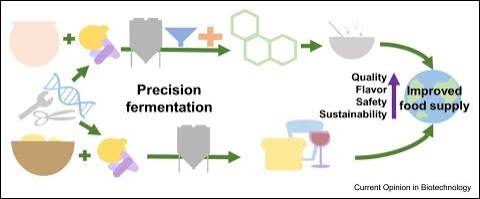
    Precision fermentation is a method of biomanufacturing where scientists program microorganisms like yeast, fungi, or bacteria to produce specific ingredients. Think of these microbes as tiny breweries, but instead of beer, they churn out proteins like whey, casein, or egg albumin.

    The process starts with identifying the DNA sequence that codes for a desired protein. That sequence is inserted into a host microbe, commonly Komagataella phaffii or Saccharomyces cerevisiae (brewer’s yeast). The microbe is then placed in a large fermentation tank, fed with sugars or starches, and as it multiplies, it secretes the desired protein. After a few days, the protein is harvested, purified, and turned into a powder or liquid ingredient ready for food production.

    This is different from traditional fermentation, like brewing beer or making yogurt, where the microbe itself transforms raw ingredients. In precision fermentation, the microbe is just a tool it’s not the final product. It’s also different from cultivated meat, which grows actual animal cells. Here, we’re growing proteins, not animals.

    A Proven Technology with a New Mission

    Precision fermentation isn’t new. Since the 1980s, it’s been used to produce rennet, an enzyme traditionally sourced from calf stomachs, for cheese-making. Today, an estimated 80–90% of hard cheese in the US and UK uses fermentation-derived rennet. This was the first FDA-approved food ingredient from a genetically engineered organism—a milestone that proved the technology’s safety and viability.

    Since then, precision fermentation has given us insulin, vitamins like B2 and B12, and enzymes used in food processing. But the current buzz is about animal proteins—the ones that are hardest to replicate without animals.

    Why Now? The Environmental Case

    Animal agriculture is a major driver of climate change, responsible for about 14.5% of global greenhouse gas emissions. Dairy alone contributes 3–4%. It’s also land- and water-intensive. Cows need pasture, feed, and huge amounts of water. Precision fermentation offers a way to produce the same proteins with a fraction of the resources.

    For example, Perfect Day, a US company, produces whey and casein through precision fermentation. Their animal-free dairy ice cream hit the market in 2021. Since then, they’ve expanded into other dairy products, all without a single cow. Remilk, an Israeli company, received FDA approval in 2023 for its whey protein. The EVERY Company produces egg proteins—no chickens involved.

    The Cost Trajectory: From Pricey to Practical

    One of the biggest hurdles has been cost. In 2019, Perfect Day’s whey cost around $100 per kilogram. By 2024, that had dropped to an estimated $10–20 per kilogram, with targets of under $5. At that price, precision-fermented proteins could undercut traditional dairy—whey typically sells for $8–12 per kilogram.

    This mirrors the trajectory of rennet, which was initially expensive but became cheap as production scaled. The same pattern is likely for other proteins, as companies optimize their processes and build larger fermentation facilities.

    What’s on the Market or Coming Soon

    Several companies are leading the charge:

    • Perfect Day (US): Whey and casein; first to market with animal-free ice cream.
    • Remilk (Israel): Whey protein; FDA approval in 2023.
    • The EVERY Company (US): Egg proteins (ovalbumin, ovomucoid).
    • Impossible Foods (US): Uses precision-fermented soy leghemoglobin (heme) for its plant-based burgers—this is what gives them the meaty flavor and color.
    • MeliBio (US): Produces real honey proteins via fermentation—bee-free honey.
    • Formo (Germany): Casein for cheese.
    • Change Foods (US/Israel): Casein for cheese.

    These companies are targeting dairy, eggs, meat flavors, and even honey—ingredients that are difficult to replace with plant-based alternatives but are perfect for precision fermentation.

    Regulatory Status: What’s Approved Where

    The regulatory landscape is evolving. In the US, the FDA regulates the final ingredient, not the process. Several precision-fermented products have received GRAS (Generally Recognized as Safe) status or ‘no questions’ letters, meaning they’re considered safe for consumption. The EU, however, requires pre-market authorization under the Novel Food Regulation. As of early 2025, no precision-fermented animal proteins have been approved for sale in the EU, though applications are pending. Singapore was the first to approve cultivated meat in 2020 and has also approved precision-fermented products. Israel has an active regulatory pathway, and the UK’s Food Standards Agency has signaled openness.

    The Bigger Picture: A Third Wave of Fermentation

    The term ‘precision fermentation’ gained traction around 2019–2020 thanks to the Good Food Institute and RethinkX, who distinguished it as the ‘third wave’ of fermentation, after traditional and biomass fermentation. This framing highlights its potential to transform food production.

    But it’s not just about food. The same technology is used to produce medicines, like insulin, and other valuable compounds. The infrastructure and science are interchangeable, so advances in one area benefit the other.

    Challenges and Considerations

    Precision fermentation isn’t a silver bullet. There are challenges:

    • Scaling up: Moving from lab-scale to commercial-scale fermentation requires significant investment. Building large bioreactors is costly.
    • Consumer acceptance: Some people are wary of genetically engineered organisms, even if the final product is identical to the traditional one. Clear labeling and education are crucial.
    • Regulatory hurdles: In some regions, like the EU, the approval process is slow, which delays market entry.

    However, the technology has a proven track record—rennet and insulin have been used safely for decades. As more products gain approval and companies scale up, costs will likely continue to drop, making these ingredients more accessible.

    Precision fermentation is not a distant dream; it’s a technology that’s already in our food supply. From rennet in cheese to insulin in medicine, it’s been quietly working behind the scenes for 40 years. Now, it’s poised to tackle one of the biggest challenges of our time: feeding a growing population sustainably. By ‘brewing’ proteins and other ingredients in labs, we can reduce the pressure on agriculture, cut emissions, and still enjoy the foods we love. The future of food might just be brewed in a steel tank.

    Summary

    • Precision fermentation uses engineered microbes (yeast, fungi, bacteria) to produce specific proteins, fats, and other ingredients.
    • It’s been used since the 1980s for rennet in cheese and insulin for diabetes.
    • Current applications include dairy proteins (whey, casein), egg proteins, and heme for plant-based meat.
    • Environmental benefits: lower greenhouse gas emissions, land and water use compared to animal agriculture.
    • Costs are falling, with companies like Perfect Day targeting <$5/kg for whey, potentially undercutting dairy prices.
    • Regulatory approvals are growing, with FDA and Singapore leading the way, while the EU is still reviewing.

    FAQ

    Q: Is precision fermentation the same as lab-grown meat?
    A: No. Lab-grown meat (cellular agriculture) grows actual animal cells. Precision fermentation uses microbes to produce specific proteins, like whey or egg white, which are then used as ingredients. The microbes are not the final product.

    Q: Are precision-fermented foods safe to eat?
    A: Yes. The FDA and other regulatory bodies have approved several products, and the technology has been used safely for decades. For example, fermentation-derived rennet has been in cheese since the 1980s.

    Q: How does precision fermentation help the environment?
    A: It requires significantly less land, water, and energy than traditional animal agriculture. For instance, producing dairy proteins via fermentation emits far fewer greenhouse gases than raising cows.

    Q: Will precision-fermented products taste the same?
    A: The goal is to create proteins that are identical to those from animals, so the taste, texture, and nutrition are the same. Many consumers have reported that animal-free dairy and egg products are indistinguishable from the real thing.

    Q: When can I buy products made with precision fermentation?
    A: Some products are already on the market, like Perfect Day’s ice cream and Impossible Foods’ burgers. Others, like cheese from Formo or Change Foods, are in development and awaiting regulatory approval in some regions.