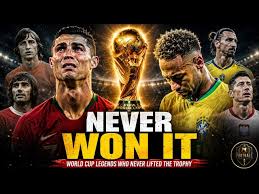
The World Cup is football’s ultimate coronation, the stage where legends are immortalized. Yet for every Pelé or Maradona who hoists the golden trophy, there are others whose brilliance never found its ultimate reward. These are the players who dazzled us, broke our hearts, and redefined the game—but whose careers are forever marked by the one trophy that eluded them.
This is not a list of the ‘almosts’ or the ‘what-ifs.’ It’s a tribute to the men whose greatness transcends silverware, whose impact on the sport is measured in moments, not medals. From the tragic genius of Cruyff to the eternal elegance of Maldini, these ten legends remind us that football’s beauty lies not only in victory, but in the pursuit of it.
The Weight of the Trophy
The World Cup is more than a tournament; it’s a cultural touchstone, a national obsession, and for many, the sole arbiter of greatness. In Brazil, a player without a World Cup is a tragedy; in Argentina, a sin. This immense pressure creates a narrative of heroes and villains, of triumph and despair. For every player who rises to the occasion, there are those who are defined by their failure to do so—not because they lacked talent, but because the margins are razor-thin. A missed penalty, a tactical error, a moment of individual brilliance from an opponent—any of these can shatter a dream that takes four years to build.
The Tragic Heroes of 1974 and 1954
Johan Cruyff: The Architect of Total Football
No player embodies the ‘tragic hero’ archetype more than Johan Cruyff. His Netherlands team of 1974 was a revelation, a whirlwind of fluid positions and relentless pressing that stunned the world. Cruyff was the conductor, a player of such intelligence and grace that he seemed to be playing a different game. Yet, in the final against West Germany, the Dutch were undone by a combination of German pragmatism and their own complacency. Cruyff’s legacy is secure—he is the father of modern football, the man who taught Barcelona to play ‘the Ajax way’—but the World Cup remains the gap in his otherwise perfect resume.
Ferenc Puskás: The Galloping Major’s Heartbreak
Twelve years earlier, another revolutionary team met a similar fate. Hungary’s ‘Golden Team’ of 1954 was the best in the world, boasting the incomparable Ferenc Puskás, a left-footed goal machine with a cannon of a shot. They had beaten West Germany 8-3 in the group stage, and led 2-0 in the final within eight minutes. Then, the ‘Miracle of Bern’ happened. The Germans, aided by rain and a controversial selection of boots, fought back to win 3-2. Puskás, who had scored twice, was left to wonder what might have been. He never got another chance; the Hungarian Revolution of 1956 scattered the team, and Puskás spent his later years in Spain, winning European Cups with Real Madrid but never the World Cup.
The ‘What Ifs’ of the 1980s and 1990s
Michel Platini: The Maestro of France
Michel Platini was the most elegant midfielder of his generation, a player who could score from free kicks with the precision of a surgeon and create chances out of nothing. He led France to the semifinals of the 1982 World Cup, where they lost a classic to West Germany on penalties, and then to third place in 1986. Platini’s France was a beautiful team, but they were denied by the Germans twice and by the brilliance of Maradona in 1986. Platini’s legacy is one of grace and intelligence, but his international career is a study in what might have been.
Zico: The White Pelé
In Brazil, Zico was hailed as the ‘White Pelé,’ a player of such technical ability that he was considered the heir to the throne. The 1982 Brazil team, featuring Zico, Sócrates, Falcão, and Júnior, is still regarded as one of the greatest teams never to win the World Cup. They played football as an art form, but in a match that became known as the ‘Tragedy of Sarriá,’ they lost to Italy 3-2 in the second round, a game that saw Paolo Rossi score a hat-trick. Zico’s World Cup story is one of unfulfilled promise, a reminder that even the most beautiful football can be undone by a single day.
Roberto Baggio: The Divine Ponytail’s Penalty
The 1994 World Cup final is etched in football lore for many reasons, but none more poignant than the image of Roberto Baggio standing over a penalty kick in the shootout. Italy and Brazil were deadlocked at 0-0, and Baggio, who had carried Italy to the final with his goals, had to score to keep his team alive. He skied it over the bar. The image of Baggio, head bowed, hands on hips, is one of the most iconic in sports history. He was the best player in the world that year, but he will forever be remembered for that miss. Baggio’s career was a tapestry of brilliance and heartbreak, and the World Cup was the thread that never quite came together.
The Defenders and the Goalkeepers
Paolo Maldini: The Eternal Captain
Paolo Maldini is arguably the greatest defender in football history. For 25 years, he was the rock upon which AC Milan and Italy built their success. He played in four World Cups, reaching the final in 1994 and the semifinals in 1990 and 1998. In 2002, a controversial goal by South Korea ended Italy’s run in the round of 16. Maldini’s longevity and consistency were unmatched, but the World Cup remained elusive. He retired in 2009 with a collection of trophies that would fill a museum, but the one he coveted most was never his.
Lev Yashin: The Black Spider
Lev Yashin is the only goalkeeper to have won the Ballon d’Or, and he is widely considered the greatest to have ever played the position. His athleticism and reflexes were revolutionary, and he changed the way goalkeepers were perceived. Yet, his World Cup record is a tale of near-misses. The Soviet Union reached the quarterfinals in 1958, the quarterfinals again in 1962, and the semifinals in 1966, where they lost to West Germany. Yashin’s legacy is secure, but the World Cup trophy was the one prize that eluded him.
The Lone Stars and the Unfulfilled
George Best: The Fifth Beatle
George Best was a genius, a player of such natural talent that he could have been the greatest of all time. But his career was plagued by personal demons and a lack of support from his national team. Northern Ireland was simply not good enough to qualify for major tournaments, and Best played in only one World Cup, in 1982, when he was past his prime. He never got the chance to shine on the biggest stage, and his legacy is one of unfulfilled potential.
Eusébio: The Black Panther
Eusébio was the first African-born superstar, a player of immense power and speed who lit up the 1966 World Cup with nine goals, including a stunning hat-trick against North Korea in the quarterfinals. Portugal finished third, but Eusébio’s brilliance was a revelation. He never got another chance to win the World Cup, as Portugal failed to qualify for the next two tournaments. His legacy is that of a pioneer, a player who showed the world what African football could be.
Alfredo Di Stéfano: The Man Who Never Played
Alfredo Di Stéfano is one of the greatest players in the history of Real Madrid, but he never played in a World Cup. His career was caught between two nations—Argentina and Spain—and his prime coincided with Spain’s weakest era. He was also denied the chance to play for Argentina in 1950 due to a strike, and by the time he became a Spanish citizen, the team was not good enough to qualify. Di Stéfano’s absence from the World Cup is one of football’s greatest injustices, a reminder that the tournament is not always a fair reflection of a player’s worth.
Cristiano Ronaldo: The Modern Icon
Cristiano Ronaldo has done everything in football—won multiple Champions Leagues, Ballons d’Or, and league titles in England, Spain, and Italy. But the World Cup has been a source of frustration. Portugal’s best finish was third in 2006, and they have never reached the final. Ronaldo has played in five World Cups, more than any other player in history, but he has never come close to lifting the trophy. At 39, his chances are fading, and his legacy, while immense, will always have that one gap.
The Enduring Legacy
These ten players represent the best of football, but they also represent the fragility of dreams. Their stories are a reminder that greatness is not always rewarded with trophies, and that the pursuit of glory is often more compelling than the achievement itself. They are the forgotten legends, the men who made us fall in love with the game, even as they suffered its cruelest heartbreaks.
The World Cup is a fickle mistress, and these ten legends know it better than anyone. They gave us moments of pure magic, but they never got the ultimate prize. Yet, their legacies are not diminished by their failure to win. If anything, their stories are more compelling because of it. They remind us that football is not just about winning, but about the beauty of the game, the passion of the fans, and the enduring hope that one day, the dream will come true. For these players, the dream never did, but their impact on the sport is eternal.
Summary
- The World Cup is the ultimate prize, but many of football’s greatest players never won it.
- Johan Cruyff and Ferenc Puskás led revolutionary teams that lost in the finals of 1974 and 1954, respectively.
- Michel Platini, Zico, and Roberto Baggio all had heartbreaks in the 1980s and 1990s, including Baggio’s infamous missed penalty in the 1994 final.
- Defenders and goalkeepers like Paolo Maldini and Lev Yashin were equally brilliant but fell short on the biggest stage.
- Players like George Best and Alfredo Di Stéfano never got a fair chance due to national team limitations or political circumstances.
- Cristiano Ronaldo’s five World Cup appearances without a title highlight the difficulty of winning the tournament.
FAQ
Q: Why is Diego Maradona not on this list?
A: Diego Maradona won the World Cup with Argentina in 1986, so he does not meet the criteria of never having won the trophy.
Q: Who is the greatest player never to win the World Cup?
A: It’s subjective, but Johan Cruyff is often cited as the greatest, given his revolutionary impact on the game and his near-miss in 1974.
Q: Did any of these players come close to winning the World Cup?
A: Yes, several reached the final: Cruyff (1974), Puskás (1954), Maldini (1994), and Baggio (1994). Others reached the semifinals or third-place matches.
Q: Why did some players like George Best never get a chance?
A: George Best’s national team, Northern Ireland, was not strong enough to qualify for most World Cups. He played in only one, in 1982, when he was past his prime.
Q: Are there any current players who might join this list?
A: Cristiano Ronaldo is the most prominent current player without a World Cup, and his chances are fading at age 39. Others like Robert Lewandowski and Mohamed Salah are also in the conversation.