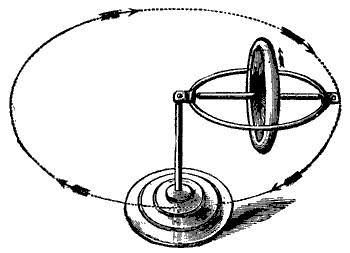
Spin a top on your kitchen table and watch it wobble, lean, and yet stubbornly refuse to fall over. It seems to defy gravity, hovering on a single point as if held by an invisible hand. But the top is no magician it’s a master of obeying physics in a way that looks like magic.
This simple toy holds the key to understanding angular momentum, torque, and precession principles that keep your smartphone’s orientation sensor accurate, stabilize drones in flight, and even explain why Earth’s axis slowly wobbles over 26,000 years. Let’s spin into the hidden physics of this everyday marvel.
The Great Escape: How a Top Evades Gravity
When you set a top spinning, gravity pulls down on its center of mass. If the top weren’t spinning, that pull would create a torque (a twisting force) about the tip, and the top would topple over. But when it’s spinning, something remarkable happens: the torque doesn’t knock the top down it makes the top’s axis rotate in a slow circle around the vertical. This motion is called precession.
Think of it like this: you’re pushing a heavy door. If you push at the edge, it swings open smoothly. But if you push at the hinges, it doesn’t open it just stays put. With a spinning top, gravity’s push is redirected. Instead of pushing the top “down,” the torque pushes the top’s axis “sideways” and because the top is spinning, that sideways push causes the axis to rotate around in a cone. This is precession, and it’s why the top seems to defy gravity: it’s not fighting gravity; it’s just taking a different path.
The Secret Ingredient: Angular Momentum
To understand why a spinning top behaves this way, we need to talk about angular momentum. This is a measure of how much rotation an object has like momentum for spinning. It depends on two things: how fast the object spins (angular velocity, ω) and how the mass is distributed relative to the spin axis (moment of inertia, I). The equation is simple: L = Iω.
The spin axis of a top points upward, so its angular momentum points upward too. Here’s the key: when a torque is applied to a spinning object, it changes the direction of the angular momentum, not its magnitude. Gravity’s torque is horizontal (perpendicular to the spin axis), so it doesn’t slow the spin down it just nudges the direction of the angular momentum vector sideways. That sideways nudge, combined with the spin, produces precession.
It’s like riding a bike: when you’re moving forward, a gentle push on the handlebars doesn’t knock you over; it just turns you. Similarly, gravity’s push on the top’s axis turns it, rather than toppling it.
The Numbers: How Fast Does a Top Spin?
A typical toy top, with a radius of about 2 cm and a mass of 50 grams, spins at 500–3,000 revolutions per minute (rpm) when launched by hand or with a string. That’s roughly 50–300 radians per second in physics units. The precession, in contrast, is much slower typically 1–10 radians per second. This huge difference in speed is why the precession looks like a smooth, lazy wobble.
The top can keep spinning upright for seconds to minutes, depending on tip friction and air drag. But there’s a critical threshold: when the spin rate drops below about 10–30 rad/s (roughly 100–300 rpm), the top can no longer maintain its balance. At that point, gravity’s torque wins, and the top topples over.
The Wobble: Nutation and Sleep
If you watch a top closely, you’ll notice it doesn’t precess perfectly smoothly—it also has a smaller, faster wobble superimposed on the precession. This secondary wobble is called nutation. It’s caused by the initial conditions (like how you launch the top) or by tiny disturbances, like air currents or imperfections in the tip. Nutation usually damps out quickly due to friction, leaving just the smooth precession.
Sometimes, a top will “sleep”—it spins upright with almost no visible precession. This happens when the top’s spin is high enough that the torque from gravity is relatively small compared to the angular momentum. As the spin slows, precession becomes more pronounced, and eventually the top falls.
A Brief History of Top Physics
The spinning top has fascinated scientists for centuries. In the 1750s, Leonhard Euler formulated the equations of rigid-body motion, which describe how a spinning object responds to forces and torques. In the early 1800s, Jean-Baptiste Biot and Félix Savart studied gyroscopic effects, and in the 1860s, Lord Kelvin and Peter Guthrie Tait wrote the first comprehensive treatise on spinning tops and gyroscopes. In 1897, Felix Klein and Arnold Sommerfeld published The Theory of the Top, a rigorous mathematical treatment. Even in the 20th century, tops were used to illustrate stability theory and chaos—the same math that describes planetary orbits and electron spin.
Beyond the Toy: Everyday Gyroscopes
The spinning top isn’t just a toy—it’s a fundamental demonstration of physics that engineers use every day. Inside your smartphone, a tiny gyroscope (essentially a miniature spinning top) helps detect orientation and rotation. Drones use gyroscopes to stay stable in the air. Aircraft and spacecraft rely on gyrocompasses and inertial navigation systems. Even a bicycle wheel is a gyroscope: when you’re riding, the spinning wheels resist tipping, which is why it’s easier to balance at speed than when you’re stopped.
And on a cosmic scale, Earth itself is a spinning top. The gravitational pull from the Sun and Moon creates a torque on Earth’s equatorial bulge, causing its axis to precess slowly over about 26,000 years. This is called the precession of the equinoxes, and it’s the same physics as your toy top, just on a much grander timescale.
So the next time you spin a top, you’re not watching a defiance of gravity—you’re watching a perfect demonstration of angular momentum and torque in action. The top’s graceful dance is a reminder that even the simplest objects can hold profound physics, and that the same principles govern everything from a child’s toy to the rotation of our planet.
Summary
- A spinning top doesn’t defy gravity; it obeys it by redirecting gravity’s torque into precession.
- Angular momentum (L = Iω) points along the spin axis; gravity’s torque changes its direction, not its magnitude.
- Precession is the slow circular motion of the spin axis, while nutation is a smaller wobble that damps out.
- Critical spin rate: a typical top falls when spin drops below ~10–30 rad/s (100–300 rpm).
- The same physics powers gyroscopes in smartphones, drones, and explains Earth’s 26,000-year axis precession.
FAQ
Q: Does a spinning top really defy gravity?
A: No, it obeys gravity completely. The top’s angular momentum causes gravity’s torque to be redirected into a circular motion of the spin axis (precession), rather than a topple, as long as it spins fast enough.
Q: Why does a top fall over when it slows down?
A: When the spin rate drops below a critical threshold, the torque from gravity becomes larger than the stabilizing effect of angular momentum, and the top can no longer precess fast enough to maintain balance.
Q: What is precession?
A: Precession is the slow rotation of the spin axis around the vertical, caused by a torque that is perpendicular to the angular momentum. It’s like the top “leaning” into a circular path instead of falling.
Q: What is nutation?
A: Nutation is a smaller, faster wobble superimposed on precession, caused by initial conditions or disturbances. It usually damps out due to friction, leaving smooth precession.
Q: How is a spinning top relevant to real-world technology?
A: The same physics is used in gyroscopes in smartphones, drones, aircraft, and spacecraft for orientation and stabilization. Even Earth’s axis precesses due to gravitational torques from the Sun and Moon.