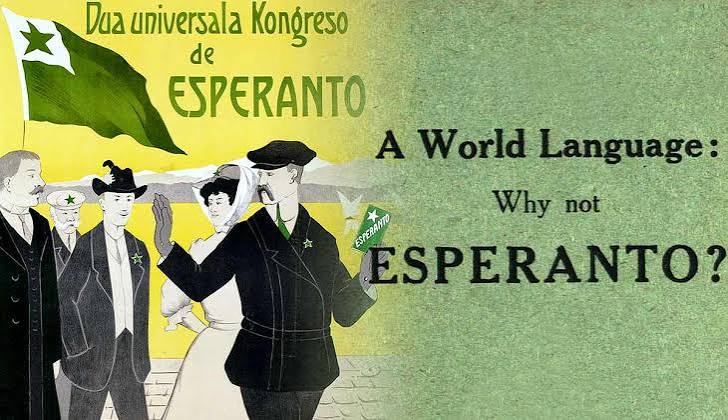
In 1887, a Polish eye doctor published a book under the pseudonym “Doctor Hoping.” Inside was a fully formed language, designed to be so regular and easy that anyone could learn it in a fraction of the time needed for English or French. Its creator believed that a neutral, second language for everyone could ease the ethnic tensions tearing apart his hometown.
That language was Esperanto, and for a few decades in the early 20th century, it came astonishingly close to becoming the world’s international tongue. It won support from the League of Nations, gained millions of speakers, and built a vibrant culture. Then it faded from the global stage — but it never disappeared. Today, Esperanto thrives online and in living rooms across the world, a testament to an idea that refuses to die.
The Man Behind the Language
Ludwik Lejzer Zamenhof grew up in Białystok, a city in the Russian Empire where Poles, Russians, Germans, and Jews lived in suspicion and sometimes violence. He saw how language divided people — each group spoke its own tongue, and that difference became a weapon. As a teenager, he began to sketch a solution: a language that belonged to no single nation, so no one would have an advantage.
By 1887, Zamenhof had refined his creation and published Unua Libro (“First Book”) in Warsaw. He signed it “Doktoro Esperanto,” which means “one who hopes.” The name stuck, and soon the language itself was called Esperanto. The book wasn’t just a grammar guide — it was a manifesto, offering a way for people to communicate as equals.
The Language’s Clever Design
Esperanto’s grammar is famously regular. It has just 16 rules, with no exceptions. Every noun ends in -o, every adjective in -a, and every infinitive verb in -i. Past tense always ends in -is, future in -os. There are no irregular verbs. Spelling is phonetic — each letter has exactly one sound, and every word is pronounced as it’s spelled.
The vocabulary draws mostly from Romance languages (about 75%), with Germanic and Slavic influences. But what makes Esperanto ingenious is its word-building system. You can create new words by adding prefixes and suffixes. For example, the prefix mal- reverses meaning: bona means “good,” so malbona means “bad.” The suffix -ino marks female: patro is “father,” so patrino is “mother.” This agglutinative structure means you need to memorize far fewer roots — a smaller mental dictionary gets you much further.
Studies suggest that learning Esperanto takes roughly a quarter to a tenth of the time needed for natural languages. This “propadeutic value” means that learning Esperanto first can actually ease the later acquisition of other languages.
The Golden Age: Esperanto at the League of Nations
The first World Esperanto Congress took place in 1905 in Boulogne-sur-Mer, France. It drew 688 attendees from 20 countries — a surprising turnout for a language that barely existed 18 years earlier. The movement grew quickly. By 1908, Esperanto speakers had founded the Universal Esperanto Association (UEA), which still coordinates the global community today.
The 1920s marked Esperanto’s peak of political influence. After World War I, the newly formed League of Nations was searching for ways to foster international cooperation. Esperanto seemed like an ideal candidate for a working language — neutral, easy to learn, and already spoken by thousands across Europe and beyond. Delegates from several countries proposed adopting it.
But France blocked the measure. French diplomats feared that any international language would undermine French cultural dominance. They lobbied hard, and the proposal was defeated. It was a turning point — Esperanto never again came so close to official global recognition.
Survival and Decline
Despite the League of Nations setback, Esperanto continued to spread. The World Congresses resumed after both World Wars, and in 1954, UNESCO formally recognized Esperanto, recommending that member states promote its use. But the rise of English as the world’s lingua franca after 1945 undercut Esperanto’s raison d’être. Why learn a constructed language when English already opens doors to business, science, and pop culture?
Esperanto didn’t die, but it became a niche. Its community grew slowly, sustained by true believers. They built something remarkable: a living culture. Esperanto has its own original literature — poetry, novels, and music written directly in the language, not translated. The Pasporta Servo network lets Esperanto speakers stay for free in other speakers’ homes across the globe, a practical demonstration of the language’s community-building power.
The Revival: Esperanto in the Digital Age
The internet changed everything for minority languages, and Esperanto was no exception. In 2015, Duolingo launched an Esperanto course. Within months, over a million users had enrolled. Today, several million people have studied Esperanto on the platform.
Esperanto’s Wikipedia now boasts over 300,000 articles, placing it in the top 40 of all Wikipedias — ahead of languages spoken by millions more people. On social media, Esperanto groups thrive, and online courses have made learning the language easier than ever.
Estimates of current speakers range widely, from 100,000 to 2 million. That’s a wide spread, but even the low end represents a remarkable survival for a language with no country and no army. About 1,000 to 2,000 people speak Esperanto as their first language, born into families where the language is used at home.
The Debate Within the Movement
Esperanto speakers themselves disagree about the language’s purpose. The older “finvenkist” view sees Esperanto as a means to an end — eventually replacing national languages for international communication, achieving what they call “final victory.” The more recent “raŭmist” perspective, named after a 1980 manifesto from Rauma, Finland, values Esperanto as a cultural community in its own right, not a tool for global change.
This internal tension is healthy. It keeps the movement dynamic. But it also reflects a deeper question: If Esperanto never becomes the world’s second language, was it a failure? Not to the thousands who gather each year at the World Esperanto Congress, where attendees from 60 or more countries converse easily in a language that most of them learned as adults. For them, Esperanto isn’t a utopian dream — it’s a working reality.
Why Esperanto Matters Now
In an age of resurgent nationalism and English as a global juggernaut, Esperanto’s story feels both nostalgic and relevant. It reminds us that language isn’t just a tool for communication — it’s also a vehicle for identity and power. Zamenhof’s invention was a bold attempt to sidestep that power dynamic entirely.
Esperanto didn’t unite the world. But it did create a small, vibrant, borderless community that has lasted over 135 years. That’s no small feat for a language born from a doctor’s hope.
Esperanto’s rise and fall — and its quiet persistence — offer a fascinating case study in idealism. It nearly became the language of the League of Nations. It lost that battle to French ego and English momentum. Yet it survives, and in the internet age, it’s finding new life. Esperanto may never unite humanity, but it proves that ordinary people can build bridges across linguistic divides, one carefully constructed word at a time.
Summary
- Esperanto was created by L. L. Zamenhof in 1887 as a neutral, easy-to-learn second language to reduce ethnic conflict.
- Its grammar is extremely regular (16 rules, no exceptions), and vocabulary draws mostly from Romance languages.
- In the 1920s, Esperanto nearly became the League of Nations’ working language, but France vetoed the proposal.
- Despite losing political momentum to English, Esperanto survived, with a rich culture and up to 2 million speakers today.
- The internet and Duolingo have sparked a revival, with Esperanto Wikipedia ranking in the top 40 by article count.
FAQ
Q: Is Esperanto a real language?
A: Yes. Esperanto has a complete grammar, a large vocabulary, and a community of speakers who use it for everyday communication. It has its own literature, music, and even native speakers.
Q: How many people speak Esperanto?
A: Estimates range from 100,000 to 2 million speakers worldwide. The wide range is because no official census exists. About 1,000–2,000 people speak it as their first language.
Q: Why did Esperanto fail to become the global language?
A: The main setbacks were the rise of English as a global lingua franca after WWII and the lack of political support. France’s veto of Esperanto in the League of Nations in the 1920s also undermined its official recognition.
Q: Is Esperanto easy to learn?
A: Yes, especially for speakers of European languages. Its grammar is completely regular, with no exceptions, and its word-building system reduces the number of roots you need to memorize. Studies suggest it takes a fraction of the time needed for natural languages.
Q: Can I learn Esperanto for free?
A: Absolutely. Duolingo offers a free Esperanto course, and many other free resources are available online, including the Lernu! website and Esperanto Wikipedia.