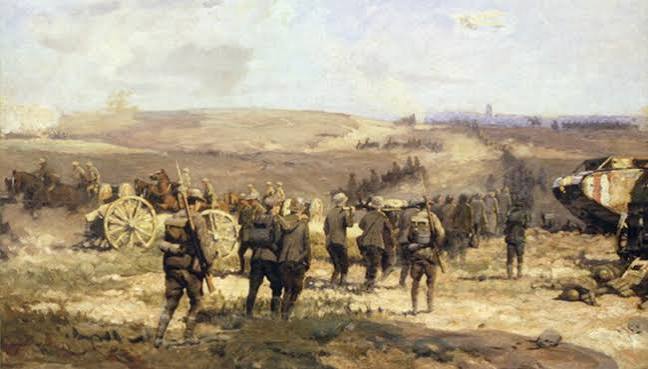
At 4:20 AM on August 8, 1918, a sudden barrage of over 2,000 artillery pieces erupted along a 12-mile front east of Amiens, France. Under the cover of fog and the roar of guns, hundreds of tanks and 120,000 Allied troops surged forward. By nightfall, they had advanced up to 8 miles, captured 12,000 prisoners, and shattered the German front line. It was the largest single-day territorial gain on the Western Front since 1914, and it triggered a crisis in the German high command. General Erich Ludendorff would later call it ‘the black day of the German Army.’ This was the beginning of the end for Germany.
Amiens was not just another battle; it was a masterclass in modern combined-arms warfare. The Allies had finally figured out how to coordinate infantry, tanks, artillery, and aircraft into a cohesive fighting machine. For the Germans, it was a devastating blow that exposed their exhaustion and signaled that the war was lost. The battle set the stage for the Hundred Days Offensive, which would end with the Armistice on November 11, 1918.
The Strategic Gamble: Why Amiens Mattered
By mid-1918, the German Spring Offensives had gained ground but at a terrible cost. After Russia’s collapse, Germany had thrown everything into a series of massive attacks to win before American troops arrived in strength. But by July, the offensives had stalled. The German army was exhausted, understrength, and demoralized. The Allies saw their chance.
The front near Amiens was a salient—a bulge created by the German advances. Amiens itself was a vital railway hub for the Allies, and the surrounding high ground was key to any future advance. If the Allies could retake it, they would not only secure the city but also open a gateway to the open country beyond.
Field Marshal Sir Douglas Haig and General Sir Henry Rawlinson conceived a bold plan: a surprise attack without the customary days-long artillery bombardment. Instead, they would use a short, intense ‘hurricane’ barrage just before zero hour. Secrecy was paramount. Troops moved at night, radio silence was enforced, and the Canadians were brought in under strict security, with leave cancelled and mail censored. Even dummy tanks were deployed to mislead German intelligence.
The Plan: A Textbook in Combined Arms
The plan was a radical departure from the slogging matches of previous years. The British Fourth Army, including the elite Australian and Canadian Corps, would lead the assault, with the French First Army on the southern flank. The Australians were commanded by Lieutenant General Sir John Monash, and the Canadians by Lieutenant General Sir Arthur Currie—two of the most innovative commanders of the war. Together, they orchestrated a coordinated attack that integrated every arm of the military.
At 4:20 AM on August 8, the artillery opened fire. Over 2,000 guns laid down a creeping barrage that moved forward in precise increments, protecting the infantry as they advanced. Behind them came 430 British Mark V and Whippet tanks—the largest tank deployment of the war to that point. The tanks crushed barbed wire, silenced machine-gun nests, and provided mobile firepower. Above, about 1,000 Allied aircraft dominated the skies, outnumbering the Germans nearly three to one. They strafed ground targets and gathered intelligence.
This was combined-arms warfare at its finest. The infantry, tanks, artillery, and airpower worked in synchronized waves, each supporting the others. The Germans, with only about 30,000–40,000 front-line defenders, were overwhelmed. They had expected a long bombardment, not this sudden, coordinated onslaught.
The Black Day of the German Army
The first day was a disaster for the Germans. They lost 12,000 prisoners and 450 guns. The front line was pushed back 8–12 miles, the deepest advance in a single day since 1914. German divisions were shattered, and reserves were too far back to respond. Ludendorff, the de facto German commander, was stunned. He later wrote, ‘August 8th was the black day of the German Army in the history of this war.’
But the battle was not without cost. The Allies suffered about 22,000 casualties over the five days of the main offensive, including 13,000 British and 9,000 French. The Germans lost about 30,000, including the prisoners. The fighting continued sporadically until August 17, but the damage was done. The German army’s morale was broken. As one German officer wrote, ‘The men were no longer what they had been; they had lost their confidence in their leaders.’
The victory at Amiens marked the start of the Hundred Days Offensive, a relentless series of Allied attacks that would push the Germans back to the Hindenburg Line and eventually force the Armistice. For the Germans, there was no recovery. The battle proved that the Allies had mastered modern warfare, and the German army could not counter it.
The Aftermath: A Turning Point in History
The Battle of Amiens was a decisive victory for the Allies, but its significance goes beyond the battlefield. It demonstrated that the stalemate of trench warfare had been broken. The coordination of tanks, infantry, artillery, and aircraft was a model for future military operations. Monash and Currie became national heroes in Australia and Canada, where the battle is still celebrated as a key moment in their nations’ histories.
For Germany, Amiens was a psychological blow from which it never recovered. The army’s exhaustion and the arrival of American troops signaled that the war was unwinnable. Ludendorff resigned in October, and the German government began seeking an armistice. When the guns finally fell silent on November 11, 1918, it was the end of a war that had claimed millions of lives. Amiens was the beginning of that end.
The Battle of Amiens was more than a military victory; it was a turning point that changed the course of the First World War. By mastering combined-arms tactics, the Allies broke the deadlock and set the stage for the final offensive. For Germany, it was the moment when defeat became inevitable. August 8, 1918, was indeed the black day of the German Army—and the beginning of the end.
Summary
- The Battle of Amiens (August 8–12, 1918) was a decisive Allied victory, with the largest single-day territorial gain on the Western Front since 1914.
- Allied forces used a surprise attack without a long bombardment, coordinating infantry, tanks, artillery, and aircraft for the first time effectively.
- German casualties were about 30,000, including 12,000 prisoners on the first day, leading Ludendorff to call it ‘the black day of the German Army.’
- The battle launched the Hundred Days Offensive, which ended with the Armistice on November 11, 1918.
- Commanders Monash (Australia) and Currie (Canada) became national heroes, and the battle is seen as a model of modern combined-arms warfare.
FAQ
Q: What was the significance of the Battle of Amiens?
A: It was the start of the Allied Hundred Days Offensive, broke the German army’s morale, and demonstrated the effectiveness of combined-arms tactics, leading to the Armistice in November 1918.
Q: How many tanks were used at Amiens?
A: About 430 British Mark V and Whippet tanks, the largest tank deployment of the war up to that point.
Q: Who commanded the Allied forces at Amiens?
A: Field Marshal Sir Douglas Haig oversaw the offensive, with General Rawlinson commanding the British Fourth Army, and Lieutenant Generals Monash and Currie leading the Australian and Canadian Corps, respectively.
Q: Why did Ludendorff call August 8, 1918, ‘the black day of the German Army’?
A: Because the German front line collapsed under a surprise attack, resulting in massive losses and a blow to morale from which the German army never recovered.
Q: How long did the main battle last?
A: The major offensive phase lasted from August 8 to August 12, with fighting continuing sporadically until August 17.