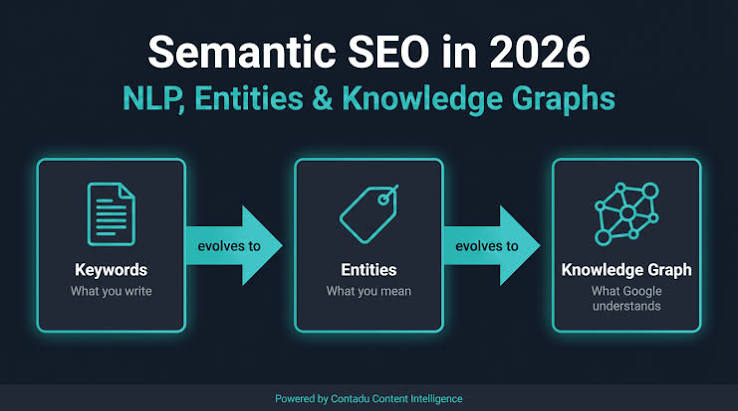
In 2013, Google quietly changed how it ranked websites. Instead of just matching the exact words you typed, it started trying to understand what you meant. That shift from keywords to meaning has only accelerated. Today, with AI-generated answers appearing at the top of search results, your content isn’t just read by people; it’s parsed by machines. Semantic SEO and entity optimization are the practices that make your content clear to these AI systems, and they’re no longer optional.
Think of it like this: a few years ago, search engines were like librarians scanning for specific book titles. Now, they’re like research assistants who read every book, summarize the key points, and explain how each one relates to the others. If your content doesn’t clearly state who you are, what you’re about, and how you connect to the wider world, that assistant will ignore you or, worse, attribute your ideas to someone else.
The Evolution from Keywords to Meaning
The old way of SEO was simple: use the exact keyword phrase on your page as many times as possible, and you’d rank. Google’s early algorithm was basically a word counter. But that approach led to spammy, low-quality content that didn’t actually answer people’s questions. So, Google started making updates:
- 2013: Hummingbird – Focused on conversational search and query intent, not just matching words.
- 2015: RankBrain – Used machine learning to understand never-before-seen queries by mapping them to known concepts.
- 2019: BERT – A huge leap. Google could now understand the context of each word in a sentence. For example, the word “bank” is different in “river bank” vs. “savings bank.” BERT gets that.
- 2021-2023: MUM and LaMDA – Expanded to understand images, videos, and conversational context.
- 2024-2025: AI Overviews – Google now generates AI-written summaries at the top of results. These summaries pull from content that is structured and entity-rich.
Each of these updates was a step toward one goal: understanding meaning, not just text. Semantic SEO is the practice of making that understanding easy for search engines.
What Is Semantic SEO?
Semantic SEO is an approach to search engine optimization that focuses on the meaning and intent behind search queries. Instead of optimizing for a single keyword phrase, you optimize for a whole topic. This involves:
- Topical Authority: Creating content that covers a subject in depth, using related terms, synonyms, and subtopics. For example, if you’re writing about “electric cars,” you might also cover “battery technology,” “charging stations,” and “environmental impact.” This builds a “topic cluster” that signals to Google you’re an expert.
- Entity-Based Optimization: Structuring your content around named entities—people, places, things, concepts—and their relationships. Instead of just writing “the CEO,” you’d write “Tim Cook, CEO of Apple.”
- Structured Data: Using schema markup to explicitly tell search engines what entities are present and how they relate. This is like giving the search engine a map of your content.
Why It Matters Now
Semantic SEO is considered “table stakes” for advanced SEO professionals. It’s not a niche tactic; it’s the baseline. With AI Overviews, the “position zero” is no longer a link but a synthesized answer. To be the source behind that answer, your content must be understandable to AI. If it’s ambiguous or unstructured, the AI will either ignore it or attribute your facts to a different entity.
What Is Entity Optimization?
An entity is a distinct thing: a person, brand, product, place, or concept. Entity optimization is the practice of making your entity easily identifiable, understandable, and authoritative to search engines and AI systems. It’s about creating a consistent, unambiguous digital footprint.
Key Components
- Knowledge Graph Presence: Google’s Knowledge Graph is a database of over 500 million entities and 35 billion facts. It powers the information panel on the right side of search results. If your entity isn’t in there, you’re invisible to AI-driven search features. Getting listed requires consistent, structured data across the web.
- Entity Resolution: Ensuring that mentions of your brand or name are correctly attributed to you, not confused with homonyms or competitors. For example, if you’re “Apple” the tech company, you don’t want to be confused with “Apple” the fruit or a local orchard.
- Relationship Mapping: Clearly defining how your entity relates to others. For example, “Apple” → “Tim Cook” → “iPhone” → “Cupertino.” This helps search engines build a coherent picture.
- Consistent NAP (Name, Address, Phone): For local businesses, ensuring your name, address, and phone number are identical across all platforms. This is a fundamental entity signal.
The Role of the Knowledge Graph
Launched in 2012, the Knowledge Graph is built from sources like Wikipedia, Wikidata, and structured data from websites. If you want to be recognized as an entity, you need to be in these sources. But even if you’re not a global brand, you can still optimize for your local entity: make sure your business listings are consistent, use schema markup on your website, and get mentioned on reputable sites.
How AI Understands Content
Modern search engines and LLMs (large language models like ChatGPT) don’t read your content like a human. They parse it into triples: subject-predicate-object. For example, “Barack Obama – was born in – Honolulu.” This is how they build their understanding of the world.
Semantic SEO is about making this parsing easy. If your content is ambiguous—for example, you use “it” without a clear antecedent—the AI might miss the point. If you have multiple entities with the same name, the AI might confuse them.
Practical Example
Let’s say you run a coffee shop called “The Daily Grind” in Austin, Texas. Without entity optimization, an AI might see your content and think you’re a coffee grinder manufacturer or a music band with the same name. To fix this:
- Use consistent NAP (Name, Address, Phone) on your website, Google Business Profile, Yelp, and anywhere else.
- Add LocalBusiness schema markup to your website, specifying your name, address, phone, hours, and menu.
- Get mentioned on local news sites and blogs with a link to your website.
- Make sure your social media profiles are consistent and link to each other.
This tells the AI: “This is a specific coffee shop in Austin, owned by this person, and it serves espresso and pastries.”
The Rise of Generative Engine Optimization (GEO)
With the rise of LLMs like ChatGPT and Gemini, a new field has emerged: Generative Engine Optimization (GEO). This is about being cited by AI tools when they answer questions. For example, if someone asks ChatGPT “What’s the best coffee shop in Austin?” and you want to be mentioned, your content needs to be structured, entity-rich, and authoritative.
GEO is related to but distinct from semantic SEO. It focuses on being present in the training data and having clear, quotable content. But the same principles apply: make your entities clear, use structured data, and build topical authority.
Practical Steps to Get Started
- Map Your Entities: List the key entities in your content: your brand, your products, your people, your locations. How do they relate? Use this to structure your content.
- Implement Schema Markup: Use Schema.org vocabulary to mark up your content. For example, use Person schema for your team, Product schema for your products, and Organization schema for your brand.
- Build Topic Clusters: Instead of writing standalone blog posts, create a pillar page that covers a topic broadly and then link to subtopic pages. This signals depth.
- Be Consistent: Use the same name, logo, and information everywhere. This helps with entity resolution.
- Get Cited: Appear on reputable websites, especially those that are themselves well-recognized entities. This boosts your authority.
- Monitor Your Knowledge Panel: Search for your brand name and see if a Knowledge Panel appears. If not, work on the steps above to get one.
Measuring Success
One challenge with semantic SEO is measuring success. Keyword rankings are clear, but topical authority is fuzzy. Instead of tracking a single keyword, track:
- Visibility across a topic cluster: Are you ranking for multiple related terms?
- Impressions for AI Overviews: Are you appearing in AI-generated summaries?
- Knowledge Panel presence: Do you have one?
- Referral traffic from AI tools: Are people clicking through from ChatGPT or Perplexity?
These metrics give a clearer picture of whether AI understands and trusts your content.
The days of gaming search algorithms with keyword stuffing are long gone. Semantic SEO and entity optimization are about building a digital footprint that is clear, consistent, and authoritative. It’s not about tricking AI; it’s about making your content genuinely understandable. The reward is not just higher rankings, but being the answer when someone asks a question—whether they ask Google, ChatGPT, or a voice assistant. Start by mapping your entities and cleaning up your structured data. The AI research assistants are already reading; make sure they get you right.
Summary
- Semantic SEO focuses on meaning and intent, not just keywords. It involves building topical authority and using structured data.
- Entity optimization makes your brand, person, or product identifiable to search engines and AI, often through Knowledge Graph presence and consistent NAP.
- Google’s evolution from keyword matching to BERT and AI Overviews has made semantic SEO essential.
- AI parses content into triples (subject-predicate-object), so clear, unambiguous content is critical.
- Generative Engine Optimization (GEO) is the next step, focusing on being cited by AI tools like ChatGPT.
FAQ
Q: What’s the difference between semantic SEO and traditional SEO?
A: Traditional SEO focused on matching exact keywords. Semantic SEO focuses on understanding user intent and covering a topic comprehensively, using related terms, synonyms, and entities.
Q: How does entity optimization help a small local business?
A: It ensures your business is correctly identified online. Consistent NAP, schema markup, and local citations help Google understand you’re a real, specific place, which is crucial for local search and AI-generated local recommendations.
Q: Do I need to use schema markup on every page?
A: Not every page, but on key pages like your homepage, product pages, and about page. Schema markup tells search engines exactly what your content is about, making it easier for them to understand and feature your content.
Q: How does Google’s Knowledge Graph affect my SEO?
A: If you’re in the Knowledge Graph, you’re more likely to appear in AI Overviews and knowledge panels. Getting there requires consistent, structured data and citations from authoritative sources.
Q: What is Generative Engine Optimization (GEO)?
A: GEO is the practice of optimizing your content to be cited by AI tools like ChatGPT and Perplexity. It involves creating clear, factual, and well-structured content that AI models can easily reference.