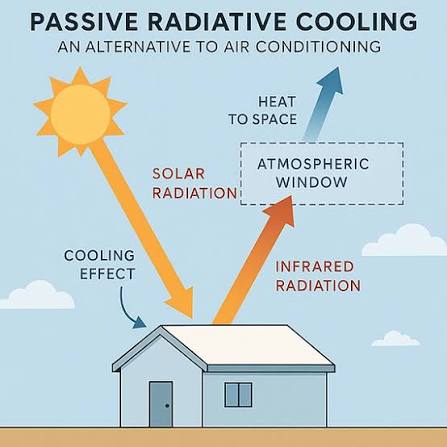
Imagine a roof that cools your house on a sunny day without using a single watt of electricity. That’s the promise of passive radiative cooling (PRC), a technology that beams heat from buildings straight into outer space. Researchers have developed paints, films, and even wood-based materials that stay several degrees cooler than the air around them, even under direct sunlight. This isn’t science fiction; it’s physics, and it’s already being tested on rooftops and data centers.
Here’s why that matters: buildings guzzle about 30–40% of the world’s energy, and a big chunk goes to air conditioning. As the planet warms, AC demand is projected to triple by 2050, putting massive strain on power grids and accelerating climate change. Passive radiative cooling offers a way to slash that energy use no refrigerants, no moving parts, just smart materials that exploit a loophole in Earth’s atmosphere.
The Physics: A Loophole in the Sky
Every object radiates heat as infrared light. You feel this when you stand near a warm wall. Normally, the atmosphere absorbs much of that infrared, trapping heat near the ground the greenhouse effect. But there’s a narrow band of wavelengths, from 8 to 13 micrometers, where the atmosphere is almost transparent. This is called the “atmospheric window.” Through it, thermal radiation can escape directly into outer space, which is a frigid 3 degrees above absolute zero.
Passive radiative cooling materials are engineered to be super-emitters in that window. They radiate heat intensely at those wavelengths, while also reflecting sunlight so they don’t warm up during the day. The result is a net heat loss: the material gets colder than the surrounding air, sometimes by 5 to 10 degrees Celsius. No electricity, no refrigerant, no noise just a surface that chills itself.
From Night-Sky Cooling to a Daytime Breakthrough
Humans have used night-sky cooling for centuries—think of desert cultures that made ice in shallow pools overnight. But daytime cooling was a pipe dream until recently because any material that emitted heat also absorbed sunlight, heating up and negating the effect.
The breakthrough came in 2014 when Stanford researchers built a multi-layer photonic material that reflected almost all sunlight while emitting strongly in the atmospheric window. Under direct sun, it stayed 4.9°C cooler than the ambient air. That was a proof of concept, but the material was expensive and fragile.
Three years later, a team at the University of Colorado Boulder created a cheaper, flexible polymer film called Radi-Cool. It had tiny pores that scattered sunlight and allowed infrared to escape, achieving 6°C below ambient. Then in 2021, Purdue University unveiled a paint made with barium sulfate nanoparticles—the same compound used in white paint and X-ray contrast—that hit 98.1% solar reflectance and 0.95 thermal emissivity. It kept surfaces about 4.5°C cooler than ambient in direct sunlight and 10°C cooler at night. This paint is cheap, easy to apply, and looks like regular white paint.
The Material Zoo: Paints, Films, and Wood
Researchers have developed a surprising variety of PRC materials, each with its own trade-offs:
- Photonic multilayers: Thin stacks of materials like polymer and silver, engineered to reflect specific wavelengths. They’re precise but costly and not ideal for large roofs.
- Polymer films: Porous PDMS or PVDF films that scatter sunlight like fog and emit infrared. They’re flexible, lightweight, and can be applied like a membrane.
- Barium sulfate paint: The current champion for cost and performance. It’s a standard paint formulation with BaSO₄ particles of varying sizes, which scatter sunlight broadly. It’s durable and can be brushed or rolled onto roofs.
- Cellulose and wood: By removing lignin from wood, it becomes white and porous, emitting heat efficiently. Delignified wood is renewable and could be used in construction.
- Biomimetic surfaces: Inspired by Saharan silver ants and white beetles, which have microscopic hairs or scales that reflect sunlight and emit heat. These structures are being mimicked in labs.
Each material has different durability, cost, and installation requirements. The paint is the most practical for retrofitting existing buildings, while films and panels might work better for new construction or specialized uses like data centers.
Real-World Performance: Not a Miracle, But Real
Lab tests are impressive, but real-world conditions are messier. PRC works best under clear, dry skies. Humidity and clouds block the atmospheric window, cutting cooling power significantly. Dust and dirt can reduce solar reflectance over time. And the cooling power itself—typically 20 to 100 watts per square meter—is modest compared to an air conditioner that removes several kilowatts. So PRC won’t replace AC in a hot, humid office with lots of internal heat. Instead, it’s a supplement that reduces the load on AC, potentially cutting energy use by 20% or more.
That’s not a failure; it’s a realistic expectation. The technology is most valuable in hot, arid climates like the Southwest U.S., the Middle East, and parts of Africa and India, where skies are clear and AC demand peaks. Even in mixed climates, PRC can help at night, pre-cooling a building so AC runs less during the day.
Several startups are already piloting PRC products. SkyCool Systems makes panels that cool water in pipes, which can be used in commercial HVAC loops. Radi-Cool has films for roofs and awnings. These systems are being tested on data centers, supermarkets, and even bus shelters. Costs are still higher than conventional white paint, but prices are falling as production scales.
The Challenges Ahead: Durability, Cost, and Standards
For PRC to go mainstream, it must survive years of weather, UV radiation, and physical wear. Paints need to resist chalking and yellowing. Films need to stay bonded. And the nanomaterials in some formulations raise questions about environmental and health impacts—lifecycle studies are scarce.
Cost is another barrier. A high-performance PRC paint might cost two to three times more than standard white paint. For a homeowner, the payback from lower AC bills might take several years, which is a hard sell. But for commercial buildings with large cooling loads, the math can work.
There’s also a regulatory gap. Building codes and energy standards like ASHRAE and IECC don’t have clear provisions for PRC. There’s no standardized test to measure cooling power or reflectivity, which makes it hard for consumers to compare products. Industry groups are working on voluntary standards, but adoption is slow.
Beyond Buildings: Urban Heat Islands and Food Storage
PRC isn’t just for roofs. It can be applied to walls, windows, and even pavements to reduce the urban heat island effect, where cities are several degrees hotter than surrounding areas. A cooler roof also means less heat radiating into the air, which can make streets and sidewalks more comfortable.
Another promising use is cold-chain storage. In developing countries, lack of refrigeration causes massive food spoilage. Simple PRC boxes could keep vaccines or produce cool without electricity, which could be life-saving in off-grid areas. The materials are passive, so they work anywhere with a clear sky.
The Bottom Line: A Tool, Not a Silver Bullet
Passive radiative cooling is a genuine breakthrough, but it’s not a substitute for air conditioning. It’s a way to reduce cooling loads, especially in sunny, dry regions. As costs drop and standards develop, PRC paints and films could become as common as insulation. The physics is sound, the materials exist, and the potential energy savings are huge—it’s now a matter of engineering, economics, and adoption.
For a homeowner, a PRC roof might be a smart investment if you live in a hot, dry climate and have a large roof area. For a city planner, it’s a tool to fight heat islands. For a policy maker, it’s a reason to update building codes. The technology won’t save the planet alone, but it’s a valuable piece of the puzzle.
Passive radiative cooling is a prime example of how clever materials can turn a basic physics principle into a practical solution. The path forward is clear: focus on durability, cost, and standardization. If those hurdles are cleared, PRC could become a standard feature of energy-efficient buildings, quietly beaming their heat into the void of space while keeping us comfortable on Earth.
Summary
- What it is: Materials that cool by radiating heat into space through the atmospheric window (8–13 µm) while reflecting sunlight, requiring no power.
- Performance: Lab and field tests show 4–10°C below ambient under direct sun, with cooling power of 20–100 W/m².
- Materials: Paints (BaSO₄), polymer films, photonic multilayers, and wood-based options, each with trade-offs in cost and durability.
- Limitations: Effectiveness drops in humid or cloudy conditions; cannot replace AC but can reduce its load.
- Status: Startups are piloting products, but costs, durability, and lack of standards are barriers to widespread adoption.
FAQ
Q: Can passive radiative cooling replace air conditioning?
A: No, not in most cases. PRC provides modest cooling (20–100 W/m²) compared to AC’s several kilowatts. It’s best used to reduce AC load, not eliminate it, especially in hot, dry climates.
Q: Does it work at night?
A: Yes, even better than during the day, because there’s no sunlight to reflect. Many materials cool to 10°C below ambient at night, which can pre-cool buildings.
Q: What makes it different from regular white paint?
A: Regular white paint reflects visible light but absorbs infrared, so it warms up. PRC paint like BaSO₄ also reflects near-infrared and emits strongly in the atmospheric window, achieving a net cooling effect.
Q: Is it expensive?
A: Currently, PRC materials cost more than conventional paints, but prices are falling. For large commercial buildings with high cooling loads, the energy savings can justify the cost.
Q: How long does it last?
A: Durability varies by material. Paints are tested for weathering and UV resistance, but long-term outdoor performance is still being studied. Most products aim for a lifespan of 10–20 years.