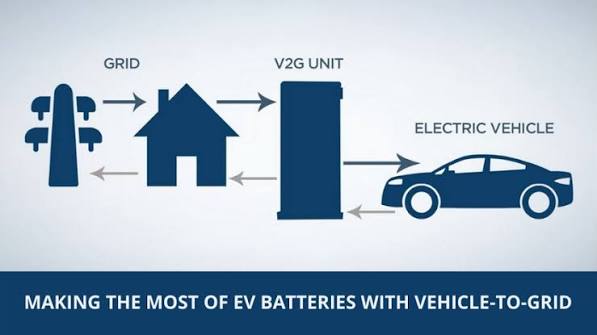
Imagine plugging in your electric car at night and earning money while you sleep not by driving, but by letting the grid borrow a few kilowatt-hours from your battery. This is the promise of Everything-to-Grid (E2G) systems, where electric vehicles and smart buildings act as decentralized batteries, sending power back to the grid when it’s needed most.
The concept isn’t science fiction. In 2023, the global vehicle-to-grid (V2G) market was worth roughly $1.5–2 billion, and pilot projects are running in over 20 countries, from California to Japan. With over 40 million EVs on the road worldwide, their combined batteries hold more energy than all utility-scale storage installations—a massive, untapped resource that could help stabilize grids powered by intermittent renewables like solar and wind.
The One-Way Grid’s Storage Problem
For over a century, electricity flowed in one direction: from large, centralized power plants to homes and businesses. The grid was designed for predictable demand and controllable generation. But the rise of renewable energy solar and wind has turned that model upside down. These sources are variable; the sun doesn’t always shine, and the wind doesn’t always blow. When they generate more power than needed, that energy is wasted (curtailed). When they generate too little, utilities must fire up fossil-fuel “peaker” plants.
Storage is the obvious solution, but building utility-scale batteries is expensive and slow. Enter the distributed storage opportunity: the batteries already sitting in our garages and driveways.
A typical EV battery holds 60–100 kilowatt-hours (kWh) enough to power a home for several days. A home battery adds another 10–20 kWh. Multiply that by millions of vehicles, and you get terawatt-hours of potential storage far more than any utility could build. And here’s the kicker: cars are parked about 95% of the time. That idle capacity can be put to work.
Vehicle-to-Grid: The Basics
Vehicle-to-grid (V2G) is the key technology. It uses a bidirectional charger that allows electricity to flow both ways: from the grid into the car, and from the car back to the grid. When you plug in, your car can talk to the grid via communication protocols like ISO 15118-20, which enable plug-and-charge and smart charging.
Here’s how it works in practice:
- Off-peak charging: You plug in at night when electricity is cheap (and often greener, thanks to wind power).
- Peak-time discharge: During the afternoon or evening, when demand spikes and prices soar, the grid draws a few kWh from your car.
- You get paid: Your utility or an aggregator credits you for the energy you provide.
This isn’t just theoretical. Nissan Leaf owners in the UK, Denmark, and Japan have been participating in V2G pilots for years. Ford’s F-150 Lightning is designed to power a home, and Hyundai, Kia, and Volkswagen are rolling out bidirectional charging in new models.
Building-to-Grid: Smart Buildings Join the Dance
Buildings are the other half of the E2G equation. A smart building with rooftop solar, battery storage, and an energy management system can do more than just consume it can become a mini power plant.
Building-to-grid (B2G) works in two ways:
- Exporting surplus: When solar panels generate more power than the building needs, the excess can be sold back to the grid.
- Load shifting: The building’s management system can temporarily reduce consumption (e.g., pre-cooling in the morning, then turning off AC during peak hours) to ease strain on the grid.
When aggregated across thousands of buildings, these small adjustments add up to significant grid services.
Aggregation: The Virtual Power Plant
Individual EVs and buildings are too small to matter on their own. That’s where aggregators come in. Companies like Octopus Energy, Nuvve, and AutoGrid pool thousands of distributed batteries into a “virtual power plant” (VPP). A VPP acts like a single, large power plant, but it’s made up of many small, flexible resources.
Aggregators use software platforms to monitor each battery’s state of charge, communicate with grid operators, and dispatch power in milliseconds when needed. This enables fast-response services like frequency regulation, which keeps the grid’s frequency stable—something that requires rapid, precise injections or withdrawals of power.
What E2G Provides to the Grid
The services E2G can offer go beyond just selling energy back. Here are the key grid services:
- Frequency regulation: Batteries can respond in milliseconds to keep the grid’s frequency at 50 or 60 Hz, a task traditionally done by large generators.
- Peak shaving: By discharging during peak demand, E2G reduces the need for peaker plants, saving utilities money.
- Renewable smoothing: When the wind dies down or clouds roll in, batteries can fill the gap instantly, making renewables more reliable.
- Backup power: In a blackout, your EV can power your home (or even your neighborhood, in some pilots).
- Infrastructure deferral: By reducing peak loads, E2G can postpone expensive upgrades to transformers and substations.
The Economics: Who Benefits?
For EV owners, the financial incentives are real but modest. Depending on the market and how often you discharge, you might earn $200–$1,000 per year. That’s not a fortune, but it can offset charging costs or even turn a profit.
Utilities benefit more directly. Avoided costs from not building peaker plants or upgrading infrastructure are estimated at $1,500–$5,000 per kilowatt of capacity. For a grid that needs gigawatts of flexibility, that adds up.
But there’s a catch: business models are still evolving. Who captures the value—utilities, aggregators, or consumers? Tariff structures are being redesigned, and many utilities are experimenting with different compensation schemes.
Battery Degradation: A Real Concern?
One of the biggest consumer fears is that V2G will wear out their car battery faster. The evidence is reassuring: modern EV batteries handle 1,000+ cycles, and V2G adds roughly 10–15% extra degradation over 10 years—often within the battery’s warranty. Many programs let you set a minimum state of charge (e.g., 20% or 80%) so you always have enough range for your commute.
Policy Push: Governments Are On Board
Governments are increasingly mandating V2G readiness. The EU’s Battery Regulation and the Alternative Fuels Infrastructure Regulation require new chargers to be bidirectional by 2027. The US Inflation Reduction Act offers tax credits for bidirectional chargers, and California’s Self-Generation Incentive Program supports V2G. Japan, a pioneer, has used V2G in disaster-prone areas since the 2011 Fukushima earthquake.
The Road Ahead: Challenges Remain
Despite the promise, E2G faces hurdles:
- Cost: Bidirectional chargers are still 2–3x more expensive than one-way ones, though prices have dropped 50% since 2020.
- Interoperability: Standards like ISO 15118-20 exist, but not all cars and chargers talk to each other seamlessly.
- Consumer trust: Some EV owners are wary of “someone else controlling my car’s battery.” Aggregators must offer opt-in programs with clear guarantees.
- Grid integration: Utilities need to upgrade their systems to handle two-way power flows.
Environmental Impact: A Net Win (Usually)
Does E2G actually help the climate? It depends on the grid’s carbon intensity. If your EV is charged from coal-heavy power, the benefit is reduced. But in grids with high renewable penetration, studies suggest E2G can cut system-wide CO2 emissions by 5–15%. The key is using E2G to store excess solar and wind, reducing curtailment and making renewables more viable.
The Bottom Line
The everything-to-grid concept is moving from pilots to mainstream. With policy support, falling costs, and growing automaker involvement, your car may soon be more than a vehicle—it could be a mini power plant earning its keep.
Everything-to-Grid isn’t just a technical novelty; it’s a practical way to make our electricity system more flexible, resilient, and renewable. As bidirectional charging becomes standard and virtual power plants scale up, the line between consumer and producer will blur. Your EV and your building could become active players in the grid, helping to balance supply and demand while reducing emissions. The future of energy isn’t just about big power stations—it’s about every device with a battery doing its part.
Summary
- E2G turns EVs and buildings into distributed batteries that can send power back to the grid, providing storage and flexibility.
- V2G and B2G are the core mechanisms, using bidirectional chargers and smart building systems.
- Aggregators pool these resources into virtual power plants to offer grid services like frequency regulation, peak shaving, and renewable smoothing.
- Economic benefits include $200–$1,000/year for EV owners and $1,500–$5,000 per kW of avoided capacity for utilities.
- Policy support is growing, with EU and US mandates for bidirectional charging, but challenges like cost and interoperability remain.
FAQ
Q: How much can I earn from V2G?
A: Depending on your market and how often you participate, you can earn $200–$1,000 per year. Some programs offer higher payouts during peak events.
Q: Will V2G damage my car’s battery?
A: Modern EV batteries are designed to handle many cycles. V2G adds about 10–15% degradation over 10 years, often within warranty. You can set a minimum state of charge to protect range.
Q: Do I need special equipment?
A: Yes, you need a bidirectional charger, which costs more than a standard one. However, prices are falling, and many programs provide incentives or rebates.
Q: Can any EV do V2G?
A: Not yet. Only certain models like Nissan Leaf, Ford F-150 Lightning, and some Hyundai/Kia/Volkswagen models support bidirectional charging. Check with your automaker.
Q: What’s the difference between V2G and B2G?
A: V2G uses electric vehicles, while B2G uses smart buildings with solar and storage. Both can export power to the grid, and when pooled, they form a virtual power plant.