Every year, pharmaceutical companies spend billions on drug candidates that ultimately fail in human trials. A major reason is that the standard preclinical models—flat dishes of cells and lab animals—often don’t predict how a drug will behave in the human body. Now, a technology the size of a USB stick is offering a way to bridge that gap: the organ-on-a-chip.
These microfluidic devices contain living human cells arranged to mimic the structure and function of specific organs. They can replicate breathing motions, blood flow, and even immune responses. While still an emerging tool, organ-on-a-chip systems are gaining attention from researchers, regulators, and industry as a more human-relevant alternative for testing drugs and studying disease.
This article explains what organ-on-a-chip technology is, how it works, why it matters, and where it stands today.
What Is an Organ-on-a-Chip?
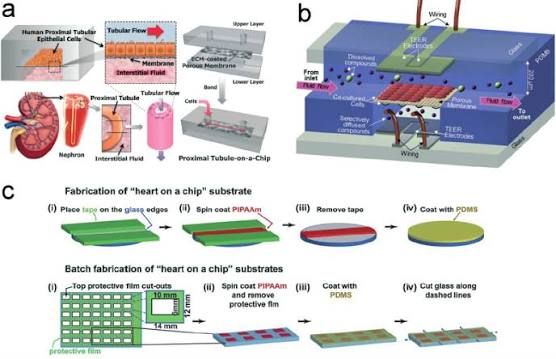
An organ-on-a-chip is a small, transparent device—often made of a rubber-like polymer called polydimethylsiloxane (PDMS)—with tiny channels etched into it. Inside these channels, living human cells are cultured in a way that mimics the architecture and function of a real organ. The chips are typically a few centimeters long, about the size of a USB stick.
The key components include:
- Microchannels that guide the flow of culture medium, simulating blood flow.
- Living human cells—either primary cells, stem-cell-derived cells, or immortalized lines—arranged to form tissue structures.
- A porous membrane that separates different compartments, allowing cells to interact across tissue–tissue interfaces, like the barrier between lung alveoli and blood vessels.
- Mechanical forces that can be applied to mimic physiological movements such as breathing, peristalsis, or shear stress from blood flow.
These elements work together to create a more realistic environment than traditional 2D cell cultures. Unlike static Petri dishes, organ-on-a-chip systems provide continuous perfusion, which delivers nutrients and removes waste, and they can integrate sensors for real-time monitoring of barrier integrity, electrical activity, or metabolism.
Why Organ-on-a-Chip Was Developed
The technology emerged to address a well-known problem in drug development: the “translational gap.” Animal models and simple cell cultures often fail to predict human responses. In fact, about 90% of drugs that show promise in animal tests ultimately fail in human trials, according to historical data. This inefficiency is costly—both in terms of money and in terms of patients who may be exposed to ineffective or harmful treatments.
Organ-on-a-chip systems aim to provide a more human-relevant platform for testing drugs before they reach clinical trials. They build on advances in microfluidics and tissue engineering, combining microfabrication techniques from the semiconductor industry with stem cell technology and organoids.
A Milestone: The Lung-on-a-Chip
The field gained significant traction in 2010 when Donald Ingber and colleagues at the Wyss Institute at Harvard University published a landmark paper in Science describing a “lung-on-a-chip.” This device replicated the mechanical breathing motions of the lung and demonstrated how immune cells respond to bacteria. It showed that mechanical forces—not just chemical signals—are important for organ function.
Since then, chips have been developed for many organs, including the liver, kidney, heart, gut, brain (blood-brain barrier), skin, and bone marrow. Researchers are also working on “body-on-a-chip” platforms that link multiple organ chips together to study systemic effects.
How Organ-on-a-Chip Systems Are Used Today
Organ-on-a-chip technology is not yet a routine tool in every lab, but it is being used in several areas:
- Toxicity screening: Particularly for liver toxicity, which is a common reason for drug failure. Liver-on-a-chip models can detect toxic effects earlier than conventional methods.
- Disease modeling: Chips have been used to study COVID-19 lung injury, cancer metastasis, and other conditions, providing insights that are difficult to obtain from animal models.
- Personalized medicine: Using cells derived from individual patients, chips could help predict how a specific person might respond to a drug.
- Rare diseases: For conditions where animal models are poor or nonexistent, chips offer a way to study disease mechanisms in human cells.
Regulatory and Industry Interest
Regulators are beginning to take notice. In 2022, the U.S. Food and Drug Administration (FDA) started evaluating organ-on-a-chip data in drug applications through its Innovative Science and Technology Approaches program. Later that year, the FDA Modernization Act 2.0 removed the mandatory requirement for animal testing before human trials, which has spurred interest in alternative methods like organ-on-a-chip.
However, no organ-on-a-chip has yet been the sole basis for a drug approval. Regulatory agencies are cautious; they want evidence that data from these devices correlates with human outcomes. The field is still working on standardization and validation.
The pharmaceutical industry sees potential cost savings. Failed drugs can cost $1–3 billion each, so catching toxicity earlier could save substantial resources. But adoption has been slow, partly due to concerns about reproducibility, the cost of chips, and the lack of standardized protocols.
Commercial Landscape and Challenges
The market for organ-on-a-chip was valued at around $100–150 million in 2023, with projections to exceed $1 billion by 2030, driven by drug development and regulatory interest. Several startups, like Emulate (spun out of the Wyss Institute), CN Bio Innovations, TissUse, and Mimetas, are commercializing the technology. However, many are not yet profitable.
Challenges include scaling manufacturing, ensuring reproducibility across different labs, and convincing risk-averse companies to change established workflows. There is also a debate about how much these chips actually mimic human organs. Some researchers warn that overstating their capabilities could harm credibility.
What Organ-on-a-Chip Is Not
It is important to clarify that an organ-on-a-chip is not a miniature organ. It is a functional subunit that replicates key aspects of a specific tissue. It lacks the complexity of a whole organ, such as the immune system, hormonal regulation, or long-term adaptation. Therefore, it is a tool for answering specific questions, not a replacement for the human body.
Looking Ahead
Despite the challenges, organ-on-a-chip technology is advancing. Researchers are developing more sophisticated systems that integrate multiple organs, incorporate immune cells, and use patient-derived cells. The potential to reduce animal testing, improve drug safety, and enable personalized medicine makes this an exciting field to watch.
As the technology matures and regulatory acceptance grows, organ-on-a-chip could become a standard component of the drug development pipeline, complementing—not necessarily replacing—existing methods.
Conclusion
Organ-on-a-chip systems are a promising bridge between traditional cell cultures and animal models, offering a more human-relevant platform for studying biology and testing drugs. While they are not yet a panacea, their ability to mimic physiological responses in a controlled, miniature format has captured the attention of scientists, regulators, and industry. With continued development and validation, these tiny devices may play a significant role in making drug development faster, safer, and more effective.
Summary
- Organ-on-a-chip are microfluidic devices, about the size of a USB stick, containing living human cells that mimic organ functions.
- They address the translational gap where 90% of drugs that pass animal tests fail in human trials.
- Key milestone: the 2010 lung-on-a-chip at Harvard’s Wyss Institute.
- Used for toxicity screening, disease modeling, and personalized medicine.
- FDA has begun evaluating OOC data, and the Modernization Act 2.0 supports alternatives to animal testing.
- Market projected to exceed $1 billion by 2030, but challenges remain in standardization and adoption.
FAQ
Q: What is an organ-on-a-chip?
A: It’s a small microfluidic device that contains living human cells arranged to mimic the structure and function of a specific organ, such as the lung, liver, or heart. It can replicate physiological conditions like blood flow and mechanical forces.
Q: How does an organ-on-a-chip work?
A: Cells are cultured in microchannels within a polymer chip. A continuous flow of culture medium mimics blood flow, and mechanical forces can be applied to simulate breathing or other movements. Sensors can monitor cell responses in real time.
Q: Why are organ-on-a-chip systems important?
A: They offer a more human-relevant alternative to traditional cell cultures and animal models for testing drugs. This could help reduce late-stage drug failures and potentially reduce animal testing.
Q: Are organ-on-a-chip systems used in drug development now?
A: Yes, they are used for toxicity screening and disease modeling in research, but they are not yet a standard requirement. Regulatory agencies like the FDA are evaluating their use in drug applications.
Q: Can organ-on-a-chip replace animal testing?
A: Not yet. While they show promise, they are not sophisticated enough to fully replicate the complexity of a whole organism. They are best seen as a complement to existing methods, not a complete replacement.