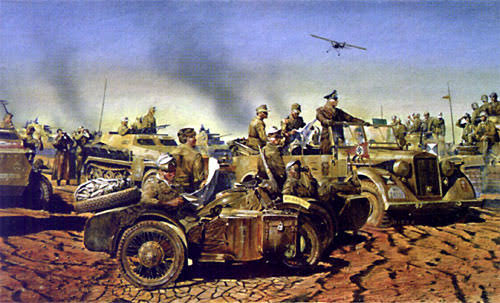
Erwin Rommel is the most famous German general of World War II. His name evokes images of desert warfare, tactical brilliance, and a kind of chivalrous conduct that seemed out of place in the Nazi regime. But the ‘Desert Fox’ was as much a product of propaganda as of actual military achievement. Over the past few decades, historians have chipped away at the legend, revealing a more complex—and less heroic—figure.
This article separates the man from the myth. We’ll trace Rommel’s rise from a WWI hero to Hitler’s favorite general, examine his campaigns in France and North Africa, and finally confront the uncomfortable truths about his relationship with Nazism and his role in the July 20 plot. The story that emerges is not about a clean soldier in a dirty war, but about a man whose reputation was carefully constructed—and is now being dismantled.
The Making of a Legend: WWI and the Interwar Years
Rommel was born in 1891 in Heidenheim, Germany, into a middle-class family. His father was a schoolteacher, and the young Rommel initially considered engineering. But he joined the infantry as an officer cadet in 1910, and the military became his life.
In WWI, Rommel fought on the Western and Eastern fronts, then in Italy. At the Battle of Caporetto in 1917, he led a series of infiltration attacks that captured key mountain positions, using tactics that would later define his style. For this, he won the Pour le Mérite, Germany’s highest military honor at the time. After the war, he stayed in the army and wrote a manual, Infantry Attacks (1937), based on his experiences. The book caught the attention of Hitler, who was always looking for officers who thought offensively. It also became a bestseller abroad—George Patton read it, and it influenced his own aggressive armored warfare.
The Ghost Division: Rommel in 1940
When WWII broke out, Rommel was given command of the 7th Panzer Division. In the invasion of France in May 1940, he ignored orders and pushed his tanks at breakneck speed, often leaving the infantry far behind. His division moved so fast that it became known as the “Ghost Division”—it seemed to be everywhere at once. In one engagement, he used captured British tanks to confuse the enemy. His success was undeniable, but it also sowed seeds for his later arrogance: he believed he could outrun logistics and outsmart any opponent.
The Desert Fox: North Africa, 1941–1943
In February 1941, Rommel was sent to North Africa to rescue the struggling Italian army. He arrived with just two divisions, but within weeks he had pushed the British back across the desert. The British, desperate to explain their defeats, began to mythologize Rommel. They called him the “Desert Fox”—a clever, chivalrous enemy who outfoxed them with daring maneuvers. This propaganda suited the British: it made their defeat seem noble and their eventual victory more glorious.
Rommel’s early successes were real. He recaptured Cyrenaica, besieged the port of Tobruk for months, and by June 1942 he had taken Tobruk and pushed his forces deep into Egypt. For that, Hitler promoted him to Field Marshal. But his advance stalled at El Alamein, just 100 miles from Alexandria. The supply lines stretched, the tanks wore out, and the British under Montgomery had the advantage of shorter logistics. Rommel’s gamble failed. After the Second Battle of El Alamein in October–November 1942, he was forced into a long retreat across Libya and Tunisia, finally leaving Africa in March 1943 due to illness—just before the Axis surrender in Tunisia.
The Myth and the Reality: Rommel’s Strategic Flaws
The legend says Rommel was a tactical genius, but historians have pointed out his strategic weaknesses. He often overextended his supply lines, underestimated logistics, and made decisions based on intuition rather than careful planning. His obsession with offensive action could be reckless. In North Africa, he ignored the advice of his quartermasters and pushed too far, which contributed to his eventual defeat. The “military genius” reputation was also inflated by British propaganda—they needed a superhuman enemy to justify their own setbacks.
A Nazi General? Rommel’s Relationship with the Regime
For decades, Rommel was seen as an apolitical soldier who served his country, not the Nazi Party. This view was promoted by his widow, his former subordinates, and even the Western Allies after the war, who found him a useful symbol of a “clean” German military. But recent scholarship has painted a different picture.
Rommel was not a member of the Nazi Party, but he was not opposed to Hitler either. He benefited from Hitler’s favor, receiving rapid promotions and decorations that were often outside the normal chain of command. He also tolerated, and at times supported, war crimes. In North Africa, he ordered “energetic action” against Jewish refugees in Tunisia, and he did not object to the murder of captured commandos. His attitude toward the Holocaust was at best indifferent, at worst complicit.
The July 20 Plot and Forced Suicide
By 1944, Rommel was in command of Army Group B in Normandy, tasked with defending the Atlantic Wall against an expected Allied invasion. He argued that the panzer divisions should be stationed near the coast, but Hitler overruled him. On D-Day, June 6, 1944, Rommel was in Germany for his wife’s birthday—a fact that has been used to explain the chaotic German response. He returned to Normandy and was wounded on July 17 when an Allied fighter strafed his car.
Three days later, on July 20, a bomb exploded in Hitler’s headquarters. The conspirators’ plot failed, but under torture, some named Rommel as a potential supporter. Hitler gave Rommel a choice: face a public trial for treason, which would mean the execution of his family, or take a cyanide pill and be given a state funeral with honors. Rommel chose suicide. On October 14, 1944, he was driven to a quiet spot, swallowed the poison, and died. His death was officially reported as resulting from his wounds—a lie that held for years.
The End of the Legend
Rommel’s role in the July 20 plot was passive at best. He had been approached by conspirators, but he was more concerned about the war’s inevitable defeat than about overthrowing Hitler. He did not actively participate, and his motives were not moral but pragmatic. The myth of Rommel as a principled resistance fighter is just that—a myth.
Today, historians like Ralf Georg Reuth and Peter Lieb have argued that Rommel was a committed Nazi who used Hitler’s favor for his career and was complicit in crimes. His legend was built on selective memory and propaganda, both by the British to explain their defeats and by postwar Germans to distance themselves from the Nazi regime. The real Rommel was a brilliant tactical commander, yes, but also a man who served a criminal regime and looked away from its horrors.
Erwin Rommel was a complex figure: a brave soldier, a talented tactician, and a man who rose to fame under a murderous dictatorship. His myth as the “clean” general served many purposes after the war, but it does not survive scrutiny. Understanding the real Rommel—with his flaws, his complicity, and his tragic end—is more valuable than preserving a legend. It reminds us that heroism is never simple, and that even the most celebrated figures can be built on sand.
Summary
- Rommel’s early successes in WWI and his manual Infantry Attacks made him a favorite of Hitler and a respected military mind.
- In WWII, he led the “Ghost Division” in France and the Afrika Korps in North Africa, earning the nickname “Desert Fox” from the British.
- His strategic flaws, especially overextending supply lines, contributed to his defeat at El Alamein.
- The “clean Wehrmacht” myth is false: Rommel was a beneficiary of Nazism, tolerated war crimes, and was not a principled opponent of Hitler.
- He was forced to commit suicide in 1944 after being implicated in the July 20 plot, but his involvement was passive and pragmatic.
FAQ
Q: Was Rommel a member of the Nazi Party?
A: No, he was not a formal member, but he supported the regime and benefited from Hitler’s favor. He was not a principled opponent of Nazism.
Q: What was Rommel’s role in the July 20 plot?
A: His involvement was minimal. He was approached by conspirators, but he did not actively participate. His concerns were more about the war’s outcome than about overthrowing Hitler.
Q: Why did the British call him the “Desert Fox”?
A: They used the nickname to explain their defeats in North Africa, creating an image of a clever and chivalrous enemy. It was part of propaganda that later contributed to the Rommel myth.
Q: Did Rommel commit war crimes?
A: He tolerated and sometimes ordered actions that were war crimes, such as the murder of captured commandos and “energetic action” against Jewish refugees in Tunisia.
Q: How did Rommel die?
A: He was forced to commit suicide in 1944 after being implicated in the July 20 plot. Hitler gave him the choice of suicide with family protection or a public trial with family persecution. He chose suicide.