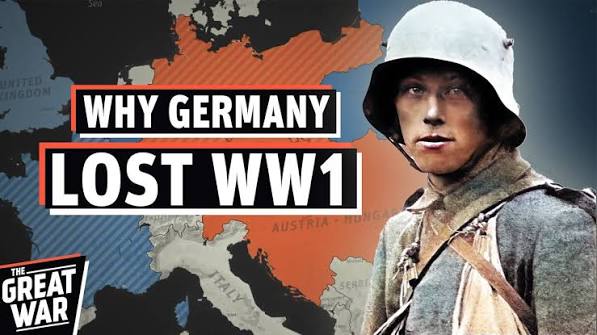
In the autumn of 1918, the German Empire was not defeated on a single battlefield. It collapsed like a house of cards—militarily exhausted, economically starved, and politically fractured. The end came swiftly: the Hundred Days Offensive broke the Western Front, the British blockade had already crippled the home front, and Germany’s allies deserted one by one. Within weeks, the Kaiser fled, the military sued for peace, and a revolution erupted in Berlin. This article traces the multifaceted reasons behind Germany’s defeat, from strategic blunders to the devastating effects of total war.
The Last Gamble: The Spring Offensives of 1918
By early 1918, Germany’s situation was dire. The British blockade had been strangling the country for over three years, and the entry of the United States into the war in April 1917 threatened to tip the balance permanently against the Central Powers. General Erich Ludendorff, the de facto military dictator of Germany, knew that time was not on his side. He launched a series of five massive offensives—collectively known as the Kaiserschlacht—between March and July 1918, aiming to knock out the Allies before American troops arrived in overwhelming numbers.
The first offensive, Operation Michael, began on March 21, 1918, with a devastating artillery bombardment. German stormtroopers, specially trained in infiltration tactics, broke through the British lines and advanced up to 60 kilometers in some places. It was the deepest penetration of Allied lines since the trench warfare began in 1914. For a few weeks, it seemed possible that Germany might win the war.
But the offensive stalled. The German army had advanced too far from its supply lines, and its soldiers were exhausted and hungry. The Allies, under the unified command of Marshal Ferdinand Foch, held key defensive positions and counterattacked relentlessly. By July, the last German offensive, Friedensturm, had failed. The German army had suffered over 800,000 casualties in these spring offensives—losses that could not be replaced. In contrast, the Allies were reinforced by fresh American troops at a rate of over a million per month by mid-1918.
The Black Day of the German Army
August 8, 1918, marked the turning point. At Amiens, Allied forces—including British, French, Canadian, and Australian troops—launched a counteroffensive supported by over 400 tanks. They broke through the German lines with astonishing ease, capturing 15,000 prisoners and 400 guns in a single day. Ludendorff called it “the black day of the German army,” not because of the territorial losses, but because of the morale collapse: German soldiers surrendered in droves, and many units refused to fight.
The Hundred Days Offensive that followed was a continuous series of Allied attacks that pushed the Germans back relentlessly. The Allies had learned to combine infantry, artillery, tanks, and aircraft in coordinated assaults—tactics that the Germans could not match with their dwindling resources. By September, the German army was in full retreat, but it was not a rout. It was a disciplined withdrawal, yet one marked by growing mutiny and desertion. The German high command knew the war was lost, but they continued to fight, hoping to secure a negotiated peace.
The Hunger Blockade
While the German army was being defeated in the field, the home front was collapsing. The British Royal Navy had imposed a naval blockade on Germany from the start of the war, cutting off imports of food, fuel, and raw materials. The blockade was not absolute—some goods trickled through via neutral countries—but it was devastating enough. By 1918, the German civilian population was suffering from severe malnutrition. The infamous “turnip winter” of 1916–17, when the potato crop failed and the population was forced to subsist on turnips, had already caused widespread suffering. Estimates suggest that between 500,000 and 800,000 German civilians died from starvation and disease caused by the blockade.
The blockade also crippled Germany’s war economy. Without access to overseas resources, Germany had to rely on Ersatz (substitute) materials—synthetic rubber, ersatz coffee, and even bread made with sawdust. But these substitutes were inferior and never enough. By 1918, German factories were producing fewer shells, guns, and aircraft than the Allies. The German war machine was slowly starving to death.
The Collapse of Germany’s Allies
Germany’s strategic position was further weakened by the rapid collapse of its allies in the autumn of 1918. On September 29, Bulgaria signed an armistice with the Allies, opening the road to the Danube and threatening Germany from the south. On October 30, the Ottoman Empire capitulated, followed by Austria-Hungary on November 3. These defections left Germany isolated, fighting alone on multiple fronts. The German army had to divert troops to shore up its faltering allies, further weakening its already exhausted forces in the West.
The collapse of Austria-Hungary was particularly significant. The Austro-Hungarian Empire, Germany’s primary ally, had been a liability for years. Its multi-ethnic armies were riddled with dissent and desertion. By October 1918, the empire was disintegrating into independent national states, and its army dissolved. Germany could no longer rely on any ally to tie down Allied forces.
The Home Front Revolts
The final blow came from within. In late October 1918, the German High Seas Fleet was ordered to sail out for a final, suicidal battle against the British Royal Navy. The sailors at Kiel mutinied, refusing to throw away their lives in a hopeless gesture. The mutiny quickly spread to other ports and then to industrial cities across Germany. Workers and soldiers formed councils, following the example of the Russian Revolution. By November 9, revolution had reached Berlin, and Kaiser Wilhelm II was forced to abdicate and flee to the Netherlands.
The new government, led by the Social Democrat Friedrich Ebert, had no choice but to sue for peace. On November 11, 1918, the Armistice was signed in a railway carriage at Compiègne, France. The guns fell silent, but the German army was not decisively beaten in a single battle. It was exhausted, demoralized, and starved, but it was still on foreign soil—inside France and Belgium. This gave rise to the dangerous myth of the “stab in the back.”
The Myth of the Stab in the Back
Even before the war ended, Ludendorff and other right-wing figures began to spread the false claim that the German army was “undefeated in the field” and had been betrayed by civilians at home—socialists, democrats, and Jews. This “stab-in-the-back” myth was a deliberate attempt to shift blame away from the military leadership and to undermine the new democratic government. It was a lie, but it was a powerful one. It poisoned German politics for the next two decades and was later weaponized by the Nazis to justify their rise to power.
The truth was that Germany lost the war because it was militarily, economically, and politically overwhelmed. The failure of the Schlieffen Plan in 1914 condemned Germany to a two-front war of attrition that it could not win. The British blockade strangled its economy. The entry of the United States tipped the numerical balance irrevocably against it. The failure of the 1918 offensives exhausted its army. And the collapse of its allies left it isolated. By November 1918, Germany was not stabbed in the back; it was simply beaten.
Germany’s defeat in the First World War was not the result of a single catastrophic mistake, but a combination of strategic errors, economic strangulation, military exhaustion, and political collapse. The war ended not because the German army was routed, but because it was no longer able to fight. The armistice of November 11, 1918, was a military surrender, but the myth of the stab in the back would live on to haunt the peace and sow the seeds of an even greater conflict.
Summary
- Germany’s last military gamble, the Spring Offensives of 1918, failed to achieve a strategic breakthrough and exhausted irreplaceable reserves.
- The Allied Hundred Days Offensive, starting with the ‘Black Day’ at Amiens on August 8, 1918, broke the German army’s morale and led to continuous retreat.
- The British naval blockade starved Germany of food and resources, causing hundreds of thousands of civilian deaths and crippling war production.
- The rapid collapse of Bulgaria, the Ottoman Empire, and Austria-Hungary in autumn 1918 left Germany isolated and fighting alone.
- The Kiel Mutiny and subsequent revolution forced the Kaiser to abdicate and led to the armistice, while the ‘stab-in-the-back’ myth falsely blamed civilians for the defeat.
FAQ
Q: What was the immediate cause of Germany’s defeat?
A: The immediate cause was the collapse of the German army during the Hundred Days Offensive, combined with the revolution at home that forced the Kaiser to abdicate and the new government to sign the Armistice on November 11, 1918.
Q: How did the British blockade contribute to Germany’s defeat?
A: The blockade cut off Germany’s access to overseas food and raw materials, causing widespread malnutrition and starvation that killed an estimated 500,000–800,000 civilians. It also severely hampered German war production, making it impossible to match Allied output.
Q: Why did the Spring Offensives of 1918 fail?
A: The offensives achieved initial territorial gains but outran their supply lines and were halted by Allied counterattacks. German casualties were irreplaceable, while Allied forces were continuously reinforced by fresh American troops.
Q: What was the ‘stab-in-the-back’ myth?
A: It was a false claim promoted by Ludendorff and other right-wing figures that the German army was undefeated in the field and had been betrayed by civilians—socialists, democrats, and Jews—who undermined the war effort and forced a surrender. This myth was later used by the Nazis to attack the Weimar Republic.
Q: How did the collapse of Germany’s allies affect the outcome?
A: The rapid defeats of Bulgaria, the Ottoman Empire, and Austria-Hungary in the autumn of 1918 isolated Germany, leaving it to fight alone on multiple fronts and reducing its ability to concentrate forces in the West.