Tag: decolonization

  • Decolonizing Economics: Unpacking the Discipline’s Colonial Baggage

    Decolonizing Economics: Unpacking the Discipline’s Colonial Baggage

    In 2014, a group of economics students at the University of Manchester published a scathing open letter. They accused their own department of teaching a ‘single, narrow, and increasingly irrelevant’ version of the subject. The letter sparked a global movement, Rethinking Economics, which soon gave rise to a more pointed demand: decolonize economics.

    Decolonizing economics is not about burning textbooks or banning Western thinkers. It is a critical movement that asks a simple but uncomfortable question: what if the discipline’s core ideas are not universal truths, but products of a specific, colonial history? This article unpacks what that means, why it matters, and what it could change.

    The Colonial Roots of Economic Thought

    Modern economics did not emerge in a vacuum. It grew up alongside European empire-building. Adam Smith wrote about the wealth of nations while Britain was expanding its colonial reach. John Stuart Mill, another founding father, worked for the East India Company for 35 years. These thinkers didn’t just happen to live in colonial times; their ideas often served colonial ends.

    Classical political economy framed colonial extraction as natural and beneficial. Mill, for instance, defended British rule in India as a necessary step toward ‘civilization.’ Later, neoclassical economics stripped away historical context, presenting itself as a value-free science of rational choices. But the assumptions baked into its models—about self-interest, efficiency, and development—were shaped by a worldview that placed Europe at the center of progress.

    The Problem with ‘Development’

    After World War II, as colonies gained independence, a new field emerged: development economics. Its mission was to help the newly independent Global South ‘catch up’ with the West. But the framework was deeply flawed.

    W.W. Rostow’s ‘stages of economic growth’ is a prime example. It portrayed all societies as moving through a linear sequence—from traditional to modern—with the United States as the endpoint. This narrative ignored how the West’s wealth was built on centuries of slavery, land dispossession, and resource extraction. It also prescribed a one-size-fits-all model of industrialization, failing to account for local contexts and histories.

    Dependency theorists like Raúl Prebisch and Andre Gunder Frank challenged this narrative head-on. They argued that underdevelopment was not a starting point but a condition produced by the global system. The core (the West) exploited the periphery (the Global South) through unequal trade and financial mechanisms. Development, they said, was not about following a Western blueprint but about breaking free from colonial structures.

    What Decolonizing Economics Actually Means

    Decolonizing economics is a broad tent. It includes radical calls to rebuild the discipline from non-Western epistemologies, and reformist pushes to pluralize the curriculum. But several common threads tie these efforts together.

    First, it means centering colonial history. Mainstream economics often treats colonialism as an externality—something that happened, but not something that shaped the discipline. Decolonial scholars argue that colonial extraction is not a footnote but a foundational force in the global economy. Understanding modern inequality requires reckoning with this history.

    Second, it means diversifying the canon. Economics courses typically teach a narrow set of Western thinkers. Decolonizing the curriculum would include scholars from the Global South, like Ha-Joon Chang, Kate Raworth, and Ndongo Samba Sylla. It would also draw on alternative economic traditions, such as Ubuntu economics in Africa, Buen Vivir in Latin America, and Islamic finance.

    Third, it means rethinking metrics and goals. GDP has long been the default measure of progress, but it ignores ecological destruction, unpaid care work, and wellbeing. Alternative frameworks, like Kate Raworth’s ‘Doughnut Economics,’ propose targets that respect planetary boundaries and social foundations. These are not just academic exercises; they have real policy implications.

    The Pushback and the Stakes

    Not everyone is on board. Some economists argue that decolonizing economics is politically motivated and threatens the discipline’s scientific rigor. They contend that economics has progressed by abstracting from context, and that ‘decolonization’ is a metaphor stretched beyond usefulness. This skepticism is not without merit—some calls for decolonization can be vague or performative.

    But the movement is not asking to abandon all economic tools. As Ha-Joon Chang puts it, the goal is to recognize that economics is a ‘political argument’ dressed in mathematical clothing. By acknowledging its assumptions, we can make room for multiple perspectives—feminist, ecological, institutional, Marxist—that better reflect the complexity of real economies.

    The stakes are high. International institutions like the IMF and the World Bank have long prescribed policies based on neoclassical models. When these fail, the consequences are borne by the world’s poorest. Decolonizing economics is not just an academic exercise; it is about who gets to define what ‘development’ means and who benefits from it.

    A Movement in Motion

    Universities are slowly responding. SOAS in London, Cambridge, and the University of Cape Town have introduced modules or reviews addressing decolonial perspectives. The American Economic Association has faced calls to diversify its leadership and programming. Student campaigns, like the 2020 ‘Decolonizing Economics’ movement, have pushed for curriculum reform.

    But the work is far from complete. In most economics departments, neoclassical theory remains the default. The voices of scholars from the Global South are still marginalized. And the discipline’s methods—heavy on math, light on history—remain resistant to change.

    Decolonizing economics is not a quick fix. It is a long, contested process. But as global crises—climate change, inequality, pandemics—expose the limits of mainstream thinking, the demand for a more plural, self-aware economics only grows louder.

    Decolonizing economics is not about throwing out the baby with the bathwater. It is about recognizing that the discipline has a history—one steeped in colonialism—and that this history shapes what we study, how we study it, and who benefits. By questioning where economic ideas come from, we open the door to imagining new ones. The result could be an economics that is not only more inclusive but also more accurate in describing the world we actually live in.

    Summary

    • Decolonizing economics critiques the Eurocentric foundations of the discipline and seeks to pluralize perspectives and methods.
    • The movement targets neoclassical assumptions, linear ‘development’ narratives, and the erasure of colonial extraction from economic history.
    • Notable figures include dependency theorists like Prebisch and Frank, and contemporary scholars like Ha-Joon Chang and Kate Raworth.
    • Practical changes include diversifying curricula, centering Global South scholars, and rethinking metrics like GDP.
    • The movement faces skepticism but has gained momentum amid global crises and calls for institutional reform.

    FAQ

    Q: Does decolonizing economics mean rejecting all Western economic theory?
    A: No. Most proponents do not want to discard all Western tools. They want to question the assumptions behind them and make room for alternative perspectives from the Global South, feminist economics, and ecological economics.

    Q: What is the difference between ‘development’ and ‘decolonization’?
    A: Traditional development economics frames the Global South as ‘lagging’ and prescribes Western models. Decolonization challenges this by centering colonial history and arguing that underdevelopment is produced by global structures, not a lack of Western-style policies.

    Q: How can I learn more about decolonizing economics?
    A: Start with works by Ha-Joon Chang (‘Economics: The User’s Guide’), Kate Raworth (‘Doughnut Economics’), and Jason Hickel (‘The Divide’). Look for syllabi from courses on pluralist economics at universities like SOAS or the New School.

    Q: What are some examples of alternative economic frameworks?
    A: Buen Vivir (from Latin America) emphasizes wellbeing and harmony with nature, Ubuntu economics (from Africa) focuses on community and reciprocity, and Islamic economics prohibits interest and emphasizes ethical investing.

    Q: Why is this relevant today?
    A: Mainstream economics has struggled to address climate change, rising inequality, and the COVID-19 pandemic. Decolonizing economics offers tools to rethink growth, value, and policy in ways that are more sustainable and equitable.
  • The War That Remade the Middle East: How WWII’s Legacy Fuels Modern Conflicts

    The War That Remade the Middle East: How WWII’s Legacy Fuels Modern Conflicts

    In the summer of 1941, British and Soviet troops rolled into Iran, forcing Reza Shah to abdicate his throne. The invasion was swift, almost bloodless, but its consequences echoed for decades. It secured the supply lines that would help the Soviet Union survive the Nazi onslaught, yet it also planted seeds of resentment that bloomed into the 1953 coup and a lasting Iranian distrust of the West.

    World War II is often remembered through the beaches of Normandy or the jungles of the Pacific. But in the Middle East, the war was a violent tide that reshaped the coastline of history. It toppled empires, created new nations, and set the stage for conflicts that still rage today. The war’s legacy in this region is not a footnote; it is the foundation of the modern Middle East.

    The Crossroads of the World

    Long before the first shot of WWII, the Middle East was already a prize. Its oil fields fueled the navies and air forces of the great powers. The Suez Canal was the jugular of the British Empire, a shortcut to India and the Far East. And its geography made it a natural crossroads for armies and ideologies.

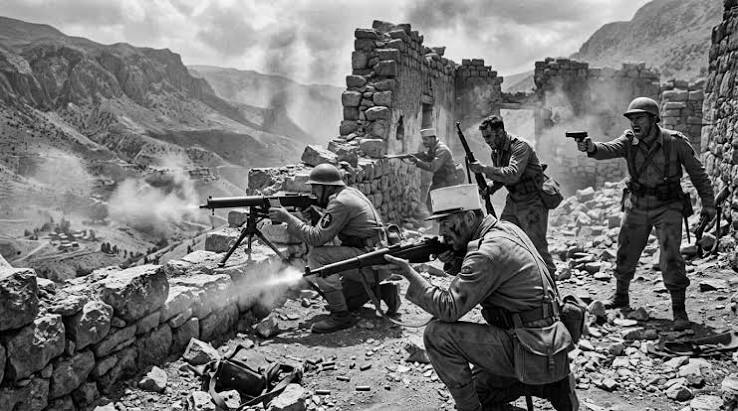
    When war erupted in 1939, the region became a theater of operations. The North African Campaign (1940–1943) saw British and Commonwealth forces push back the Italians and Germans in a back-and-forth struggle across Libya and Egypt. To the east, the Anglo-Soviet invasion of Iran in 1941 was a preemptive strike to secure oil and open the Persian Corridor a route that would deliver over 4 million tons of Lend-Lease aid to the Soviet Union. Meanwhile, in the Levant, British and Free French forces ousted Vichy French control from Syria and Lebanon, a campaign that would set those territories on the path to independence in 1943–1946.

    These campaigns were not abstract chess moves. They brought hundreds of thousands of Allied troops into the region, along with their equipment, their ideas, and their promises. The war disrupted local economies, caused famines in Iran and the Levant, and accelerated urbanization as people flocked to cities for work and safety. It also expanded oil production dramatically, cementing the region’s global importance.

    The Promise of Self-Determination

    In August 1941, Franklin Roosevelt and Winston Churchill issued the Atlantic Charter, a declaration of principles for the post-war world. It affirmed the right of all peoples to choose their own government. For Arab nationalists, these words were a beacon. They had lived under British and French mandates since the collapse of the Ottoman Empire, and they saw the war as a chance to claim their freedom.

    Churchill later insisted that the charter applied only to Europe, not to the British Empire. But the damage was done. The idea of self-determination had taken root. The war had armed and trained a generation of local officers and elites, many of whom would lead independence movements. When the war ended, Britain and France were economically and militarily exhausted, unable to maintain their colonial grip. The result was a wave of decolonization: Syria and Lebanon gained full independence in 1946, Jordan followed suit, and the British withdrew from Palestine in 1948, leaving behind a volatile situation.

    The Arab League, founded in Cairo in 1945, was a visible sign of this new era. It was a platform for pan-Arab coordination, but it also exposed the divisions that would come to define the region.

    The Holocaust and the Creation of Israel

    The Holocaust was the darkest shadow of WWII, and its legacy in the Middle East is profound. The systematic murder of six million Jews created an international moral imperative for a Jewish homeland. The Balfour Declaration of 1917, which had promised British support for a Jewish national home in Palestine, now seemed like a debt that had to be paid.

    But Palestine was not empty. It was home to a growing Arab population that had its own national aspirations. The war had intensified Jewish immigration and the Zionist project, and the horrors of the Holocaust made the establishment of a Jewish state a matter of existential urgency for many survivors. In 1947, the United Nations voted to partition Palestine into separate Jewish and Arab states. The Arabs rejected the plan; the Jews accepted it. In 1948, Israel declared independence, and the first Arab-Israeli war began.

    The creation of Israel is often seen as a direct consequence of WWII and the Holocaust. But the roots of the conflict go deeper, to the Balfour Declaration and decades of Zionist settlement. WWII did not create the conflict; it accelerated and intensified it, making a resolution tragically more difficult.

    A New World Order

    When the guns fell silent in 1945, the Middle East was no longer the backyard of Britain and France. The United States, emerging from the war as a superpower, began to fill the vacuum. The onset of the Cold War turned the region into a chessboard for U.S.–Soviet rivalry. Superpowers backed different regimes, fueled arms races, and manipulated coups. The Baghdad Pact, Nasser’s alignment with the USSR, and the 1953 CIA-backed coup in Iran were all moves in this larger game.

    For Iran, the legacy of WWII was particularly bitter. The 1941 invasion had been a violation of sovereignty, but it also modernized the country’s infrastructure and state institutions. The war’s aftermath set the stage for the nationalization of the oil industry under Mossadegh and his subsequent overthrow, a coup that deeply shaped Iran’s distrust of Western powers. That distrust persists today.

    For Arab nationalists, WWII was a time when the hypocrisy of the colonial powers was laid bare. They fought for freedom in Europe while denying it in the Middle East. The creation of Israel was seen as a Western imposition, a way to assuage guilt over the Holocaust at the expense of the Palestinians. This perspective continues to fuel regional conflicts.

    The Artificial Borders

    The war accelerated the creation of new nation-states, but the borders were often arbitrary, drawn by colonial powers with little regard for ethnic or sectarian realities. Syria, Lebanon, Jordan, and Israel were all carved out of the former Ottoman territories, and many of these borders remain contested today. The Kurdish people, for example, found themselves divided among several countries, a source of ongoing tension. The creation of Israel, in particular, reshaped the map in ways that continue to provoke conflict.

    The War’s Long Shadow

    World War II is not a distant memory in the Middle East; it is a living history. The strategic importance of the region, the promises of self-determination, the trauma of the Holocaust, the rise of the United States, and the artificial borders—all of these are wartime legacies that still influence modern conflicts. The Arab-Israeli conflict, the Iranian distrust of the West, the instability in Syria and Iraq, and the proxy wars of the 21st century all have roots in the upheaval of 1939–1945.

    To understand the Middle East today, one must look back to the war that remade it. The guns have long since fallen silent, but the echoes of that conflict are still heard in every ceasefire, every protest, and every diplomatic standoff.

    World War II reshaped the Middle East in ways that still reverberate. It destroyed empires, created nations, and set the stage for a Cold War that turned the region into a battlefield of ideologies. The promises of self-determination were left unfulfilled, the trauma of the Holocaust led to a new state and a new conflict, and the strategic importance of oil made the region a pawn in global power struggles. The legacy of WWII is not merely historical; it is the foundation of modern Middle Eastern politics and conflict.

    Summary

    • WWII was a critical theater in the Middle East due to oil, the Suez Canal, and the Persian Corridor, which delivered over 4 million tons of aid to the USSR.
    • The war weakened Britain and France, accelerating decolonization and the creation of new states like Syria, Lebanon, and Jordan.
    • The Holocaust intensified international support for a Jewish homeland, leading to the 1947 UN Partition Plan and the 1948 Arab-Israeli War.
    • The rise of the U.S. and the Cold War turned the Middle East into a proxy battleground, with superpowers supporting rival regimes.
    • The artificial borders drawn during and after WWII continue to fuel ethnic and sectarian conflicts today.

    FAQ

    Q: Did WWII cause the Arab-Israeli conflict?
    A: No. The conflict predates WWII, rooted in the Balfour Declaration and Zionist settlement. WWII and the Holocaust intensified and accelerated it, but did not create it.

    Q: Was the Middle East a minor theater in WWII?
    A: No. It was strategically vital for oil, logistics, and the defeat of the Axis. The Persian Corridor alone delivered over 4 million tons of supplies to the Soviet Union.

    Q: How did WWII affect Iran?
    A: The 1941 Anglo-Soviet invasion forced Reza Shah to abdicate, but it also modernized infrastructure. The war’s aftermath set the stage for the 1953 CIA-backed coup, shaping long-term Iranian distrust of the West.

    Q: What role did the Atlantic Charter play?
    A: Its promise of self-determination was cited by Arab nationalists, even though Churchill later said it didn’t apply to the British Empire. It fueled decolonization movements.

    Q: How are artificial borders a legacy of WWII?
    A: The war accelerated the creation of states like Syria, Lebanon, Jordan, and Israel, often with arbitrary borders that ignore ethnic and sectarian realities, leading to enduring conflicts.