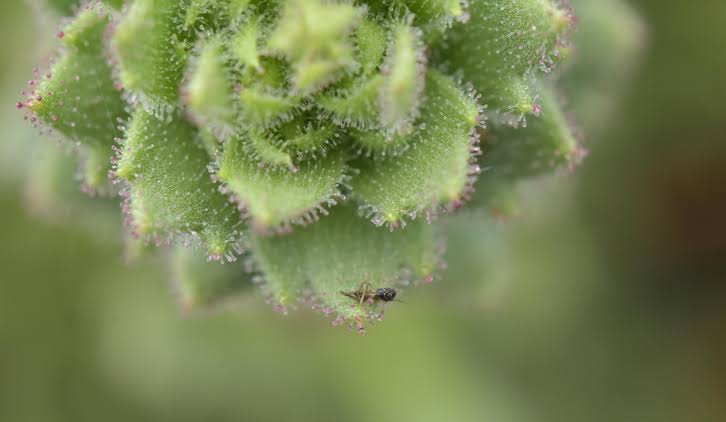
In 1875, Charles Darwin published Insectivorous Plants, a detailed study of species like sundews and Venus flytraps. But he also speculated that many other plants with sticky hairs might be secretly carnivorous, even without dramatic traps. Now, researchers have confirmed that Triaenophora, a plant from the high mountains of southwest China, fits that description providing concrete evidence for Darwin’s 150-year-old idea.
The discovery is more than a botanical curiosity. It shows that carnivory can be subtle, evolving in forms that don’t immediately scream “meat-eater.” And it underscores how nutrient-poor environments, like alpine soils, can drive plants to adopt surprising strategies.
A Plant That Was Always Suspected
Triaenophora is a small genus of perennial herbs that grow on rocky slopes and scree fields at elevations above 2,500 meters in the Chinese provinces of Sichuan, Yunnan, and possibly Guizhou. The plants have sticky glandular hairs on their leaves and stems, which long led botanists to suspect they trapped insects. But trapping alone isn’t enough to qualify as carnivorous—the plant must also digest and absorb nutrients from its prey.
Until recently, that evidence was missing. But a team of researchers, including Chinese botanists and international collaborators, has now provided it. Their findings, published in a peer-reviewed journal, confirm that Triaenophora is genuinely carnivorous, not just an accidental insect trap.
Darwin’s Insight
Darwin’s Insectivorous Plants was a landmark work that documented how sundews, butterworts, and bladderworts capture and digest prey. But he also made a broader prediction: that many more plants with glandular hairs might be carnivorous, even if they lacked the iconic snap-traps or pitchers. He saw carnivory as an adaptation to nitrogen-poor soils, a hypothesis that has held up well.
Triaenophora fits that prediction perfectly. Its alpine habitat is nutrient-poor because cold temperatures slow decomposition, leaving little available nitrogen. The plant’s sticky hairs capture insects, and its digestive enzymes break them down, releasing nitrogen that the plant absorbs.
The Evidence for Carnivory
The research team used a combination of methods to confirm carnivory. They detected protease and other digestive enzymes on the glandular hairs. They used stable isotope analysis—labeling insects with ¹⁵N—to show that nitrogen from prey was absorbed into plant tissues. And they grew plants with and without insect feedings, finding that those fed insects grew better.
This is the kind of evidence that separates true carnivory from mere “protocarnivory,” where plants may trap insects but don’t fully digest or benefit from them. Triaenophora does all three: it traps, digests, and absorbs.
Why This Matters
Carnivorous plants are rare—only about 630 to 750 species worldwide—and most are found in sunny, wet, nitrogen-poor habitats like bogs and heathlands. Alpine Asia has been understudied compared to other regions, so finding a new carnivorous species there expands the known range and diversity of this trait.
But the deeper significance is evolutionary. Darwin suggested that carnivory evolves gradually, from simple sticky traps to more complex structures. Triaenophora may represent an early or intermediate stage in that process. It’s a reminder that evolution often works in subtle steps, not just dramatic leaps.
A Call to Re-Examine Other Plants
The discovery also encourages botanists to look again at other glandular-haired plants, especially in nutrient-poor environments. There may be many more “cryptic” carnivores out there, plants that don’t look like the Venus flytrap but are just as deadly to insects.
In fact, the concept of “protocarnivory” has been around for years, but confirming it in a new lineage is significant. It shows that the boundary between carnivorous and non-carnivorous plants is more fluid than we once thought.
The Broader Picture
Carnivory has evolved independently multiple times across the plant kingdom. Triaenophora belongs to the broomrape family (Orobanchaceae), which is not closely related to other carnivorous groups. That’s a powerful example of convergent evolution: when similar ecological pressures—like low nitrogen—lead to similar adaptations in distant lineages.
Darwin would likely have been delighted. He hypothesized that carnivory was a response to nitrogen scarcity, and that it could exist in forms less dramatic than the Venus flytrap. Triaenophora is a concrete, living example of both points.
The research also highlights the importance of studying under-explored habitats. High-altitude regions are extreme environments, and plants there often have unique adaptations. Who knows what else is hiding in the scree fields of the Himalayas or the Hengduan Mountains?
The confirmation of carnivory in Triaenophora is a satisfying vindication of Darwin’s foresight. It shows that even a century and a half later, his ideas can still guide discovery. And it reminds us that the natural world is full of surprises—if we know where to look.
Summary
- Triaenophora, a plant from alpine southwest China, has been confirmed as carnivorous, supporting Darwin’s 1875 hypothesis about plants with sticky hairs.
- Researchers found digestive enzymes, nitrogen absorption from prey, and growth benefits from insect feeding.
- The discovery expands the known range of carnivorous plants into alpine Asia and suggests many more may exist.
- It demonstrates convergent evolution in a new plant family and supports a gradual model for the evolution of carnivory.
FAQ
Q: What is Triaenophora?
A: It’s a genus of perennial herbs found in high-altitude, rocky habitats in southwest China, known for sticky glandular hairs.
Q: How did researchers confirm it’s carnivorous?
A: They found digestive enzymes, used isotope labeling to show nitrogen from insects was absorbed, and observed better growth in plants fed insects.
Q: Why is this linked to Darwin?
A: In 1875, Darwin speculated that many plants with glandular hairs might be carnivorous, even without obvious traps. This discovery supports that idea.
Q: Why does this matter for evolution?
A: It shows carnivory can evolve subtly and has arisen independently in a new plant family, supporting convergent evolution.
Q: Are there other plants like this?
A: Possibly. The finding encourages re-examining other glandular-haired plants, especially in nutrient-poor environments.