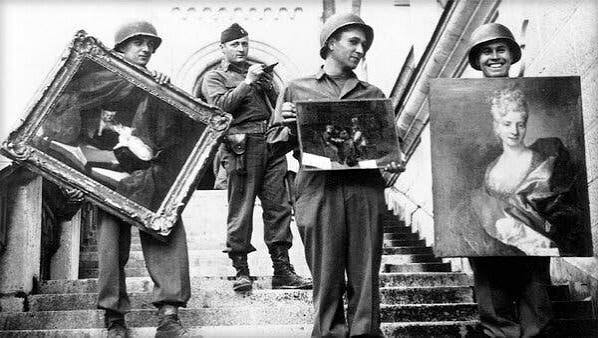
In the spring of 1945, as Allied tanks rolled into the German countryside, a small group of middle-aged art historians and museum curators drove through the front lines in unarmored jeeps, carrying nothing more than maps, notebooks, and a fierce determination. Their mission was not to capture territory or destroy enemy positions, but to find and rescue the millions of artworks the Nazis had stolen and hidden across Europe. They were the Monuments, Fine Arts, and Archives officers—the Monuments Men—and their work would define how the world protects cultural heritage in times of war.
The Threat to Civilization
The Nazis’ systematic looting of Europe’s art was not a sideshow to the war; it was a core part of their ideology. Under the direction of the Einsatzstab Reichsleiter Rosenberg (ERR), special units confiscated Jewish-owned collections across occupied Europe. Hitler planned to fill a grand Führermuseum in Linz, Austria, with the best of these stolen works, while Hermann Göring, second in command of the Third Reich, built his own private collection from the spoils.
By 1943, the scale of the destruction and theft had become a concern for the Allies. Historic cities were being reduced to rubble, and priceless monuments were disappearing under bombs. The American art world, led by the American Defense Harvard Group, pressured the U.S. government to act. In response, the Roberts Commission was created, and the Monuments, Fine Arts, and Archives program was born.
The Unlikely Soldiers
The MFAA was a group of about 345 men and women from 13 nations. They were not trained soldiers; they were art historians, curators, architects, and educators. George Stout, a conservator who pioneered modern art conservation techniques, developed the methods for packing and moving fragile works. James Rorimer, who would later become the director of the Metropolitan Museum of Art, led the group in the European Theater. Sculptor Walker Hancock worked in Italy and later helped recover works from the Altaussee salt mine in Austria.
One of the most remarkable figures was Rose Valland, a French art historian who was not officially an MFAA officer but whose intelligence was crucial. Working at the Jeu de Paume museum in Paris, which the Nazis used as a sorting depot for looted art, she secretly recorded the details of every shipment—where it came from, where it was going. Her meticulous notes, passed to the Allies, provided the roadmap for recovery.
These were men and women in their 30s and 40s, often physically unfit for combat, yet they operated near the front lines, sometimes under fire. They faced constant skepticism from military commanders who saw them as a burden. But they persisted, armed with the conviction that civilization’s treasures were worth risking their lives for.
The Hunt for the Salt Mines
As the war drew to a close, the Monuments Men received reports that the Nazis had hidden vast quantities of art in salt mines, which offered stable temperature and humidity. The most famous of these was the Merkers salt mine in Germany, where they found not only artworks but the German national gold reserves. But the most extraordinary discovery came in Altaussee, Austria, in May 1945.
Deep inside the Altaussee mine, the Monuments Men found over 6,500 paintings, including works by Vermeer, Michelangelo, and the Ghent Altarpiece—one of the most important artworks in European history. The Nazis had stored them there, and in the final days of the war, they had placed explosives at the mine’s entrance with orders to destroy everything. But the miners, who had been forced to work there, removed the explosives and saved the treasures.
The recovery was painstaking. Each work had to be carefully packed and transported to a Central Collecting Point, where it was identified, cataloged, and prepared for return. The Monuments Men worked for years after the war, sorting through over 1,000 repositories—mines, castles, monasteries—and recovering an estimated 5 million cultural objects.
The Cost of Duty
The work was not without sacrifice. Two MFAA officers were killed in action: Ronald Balfour, a British art historian, died in 1945 while trying to save a church in Cleves, Germany. Their deaths underscored the danger these scholars faced, not with weapons but with clipboards.
The Monuments Men also faced moral dilemmas. After the war, some MFAA officers protested the U.S. decision to send German-owned art to America for safekeeping, arguing that it violated the principles they had fought for. Their protest, known as the Wiesbaden Manifesto, was a reminder that the line between protection and looting can be thin.
A Lasting Legacy
The Monuments Men’s work did not end with the return of art. Their experience influenced the creation of the 1954 Hague Convention for the Protection of Cultural Property in the Event of Armed Conflict, which established international norms for preserving heritage during war. Today, the U.S. military has a similar unit, the Monuments, Fine Arts, and Archives program, which was deployed in Iraq and Afghanistan.
The story of the Monuments Men has been told in books and films, most notably the 2014 George Clooney movie. But the real story is more complex and more remarkable. These were not action heroes; they were scholars who believed that a society’s culture is worth protecting, even at the cost of their own safety.
The Unfinished Work
Not every piece was recovered. Some works remain missing, their fates unknown. Some restitutions were delayed for decades, and some families never saw their treasures again. The Monuments Men’s work was not perfect, but it set a precedent that the world has followed ever since.
In the quiet halls of the Central Collecting Points, amid the smell of old canvas and packing straw, a small group of dedicated people ensured that the Nazis’ attempt to erase a culture did not succeed. They were not soldiers in the traditional sense, but they fought a battle that mattered just as much.
The Monuments Men’s legacy is not just in the millions of artworks they saved, but in the principle they established: that cultural heritage is a universal treasure, worth defending even in the darkest times. Their story is a reminder that even in the chaos of war, there are those who fight to preserve beauty, knowledge, and history for future generations.
Summary
- The Monuments, Fine Arts, and Archives (MFAA) program was a group of about 345 art historians, curators, and architects from 13 nations who served in WWII.
- They were tasked with protecting cultural property from war damage and recovering art looted by the Nazis.
- Key figures included George Stout, James Rorimer, Walker Hancock, and French art historian Rose Valland.
- Major recoveries included the Merkers salt mine (with the bust of Nefertiti) and the Altaussee salt mine (with over 6,500 paintings, including the Ghent Altarpiece).
- The MFAA’s work influenced the 1954 Hague Convention and set a precedent for cultural preservation in conflict.
FAQ
Q: Who were the Monuments Men?
A: They were a group of approximately 345 men and women from 13 nations, mostly art historians, curators, architects, and educators, who served in the Allied armies during World War II to protect cultural property and recover looted art.
Q: How much art did they recover?
A: They searched over 1,000 repositories and recovered an estimated 5 million cultural objects, though exact numbers vary by source.
Q: What was the most significant discovery?
A: The Altaussee salt mine in Austria, where they found over 6,500 paintings, including works by Vermeer, Michelangelo, and the Ghent Altarpiece.
Q: Did any Monuments Men die in the line of duty?
A: Yes, two were killed in action: Ronald Balfour, a British art historian, and another officer whose name is less well-known.
Q: What impact did they have on modern practice?
A: Their work influenced the 1954 Hague Convention for the Protection of Cultural Property in Armed Conflict, and the modern U.S. military has a similar unit today.