In 1989, a three-digit number quietly began its ascent to becoming one of the most consequential metrics in American life. That year, Fair Isaac Corporation introduced the first generic credit bureau risk score a statistical tool that could be used across lenders, not just one. Six years later, Fannie Mae and Freddie Mac made it mandatory for all conventional mortgages, and the credit score cemented its role as the de facto gatekeeper to housing, jobs, and insurance.
Today, over 200 million Americans have credit files, and scores influence more than 90% of consumer lending decisions. Yet this system’s origins are surprisingly obscure: it emerged not from consumer advocacy or financial regulation, but from Cold War-era statistical modeling, military-funded research, and a cultural faith in quantification. Understanding how a risk metric became so pervasive reveals both its power and its blind spots especially for the 26 million Americans who remain ‘credit invisible.’
What Exactly Is a Credit Score?
A credit score is a three-digit number, typically ranging from 300 to 850, that statistically predicts the likelihood that a consumer will repay a debt within 90 days. It is not a measure of character, intelligence, or financial literacy—only a probability based on past behavior. The dominant model is the FICO Score, created by Fair Isaac Corporation. Its main competitor, VantageScore, was launched in 2006 by the three major credit bureaus: Equifax, Experian, and TransUnion.
The FICO score is calculated from five components:
- Payment history (35%): Whether you’ve paid past debts on time.
- Amounts owed (30%): How much debt you carry relative to your credit limits.
- Length of credit history (15%): How long your accounts have been active.
- New credit (10%): Recent applications for credit.
- Credit mix (10%): The variety of credit types you have, such as credit cards, auto loans, and mortgages.
These percentages show that the score is backward-looking—it heavily weighs what you’ve done before, not what you might do in the future.
Before the Algorithm: Credit as Personal Judgment
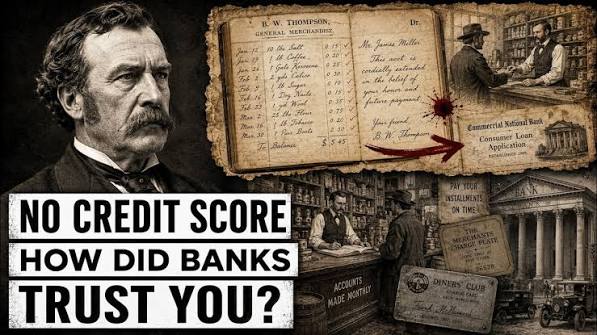
For most of American history, credit was extended based on personal relationships. A local merchant knew his customers by name, their families, and their reputations. But as the economy nationalized in the late 19th and early 20th centuries, credit bureaus emerged as ‘mercantile agencies’ to collect information about consumers across distances. The first of these, Dun & Bradstreet, relied on subjective reports from local informants—often biased, inconsistent, and prone to error.
By the mid-20th century, consumer credit had exploded with installment plans and revolving charge accounts. Lenders faced a problem: they needed to assess risk faster and more objectively as the volume of applications grew. The old system of character judgments was slow, subjective, and often discriminatory.
The solution came from an unlikely source: the military-industrial complex.
The Cold War Connection: How Military Math Shaped Credit
During the 1950s and 1960s, the United States poured massive funding into operations research and statistical modeling—techniques developed for military applications like missile guidance and code-breaking. This era also saw the rise of McCarthy-era surveillance, which normalized the idea that citizens could be tracked and categorized by centralized data systems.
In this environment, two men—Bill Fair and Earl Isaac—founded Fair, Isaac and Company in San Francisco in 1956. Their first product was a credit scoring system for a small finance company. They drew on statistical pattern recognition techniques that had been refined for military use. The cultural ethos of the time—faith in quantification, systems analysis, and ‘scientific management’—made the idea of reducing human character to a formula seem not just plausible, but progressive.
Fair and Isaac argued that their scores were fairer than human judgment. A loan officer’s gut feeling could be swayed by race, gender, or class bias. An algorithm, they claimed, was colorblind. This argument proved persuasive, especially after the Equal Credit Opportunity Act of 1974 and the Fair Housing Act made it illegal to discriminate on the basis of race, gender, religion, and other factors. Lenders could now point to a score as evidence of compliance—a statistical tool was easier to defend than a subjective decision.
Yet this ‘objectivity’ was incomplete. Scores were built on historical data that reflected past discrimination, such as redlining, which denied mortgages to minority neighborhoods. The algorithm didn’t create those patterns, but it encoded them, making them harder to challenge.
1989: The Turning Point
Before 1989, credit scores were custom-built for individual lenders. If you applied for a car loan, the lender might have its own proprietary model that didn’t follow you elsewhere. That changed when FICO introduced the first generic credit bureau risk score—a single number that could be used across lenders.
The implications were immediate. A score could now follow a consumer across all financial relationships. If you had a low score with one lender, it would affect your ability to get credit from any other. The score became a portable financial identity.
But the real inflection point came in 1995, when Fannie Mae and Freddie Mac—the government-sponsored enterprises that back most U.S. mortgages—began requiring FICO scores for all conventional mortgages. From that moment, the credit score became a de facto national ID for financial life. To buy a home, you needed a good score. There was no opting out.
Beyond Credit: The Score’s Expansion into Every Corner of Life
The credit score’s reach soon extended far beyond lending. Today, your credit file can influence:
- Insurance: Auto and home insurers use ‘credit-based insurance scores’ in most states, justified by a statistical correlation with claims risk. A low score can mean higher premiums, even if you’re a safe driver.
- Employment: Most employers run credit checks on job applicants. While legal in most states, these checks can disqualify candidates, especially for jobs involving financial responsibility.
- Utilities and rentals: Landlords routinely pull credit reports, and utility companies may require deposits from those with thin files. Cell phone contracts, too, often hinge on creditworthiness.
This expansion has made the score a gatekeeper not just for credit, but for basic necessities like housing and employment.
The Scale and the Invisible
The credit reporting industry generates roughly $17–20 billion annually. Over 200 million Americans have credit files. Yet the system has significant gaps. An estimated 26 million Americans—roughly 1 in 10 adults—are ‘credit invisible,’ meaning they have no credit file at all. Another 19 million have ‘unscorable’ files—too thin to generate a score. These individuals are often young, low-income, or members of minority communities, and they face barriers to accessing even basic financial services.
In response, new ‘alternative data’ scoring models are emerging that consider rent payments, utility bills, and other non-traditional data. VantageScore has incorporated such data, but FICO remains dominant. While alternative data could help bring the invisible into the system, it also raises privacy concerns—the same data that could score you could also be used to track you.
Regulation and the Future
Regulation has lagged behind the score’s rise. The Fair Credit Reporting Act of 1970 was the first federal law to regulate credit reporting, but it predates the generic score by two decades. The Fair and Accurate Credit Transactions Act of 2003 mandated free annual credit reports, giving consumers a way to check their files. The Dodd-Frank Act of 2010 created the Consumer Financial Protection Bureau, which gained supervisory authority over credit bureaus.
Yet errors remain common, and consumers have limited recourse. A 2012 Federal Trade Commission study found that one in five consumers had an error on at least one credit report. Disputing errors can be a bureaucratic nightmare, and the bureaus have little incentive to correct them quickly.
Conclusion: A Tool, Not a Verdict
The credit score is a powerful statistical tool, but it is not an objective measure of worth. Its history is rooted in Cold War-era faith in algorithms and military-funded research, and its expansion into housing, jobs, and insurance has made it a gatekeeper of American life. As alternative data and new scoring models emerge, the question is not whether scores will disappear—they are too entrenched for that—but whether they can be made fairer, more transparent, and more inclusive.
The credit score is a powerful statistical tool, but it is not an objective measure of worth. Its history is rooted in Cold War-era faith in algorithms and military-funded research, and its expansion into housing, jobs, and insurance has made it a gatekeeper of American life. As alternative data and new scoring models emerge, the question is not whether scores will disappear—they are too entrenched for that—but whether they can be made fairer, more transparent, and more inclusive.
Summary
- Credit scores are three-digit numbers (300–850) that predict debt repayment likelihood, with FICO and VantageScore as the main models.
- Fair Isaac and Company was founded in 1956, drawing on Cold War-era statistical modeling; the first generic FICO score appeared in 1989, and Fannie Mae/Freddie Mac made it mandatory for mortgages in 1995.
- Scores expanded beyond lending to insurance, employment, and rentals, affecting over 200 million Americans and 90% of lending decisions.
- An estimated 26 million Americans are ‘credit invisible’—no credit file at all—highlighting inclusivity gaps.
- Regulation (FCRA, FACTA, Dodd-Frank) has lagged, and errors affect 1 in 5 consumers, raising fairness concerns.
FAQ
Q: What is a credit score?
A: A credit score is a three-digit number (typically 300–850) that statistically predicts the likelihood a consumer will repay a debt within 90 days. The most common is the FICO Score, but VantageScore is a rival model.
Q: When did credit scores become widely used?
A: The first generic FICO score was introduced in 1989, but the tipping point was 1995, when Fannie Mae and Freddie Mac began requiring FICO scores for all conventional mortgages.
Q: How is a credit score calculated?
A: FICO scores weigh five factors: payment history (35%), amounts owed (30%), length of credit history (15%), new credit (10%), and credit mix (10%).
Q: Can employers see my credit score?
A: Yes, most employers run credit checks on job applicants, though they typically see a modified report without the score itself. This is legal in most states, with some restrictions.
Q: What does ‘credit invisible’ mean?
A: It refers to the roughly 26 million Americans (1 in 10 adults) who have no credit file at all, making it impossible to generate a score. This often affects young people, low-income individuals, and minorities.