Tag: constellations

  • The Celestial Atlas: How 88 Constellations Became the Night Sky’s Official Map

    The Celestial Atlas: How 88 Constellations Became the Night Sky’s Official Map

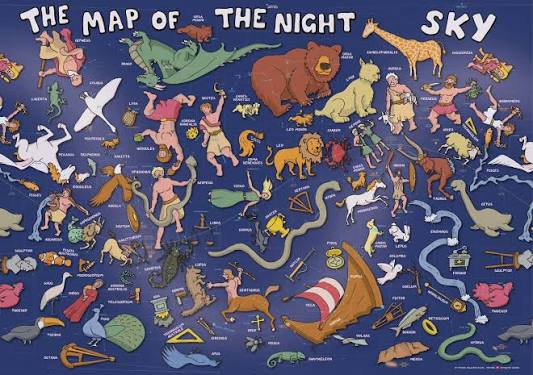
    When you look up on a clear night, you’re seeing a sky that has been mapped, divided, and named over thousands of years. The 88 constellations recognized today weren’t always so neatly defined. They emerged from a messy history of myth, exploration, and scientific standardization.

    This is the story of how ancient stargazers’ patterns became a universal system—and why, even in an age of space telescopes, we still use the same Latin names that Ptolemy wrote down in 150 CE.

    From Babylon to Greece: The First Sky Maps

    Long before the IAU, Babylonian astronomers were the first to record constellations. The Mul.Apin tablets, dating to around 1200 BCE, list star groups that later showed up in Greek astronomy. Leo, Scorpius, and Taurus all have clear Mesopotamian roots. When Homer wrote about Orion and the Pleiades in the 8th century BCE, he was tapping into a tradition that was already centuries old.

    The Greeks didn’t just inherit these patterns—they wove them into mythology. Heroes, monsters, and gods filled the sky: Perseus, Andromeda, Hercules, and the rest. Each constellation became a visual story, preserving myths for generations. When Claudius Ptolemy compiled his Almagest around 150 CE, he catalogued 48 constellations, drawing on this rich Greek tradition. His book became the definitive star guide for the next 1,400 years.

    The Great Southern Gap

    The ancient Mediterranean skywatchers had a blind spot: they couldn’t see the southernmost stars. As European explorers sailed south in the 16th and 17th centuries, they encountered a sky full of unfamiliar stars. Dutch navigators Pieter Dirkszoon Keyser and Frederick de Houtman mapped these southern skies in the 1590s, and astronomer Petrus Plancius turned their observations into new constellations.

    Plancius introduced about 12 new southern constellations, including the Toucan and the Bird of Paradise. Later, in the 1750s, French astronomer Nicolas-Louis de Lacaille added 14 more. But instead of mythological heroes, he chose scientific instruments: the Air Pump, the Furnace, the Clock. This was a radical departure from the old naming tradition—a nod to the Enlightenment’s obsession with observation and measurement.

    Chaos in the Heavens: The Need for Standardization

    By the 19th century, the sky was getting crowded. Different astronomers had proposed over 100 constellations, often overlapping or conflicting. Charts disagreed, and navigators and scientists needed a common reference. In 1922, the International Astronomical Union (IAU) stepped in and voted to standardize the list at 88. Eight years later, Belgian astronomer Eugène Delporte drew precise boundaries along lines of right ascension and declination, ensuring every point in the sky belonged to exactly one constellation.

    Since 1930, the 88 have remained fixed. No new constellations have been added, and none have been removed. The boundaries Delporte drew are still in use today.

    The Naming Game: Latin, Genitives, and Asterisms

    Each official constellation has a Latin name, like Ursa Major or Orion. But you’ll often hear English versions: the Great Bear, the Hunter. The Latin names aren’t just for show—they’re used in star catalogues. To name a star, you use the genitive (possessive) form of the constellation: Alpha Centauri means “Alpha of Centaurus,” and Beta Orionis means “Beta of Orion.”

    This grammatical quirk means that learning constellation names is also a lesson in Latin declensions. Vela (the Sails) becomes Velorum, but Puppis (the Stern) stays Puppis. It’s a hidden grammar that astronomers must master.

    Asterisms are different from constellations. They’re recognizable patterns that aren’t officially recognized. The Big Dipper, for example, is an asterism within the constellation Ursa Major. The Summer Triangle and the Teapot in Sagittarius are other famous asterisms.

    A Sky of Many Cultures

    The 88 official constellations are a product of Western history. They represent just one way of organizing the stars. Other cultures have entirely different systems. Chinese astronomers divided the sky into 28 “mansions,” grouping stars in ways that don’t match the Greek constellations. Indigenous Australian cultures saw the Emu in the Sky, not as a pattern of stars but as a dark nebula—a shape traced by the absence of light.

    The naming of the southern constellations by Europeans was a colonial act. It overwrote or ignored the indigenous star knowledge that had existed for centuries. The sky, like the land, was claimed and renamed by explorers. Today, there’s growing recognition of this lost knowledge, and efforts to preserve and revive indigenous astronomy are gaining momentum.

    Why These Names Stick

    Despite the cultural baggage, the 88 constellations have endured for nearly a century. Their Latin names provide a stable, universal reference. The boundaries are exact, making them useful for astronomers. And the myths behind them—Orion the hunter, Cassiopeia the queen—still capture our imagination.

    The language of stars is a blend of ancient storytelling and modern science. It’s a map of the sky that has been drawn and redrawn, but the lines have held. That’s a remarkable achievement for a system that began with Babylonian priests and Greek poets.

    The 88 constellations are more than just patterns in the sky. They’re a living record of human history—from Babylonian tablets to Dutch ships to the IAU’s meeting rooms. The next time you spot Orion’s belt, remember that you’re seeing the same stars that a poet in Homer’s time described, and that the name you use was formalized less than a century ago. The sky may be ancient, but its map is still being written.

    Summary

    • The 88 official constellations were standardized by the IAU in 1922, with boundaries fixed in 1930 by Eugène Delporte.
    • Ptolemy’s Almagest (c. 150 CE) catalogued 48 constellations, forming the foundation of Western astronomy.
    • Southern constellations were added by European explorers like Petrus Plancius and Nicolas-Louis de Lacaille, who chose scientific names over mythology.
    • Asterisms like the Big Dipper are not official constellations but recognizable patterns within them.
    • The official system reflects a Western, Greco-Roman perspective, while other cultures—like Chinese and Indigenous Australian—have entirely different star groupings.

    FAQ

    Q: How many constellations are officially recognized?
    A: There are 88 official constellations, as defined by the International Astronomical Union (IAU) since 1922.

    Q: What is the difference between a constellation and an asterism?
    A: A constellation is an officially recognized region of the sky with defined boundaries. An asterism is a recognizable pattern of stars that isn’t an official constellation, like the Big Dipper.

    Q: Why are constellation names in Latin?
    A: Latin was the language of scholarship in Europe when the constellations were catalogued. The IAU kept Latin names to ensure a universal, unchanging reference.

    Q: Did ancient Greeks see the same constellations we do?
    A: They saw many of the same patterns, but the official list includes additions made later for the southern sky, which they couldn’t see.

    Q: Can new constellations be added?
    A: No. The 88 constellations have been fixed since 1930, and the IAU has no plans to change them.
  • The Cosmic Hunt: How Ancient Cultures Saw the Same Stars Differently

    The Cosmic Hunt: How Ancient Cultures Saw the Same Stars Differently

    Look up on a clear night, and you’ll see the same stars that ancient Greeks, Norse seafarers, Lakota hunters, and Aboriginal Australians saw. Yet each culture told completely different stories about those patterns. The Big Dipper was a bear to some, a wagon to others, and a stretcher carrying a wounded man to the Lakota. Orion, the mighty hunter of Greek myth, was a chief’s arm to the Lakota and the three gods of fortune in China.

    This isn’t just a curiosity of history. It shows how human brains are wired to find patterns, and how our environment shapes what we see. The stars themselves don’t change, but the stories we attach to them reveal what each culture valued, feared, and needed to remember.

    The Same Sky, Different Stories

    Imagine a group of ancient Greeks and a group of Lakota Sioux both looking at the same cluster of seven stars. The Greeks saw a bear, Ursa Major, and told stories of Zeus turning a nymph into a bear to save her from his jealous wife. The Lakota saw not a bear, but a stretcher carrying a wounded man, with four stars forming the poles and three forming the man himself. Both groups looked at the same pattern, but their interpretations were shaped by their environments: bears were common in both Greece and North America, but the Lakota’s story reflects a nomadic lifestyle where carrying the wounded was a daily reality.

    This diversity is the heart of the “Cosmic Hunt,” a term anthropologists use for a widespread myth pattern where a hunter (often with dogs) chases an animal across the sky. The pattern appears in cultures from Siberia to Australia, from Scandinavia to Africa. But the details change: the hunter might be Orion, the animal might be a bear, a deer, or an emu, and the chase might take place across the Milky Way, which many cultures saw as a river or a road.

    Why Do We See Shapes in the Sky?

    Humans are pattern-seeking creatures. Our brains are wired to recognize faces and shapes, a phenomenon called pareidolia. When we look at a random scatter of stars, we can’t help but impose order. This is why every culture has constellations, even though the stars themselves have no inherent shape. The patterns we see are often those that matter to us: a hunter sees a hunter, a farmer sees a plow, a sailor sees a canoe.

    Consider the Polynesians, who navigated vast stretches of the Pacific by canoe. They saw the stars as a great canoe, with the hull formed by the Milky Way and the oars by bright stars. The Mongols, living on the steppes, saw herds of animals and hunters in the sky. The Inuit, in the Arctic, saw bears and caribou. The same stars, different lives, different stories.

    The Cosmic Hunt Across Cultures

    Let’s take a closer look at how three very different cultures interpreted the same star groupings.

    Orion: Hunter, Hand, or Three Gods?

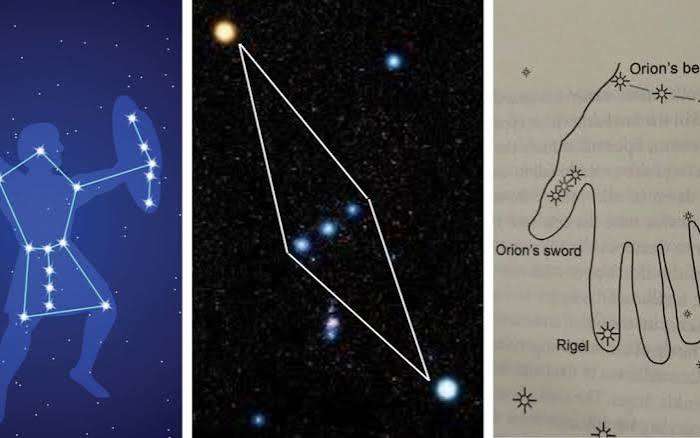
    To the ancient Greeks, Orion was a giant huntsman, placed in the sky by Zeus after his death. He forever chases the Pleiades (the Seven Sisters) across the heavens, accompanied by his faithful dog, Canis Major. The constellation is easy to spot: three bright stars form his belt, and his shoulders and feet are marked by other bright stars.

    The Lakota people of North America saw something entirely different. They called this group of stars “The Hand,” representing the arm of a chief. The three stars of Orion’s belt were the wrist, and the stars above and below were the fingers and thumb. This wasn’t a hunter but a symbol of authority and strength.

    In China, the three stars of Orion’s belt were known as “Fu, Lu, Shou” — the gods of fortune, prosperity, and longevity. These were not mythic characters in a hunt but objects of veneration, representing wishes for a good life. Each culture took the same pattern and wove it into their own values and beliefs.

    The Big Dipper: Bear, Wagon, or Stretcher?

    In Western astronomy, the Big Dipper is not a constellation but an asterism — a recognizable pattern within the larger constellation Ursa Major. But many cultures treat these seven stars as a distinct and meaningful grouping.

    The Greeks saw a bear, and the name Ursa Major reflects that. The Norse, however, saw Odin’s wagon, and they called it Karlavagnen. The wagon was a practical vehicle for a god who traveled the sky, and the stars were the wheels and the shaft.

    The Lakota again had a different story. They saw the four stars of the bowl as a stretcher, and the three stars of the handle as the wounded man being carried. This story served a practical purpose: it reminded the Lakota of the importance of caring for the injured, a lesson essential for survival on the plains.

    The Pleiades: Sisters, Hens, or Maidens?

    The Pleiades, a tight cluster of seven stars, are one of the most universally recognized star patterns. In Greek myth, they were the Seven Sisters, daughters of Atlas, who were pursued by Orion. In Norse tradition, they were hens with their chicks. The Lakota saw them as the Seven Maidens, often associated with the buffalo.

    In Australian Aboriginal cultures, the Pleiades are the Seven Sisters, and they are pursued by a man, often identified with Orion. This story is part of a larger epic that spans the sky, and it teaches lessons about proper behavior and the dangers of obsession.

    The Milky Way: A River, a Road, or a Hunt

    The Milky Way, that band of light stretching across the sky, is not a constellation but a collection of billions of stars. Yet it plays a central role in many cultures’ sky stories. To the Greeks, it was the Milky Way, the spilled milk of the goddess Hera. To the Norse, it was the path of the dead, leading to Valhalla. To many Aboriginal Australian peoples, it is the river in the sky, and the dark patches within it form the “Emu in the Sky.”

    This emu is not made of stars but of dark nebulas — clouds of dust that block the light behind them. For Aboriginal Australians, the emu’s position in the sky signaled when to hunt emu eggs. When the emu’s head appeared on the horizon, it was time to look for eggs on the ground. This is a perfect example of how practical knowledge was encoded in myth.

    The Cosmic Hunt is often set along the Milky Way. The hunter chases the animal across the celestial river, and the chase explains the changing positions of the constellations throughout the year. For cultures that depended on hunting, this story made the sky a map and a calendar.

    Why So Many Similarities?

    Given that the stars are the same for everyone, it’s not surprising that many cultures developed similar motifs. But the Cosmic Hunt is so widespread that some scholars wonder if it originated from a single ancient source. Anthropologist Yuri Berezkin has catalogued hundreds of versions of the Cosmic Hunt, and he notes that they appear in cultures that had no known contact.

    There are two main explanations. First, cultural diffusion: the story spread through ancient migrations and trade routes, changing as it moved. Second, independent invention: human minds, facing similar environments and similar skies, came up with similar stories on their own. The truth likely lies in a combination of both. The Cosmic Hunt may have been invented many times, but it also traveled, and each culture adapted it to their local fauna and flora.

    The Sky Changes, Too

    One thing that complicates the story is that the sky itself changes over time. The Earth wobbles on its axis, a slow process called precession, which shifts the positions of constellations relative to the horizon over thousands of years. A star pattern that marked the spring equinox in 3000 BCE no longer does so. This means that the same constellation had different seasonal meanings for different cultures at different times.

    For example, the Big Dipper is circumpolar in northern latitudes, meaning it never sets. But in ancient Egypt, it was not always visible, and its position changed over the centuries. This would have affected how different cultures used it for timekeeping and navigation.

    The Stars as Mnemonics

    Why did cultures go to the trouble of inventing such elaborate stories? One practical reason is that stories are easier to remember than star charts. If you need to know when to plant crops or when to migrate, a story about a hunter chasing a bear is more memorable than a list of coordinates.

    The Cosmic Hunt served as a mnemonic device. The hunter, the animal, and the chase encoded information about the seasons. When Orion disappeared from the evening sky, the Greeks knew that winter was coming. When the Emu in the Sky appeared, Aboriginal Australians knew it was time to collect eggs. The stories were not just entertainment; they were survival tools.

    The Modern Sky

    Today, we still look at the same stars, but our stories have changed. We see Orion as a hunter, but we also know it as a region of star formation. The Big Dipper is a pointer to the North Star, but it’s also a constellation in the International Astronomical Union’s official list. Our culture has its own myths, from the stories we tell about the zodiac to the names we give to exoplanets.

    But the ancient stories remind us that the sky is a canvas on which we project our hopes, fears, and daily realities. The stars themselves are indifferent, but we are not. And that is what makes the Cosmic Hunt so fascinating: it shows us that the universe is not just out there, but also in here, in our minds.

    The Cosmic Hunt is a reminder that the night sky is a shared human heritage, yet each culture has painted it with its own colors. The stars are constant, but our stories are not. By looking at how others have seen the same patterns, we gain a deeper appreciation for the diversity of human imagination and the common threads that connect us all.

    Summary

    • The same star patterns, like Orion and the Big Dipper, have radically different myths across cultures, from Greek hunters to Lakota stretchers.
    • Cultural and environmental factors shape what we see in the stars: sailors see canoes, hunters see game, farmers see plows.
    • The Cosmic Hunt is a global motif, possibly spread by cultural diffusion, independent invention, or both.
    • The Milky Way often serves as a celestial river or road, and in Aboriginal Australian culture, its dark patches form the Emu in the Sky, a seasonal indicator.
    • Constellations served as mnemonic devices, encoding practical knowledge about seasons and navigation in memorable stories.

    FAQ

    Q: Why do different cultures see different things in the same stars?
    A: Because humans are pattern-seeking animals, and we tend to project our own environment and experiences onto random arrangements of stars. A culture that relies on hunting sees hunters; a seafaring culture sees canoes.

    Q: Is the Cosmic Hunt a single myth or many independent ones?
    A: It’s a recurring motif that appears in many cultures. Some scholars argue it spread from a common source, while others think it was invented independently in different places. The truth likely involves both.

    Q: How did ancient cultures use constellations practically?
    A: They used them as calendars and navigation aids. The stories attached to star patterns served as mnemonic devices, making it easier to remember when to plant crops, when to migrate, or how to find directions.

    Q: What is the Emu in the Sky?
    A: It’s a constellation made of dark patches in the Milky Way, not stars. Aboriginal Australians used its position to time the collection of emu eggs.

    Q: Do the stars change over time?
    A: Yes, due to precession, the Earth’s axis wobbles over thousands of years, shifting the positions of constellations relative to the horizon. This means the same star pattern had different meanings for different cultures at different times.