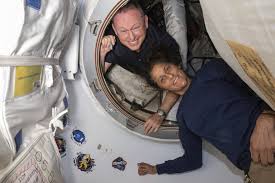
On August 18, 2026, two astronauts floated outside the International Space Station (ISS) for 6 hours and 23 minutes. Their goal: to finish installing a high-speed communications system component. What makes this spacewalk unusual isn’t just the hardware—it’s the people. Anil Menon (NASA) and Sophie Adenot (ESA) are both on their first spaceflight, and this was their first spacewalk. For decades, such complex EVAs were reserved for seasoned astronauts. Now, a new generation is taking the lead.
The Spacewalk: What Happened
At 400 kilometers above Earth, Menon and Adenot worked in the vacuum of space, tethered to the ISS. Menon wore the suit with a red stripe on the legs—the designation for EV1, the lead spacewalker. Adenot, as EV2, wore the unstriped suit. Their task: finishing the installation of a high-speed communications antenna or data relay system. The word “finishing” is key—this wasn’t a first step. Previous spacewalks or robotic arms had already positioned the hardware, and this EVA was the final assembly and connection.
Spacewalks are physically demanding. The suits are pressurized at 4.3 psi, making every movement work against the suit’s stiffness. Astronauts train for hours in NASA’s Neutral Buoyancy Laboratory, a giant pool that simulates microgravity. But no amount of training fully prepares you for the reality of looking down at Earth from the void.
Why High-Speed Communications Matter
The ISS has used radio frequency (RF) systems for decades, but they’re limited. Laser communications—like the kind Menon and Adenot installed—can transmit data at rates 10 to 100 times faster. That means more science data can be sent back to Earth, from high-resolution Earth imaging to biomedical experiments. This upgrade isn’t just for the ISS; it’s a testbed for Artemis missions to the Moon and future Mars expeditions, where high-bandwidth links will be essential.
This EVA is part of a broader trend: the ISS is aging, but it’s also being upgraded. Over 250 spacewalks have been conducted since 1998, and most early ones were for assembly. Now, they’re mostly maintenance and upgrades—a sign of the station’s maturity.
Who Are These Astronauts?
Anil Menon is a physician and former SpaceX medical director. He was selected in NASA’s 2021 astronaut class, part of the “Artemis Generation.” Sophie Adenot is a French helicopter test pilot and engineer, selected by ESA in 2022. Both bring unique skills: Menon’s medical background is crucial for long-duration missions, while Adenot’s test pilot experience means she’s used to high-stakes, precise operations.
The fact that both are rookies is significant. In the past, a complex EVA would be led by veterans. Now, with a new generation and commercial partners, the training and trust in these astronauts is such that they can handle it. This also reflects a shift toward international cooperation—ESA and NASA working side-by-side on critical tasks.
The Challenges of a First Spacewalk
A first spacewalk is a mental and physical challenge. The suit is your own personal spacecraft—you’re isolated, with only your training and your crewmate. The “overview effect,” the profound cognitive shift astronauts often experience seeing Earth from space, can be overwhelming. But Menon and Adenot executed the installation flawlessly, a testament to their preparation and the support teams on the ground.
For Menon, the journey from medicine to spaceflight is inspiring. For Adenot, from flying fighter jets to floating in space. Their presence on this EVA opens doors for diverse STEM careers, showing that there’s no single path to becoming an astronaut.
What’s Next?
This spacewalk is a stepping stone. Both astronauts may fly to the Moon or Gateway in future missions. The high-speed communications they installed will enable more data-intensive science and validate technologies for Artemis. As the ISS transitions to commercial space stations in the late 2020s, the experience gained from this EVA will be invaluable.
In the meantime, Menon and Adenot will continue their Expedition 75 duties aboard the ISS. But for 6 hours and 23 minutes on that August morning, they were the face of a new era in human spaceflight.
The August 18, 2026 spacewalk wasn’t just about cables and antennas—it was about the future. Two first-time astronauts proved that the next generation is ready to take on the most demanding tasks in space. The high-speed links they installed will pay dividends for years to come, and their example will inspire countless others to reach for the stars.
Summary
- Anil Menon (NASA) and Sophie Adenot (ESA) completed a 6h 23m spacewalk on August 18, 2026, to finish installing a high-speed communications component on the ISS.
- Both astronauts are on their first spaceflight and first EVA, marking a generational shift in spacewalk assignments.
- The upgrade enhances data transmission rates, benefiting science and future Artemis missions.
- Menon wore the EV1 red-striped suit, leading the EVA; Adenot served as EV2.
- This EVA reflects the ISS’s transition from assembly to maintenance and upgrade missions.
FAQ
Q: What is a spacewalk?
A: A spacewalk, or extravehicular activity (EVA), is when an astronaut leaves the spacecraft to perform tasks outside, wearing a specialized suit for protection.
Q: Why is high-speed communications important for the ISS?
A: Higher data rates allow more scientific data to be transmitted to Earth, enabling more complex experiments and real-time video, which is crucial for future deep-space missions.
Q: What does the red stripe on the spacesuit mean?
A: In NASA’s EMU suits, the red stripe identifies the lead spacewalker (EV1), who is responsible for the overall EVA. The other astronaut (EV2) wears a suit without a stripe.
Q: How do astronauts train for a spacewalk?
A: They train extensively in the Neutral Buoyancy Laboratory (a large pool) and using virtual reality to simulate the microgravity environment, practicing every step until it’s second nature.
Q: What’s next for these astronauts?
A: Both are expected to continue their Expedition 75 mission and may be considered for future lunar or Gateway missions, building on this experience.