
Tag: China

  • A 150-Year-Old Darwin Hypothesis Finds Support in a Chinese Alpine Plant

    A 150-Year-Old Darwin Hypothesis Finds Support in a Chinese Alpine Plant

    In 1875, Charles Darwin published Insectivorous Plants, a detailed study of species like sundews and Venus flytraps. But he also speculated that many other plants with sticky hairs might be secretly carnivorous, even without dramatic traps. Now, researchers have confirmed that Triaenophora, a plant from the high mountains of southwest China, fits that description providing concrete evidence for Darwin’s 150-year-old idea.

    The discovery is more than a botanical curiosity. It shows that carnivory can be subtle, evolving in forms that don’t immediately scream “meat-eater.” And it underscores how nutrient-poor environments, like alpine soils, can drive plants to adopt surprising strategies.

    A Plant That Was Always Suspected

    Triaenophora is a small genus of perennial herbs that grow on rocky slopes and scree fields at elevations above 2,500 meters in the Chinese provinces of Sichuan, Yunnan, and possibly Guizhou. The plants have sticky glandular hairs on their leaves and stems, which long led botanists to suspect they trapped insects. But trapping alone isn’t enough to qualify as carnivorous—the plant must also digest and absorb nutrients from its prey.

    Until recently, that evidence was missing. But a team of researchers, including Chinese botanists and international collaborators, has now provided it. Their findings, published in a peer-reviewed journal, confirm that Triaenophora is genuinely carnivorous, not just an accidental insect trap.

    Darwin’s Insight

    Darwin’s Insectivorous Plants was a landmark work that documented how sundews, butterworts, and bladderworts capture and digest prey. But he also made a broader prediction: that many more plants with glandular hairs might be carnivorous, even if they lacked the iconic snap-traps or pitchers. He saw carnivory as an adaptation to nitrogen-poor soils, a hypothesis that has held up well.

    Triaenophora fits that prediction perfectly. Its alpine habitat is nutrient-poor because cold temperatures slow decomposition, leaving little available nitrogen. The plant’s sticky hairs capture insects, and its digestive enzymes break them down, releasing nitrogen that the plant absorbs.

    The Evidence for Carnivory

    The research team used a combination of methods to confirm carnivory. They detected protease and other digestive enzymes on the glandular hairs. They used stable isotope analysis—labeling insects with ¹⁵N—to show that nitrogen from prey was absorbed into plant tissues. And they grew plants with and without insect feedings, finding that those fed insects grew better.

    This is the kind of evidence that separates true carnivory from mere “protocarnivory,” where plants may trap insects but don’t fully digest or benefit from them. Triaenophora does all three: it traps, digests, and absorbs.

    Why This Matters

    Carnivorous plants are rare—only about 630 to 750 species worldwide—and most are found in sunny, wet, nitrogen-poor habitats like bogs and heathlands. Alpine Asia has been understudied compared to other regions, so finding a new carnivorous species there expands the known range and diversity of this trait.

    But the deeper significance is evolutionary. Darwin suggested that carnivory evolves gradually, from simple sticky traps to more complex structures. Triaenophora may represent an early or intermediate stage in that process. It’s a reminder that evolution often works in subtle steps, not just dramatic leaps.

    A Call to Re-Examine Other Plants

    The discovery also encourages botanists to look again at other glandular-haired plants, especially in nutrient-poor environments. There may be many more “cryptic” carnivores out there, plants that don’t look like the Venus flytrap but are just as deadly to insects.

    In fact, the concept of “protocarnivory” has been around for years, but confirming it in a new lineage is significant. It shows that the boundary between carnivorous and non-carnivorous plants is more fluid than we once thought.

    The Broader Picture

    Carnivory has evolved independently multiple times across the plant kingdom. Triaenophora belongs to the broomrape family (Orobanchaceae), which is not closely related to other carnivorous groups. That’s a powerful example of convergent evolution: when similar ecological pressures—like low nitrogen—lead to similar adaptations in distant lineages.

    Darwin would likely have been delighted. He hypothesized that carnivory was a response to nitrogen scarcity, and that it could exist in forms less dramatic than the Venus flytrap. Triaenophora is a concrete, living example of both points.

    The research also highlights the importance of studying under-explored habitats. High-altitude regions are extreme environments, and plants there often have unique adaptations. Who knows what else is hiding in the scree fields of the Himalayas or the Hengduan Mountains?

    The confirmation of carnivory in Triaenophora is a satisfying vindication of Darwin’s foresight. It shows that even a century and a half later, his ideas can still guide discovery. And it reminds us that the natural world is full of surprises—if we know where to look.

    Summary

    • Triaenophora, a plant from alpine southwest China, has been confirmed as carnivorous, supporting Darwin’s 1875 hypothesis about plants with sticky hairs.
    • Researchers found digestive enzymes, nitrogen absorption from prey, and growth benefits from insect feeding.
    • The discovery expands the known range of carnivorous plants into alpine Asia and suggests many more may exist.
    • It demonstrates convergent evolution in a new plant family and supports a gradual model for the evolution of carnivory.

    FAQ

    Q: What is Triaenophora?
    A: It’s a genus of perennial herbs found in high-altitude, rocky habitats in southwest China, known for sticky glandular hairs.

    Q: How did researchers confirm it’s carnivorous?
    A: They found digestive enzymes, used isotope labeling to show nitrogen from insects was absorbed, and observed better growth in plants fed insects.

    Q: Why is this linked to Darwin?
    A: In 1875, Darwin speculated that many plants with glandular hairs might be carnivorous, even without obvious traps. This discovery supports that idea.

    Q: Why does this matter for evolution?
    A: It shows carnivory can evolve subtly and has arisen independently in a new plant family, supporting convergent evolution.

    Q: Are there other plants like this?
    A: Possibly. The finding encourages re-examining other glandular-haired plants, especially in nutrient-poor environments.
  • AI Regulation in 2026: From Voluntary Pledges to Binding Law

    AI Regulation in 2026: From Voluntary Pledges to Binding Law

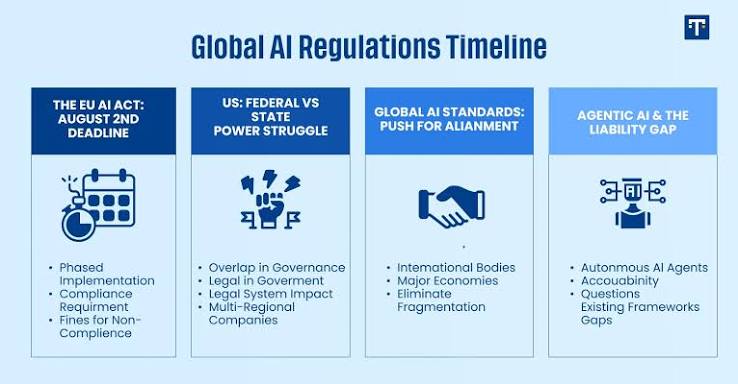
    In 2023, tech CEOs lined up to sign voluntary AI safety commitments at the White House. By 2026, those handshake deals have been replaced by binding legal obligations, hefty fines, and the first international treaty on AI. The shift from self-regulation to government enforcement is the defining story of AI policy this year.

    Three major jurisdictions—the European Union, the United States, and China—are now charting very different courses. The EU is enforcing the world’s first comprehensive AI law. The US is still relying on a patchwork of state rules and federal guidance. And China has doubled down on strict content controls and state oversight. Understanding these diverging approaches is essential for anyone building, deploying, or using AI systems in 2026.

    The EU AI Act: The World’s First Comprehensive AI Law Goes Live

    The European Union’s AI Act became binding law in August 2024, but 2026 is the year it really bites. The most significant deadline falls in August 2026, when all “high-risk” AI systems—those used in hiring, credit scoring, healthcare, and law enforcement—must be fully compliant. That means companies deploying these systems need to have risk management frameworks, data governance practices, and human oversight mechanisms in place.

    General-purpose AI models (like the ones powering ChatGPT) also face new transparency rules. Providers must publish summaries of the copyrighted material used in training, and they need to respect EU copyright law. The European AI Office, established in 2024, is now coordinating enforcement across member states, and the first fines are expected this year. Penalties can reach up to 7% of global annual turnover—a figure designed to get the attention of even the largest tech companies.

    The United States: A State-Level Patchwork and a Federal Vacuum

    No comprehensive federal AI law exists in the US as of early 2026. The 2023 executive order on AI was rescinded in January 2025, and Congress has yet to pass anything substantial. Instead, regulation is happening in two arenas: sectoral agencies and state legislatures.

    The FDA regulates AI in medical devices, the FTC polices consumer harm and deceptive practices, and the EEOC is scrutinizing algorithmic hiring. But the most aggressive action is at the state level. Colorado’s AI Act, which takes effect in 2026, requires companies to conduct impact assessments for high-risk systems. California has passed several laws, including SB 53 (mandating transparency for AI-generated content) and AB 2013 (requiring disclosure of training data). Texas also has deepfake disclosure rules with 2026 effective dates.

    This state-by-state approach creates a compliance headache for businesses, but it also reflects a political stalemate in Washington. The federal government’s focus has shifted toward national security, with the US AI Safety Institute testing frontier models and export controls limiting advanced chip sales to China.

    China: The Strictest and Most Comprehensive Model

    China’s approach is the most centralized and restrictive. The 2023 Interim Measures for Generative AI remain in force, and by 2026 they’ve been supplemented with rules on AI-generated content labeling, algorithmic recommendation transparency, and deepfake registration. All AI systems must align with “core socialist values,” and companies must conduct security assessments before releasing generative AI services to the public.

    Chinese regulations also require algorithms to be transparent to regulators, and recommendation systems must offer users options to disable personalized content. The state’s priorities are clear: maintaining social stability, controlling information flows, and ensuring the Communist Party retains ultimate authority over AI deployment.

    The Council of Europe Treaty: A Global Baseline

    The Council of Europe’s Framework Convention on AI is the first binding international treaty focused on AI. It opened for signature in September 2024, and by late 2026 it’s expected to hit the ratification thresholds needed to enter into force. The treaty covers human rights, democracy, and the rule of law, and it’s open to non-European countries—the UK, the US, and Japan are among the signatories.

    This is significant because it creates a common baseline for AI governance across very different legal systems. It requires signatories to ensure AI systems are not used to undermine democratic processes, and it mandates legal remedies for those harmed by AI decisions. Even if enforcement is weak, the treaty establishes a shared vocabulary and a mechanism for international cooperation.

    The OECD and UN: Soft Law Becoming Harder

    The OECD’s AI Principles were updated in 2024 to cover general-purpose AI and foundation models. By 2026, the OECD is running a peer-review mechanism where countries assess each other’s AI policies. This soft-law approach doesn’t have direct penalties, but it creates reputational pressure and helps spread best practices.

    At the UN level, the Global Digital Compact adopted in 2024 calls for an international AI governance body. A feasibility report is due to the General Assembly in 2026. While this is unlikely to produce a binding global regulator soon, it keeps the idea of international coordination alive.

    Enforcement and Litigation: The New Frontier

    Voluntary commitments are out; binding obligations are in. The first enforcement actions under the EU AI Act are expected in 2026, and they’ll set precedents for how the rules are interpreted. Fines are the primary tool, but injunctions—forcing companies to stop using non-compliant systems—are also possible.

    Copyright cases are also coming to a head. The New York Times v. OpenAI and Getty Images v. Stability AI lawsuits will likely see major rulings this year. The outcomes will define whether training on copyrighted works is “fair use” (the US standard) or requires explicit licensing (the EU approach). These decisions could reshape the economics of AI development.

    The Innovation vs. Safety Tension

    Industry groups warn that heavy regulation will drive AI development to friendlier shores and hurt small businesses. Civil society argues the current rules are too weak, pointing to AI systems deployed in hiring and policing with little accountability. Governments are split: the EU leans on the precautionary principle, while the US favors light-touch rules to maintain its edge.

    This tension is playing out in debates about facial recognition bans, mandatory human oversight, and the right to explanation. Expect more litigation and more legislative activity as the consequences of AI become impossible to ignore.

    The Global South’s Call for a Seat at the Table

    African, Latin American, and Southeast Asian nations argue that AI governance is being written by the Global North without their input. They’re pushing for technology transfer, data sovereignty, and protections against “AI colonialism”—where developed countries extract data from developing ones without benefit sharing. This perspective is gaining traction at the UN and OECD, but concrete concessions have been slow.

    What to Watch for the Rest of 2026

    Three things will define the rest of the year. First, the EU’s first enforcement actions will show whether the AI Act has real teeth. Second, the US midterm elections could shift federal priorities, potentially leading to a national AI law if Democrats regain control of Congress. Third, the Council of Europe treaty’s entry into force will cement international norms.

    AI regulation is no longer a theoretical debate. It’s a practical compliance issue for companies and a pressing policy challenge for governments. The rules are being written now, and they’ll shape the technology’s trajectory for decades.

    The era of voluntary AI commitments is over. In 2026, governments are translating principles into penalties, and the first enforcement cases are setting the course for the next decade. Whether you’re a developer, a business leader, or just someone using AI-enabled tools, the regulatory landscape is now part of your reality. Staying informed isn’t optional—it’s a survival skill.

    Summary

    • The EU AI Act is the first comprehensive AI law, with high-risk obligations fully applicable by August 2026.
    • The US relies on sectoral rules and state laws (e.g., Colorado, California) due to a lack of federal legislation.
    • China enforces strict content controls and state security requirements.
    • The Council of Europe’s AI treaty is expected to enter into force in late 2026.
    • The first major enforcement actions and copyright rulings will shape AI governance.

    FAQ

    Q: What is the EU AI Act?
    A: The EU AI Act is the world’s first comprehensive, binding law regulating AI. It categorizes AI systems by risk and imposes strict obligations on high-risk systems and general-purpose AI models. It entered into force in August 2024, with phased implementation.

    Q: Does the US have a federal AI law?
    A: No, as of early 2026, there is no comprehensive federal AI law. Regulation is a patchwork of sectoral rules (from agencies like FDA and FTC) and state laws, such as the Colorado AI Act and California’s SB 53.

    Q: How does China regulate AI?
    A: China has the strictest and most comprehensive AI regulations, focusing on state security, content control, and alignment with “core socialist values.” It requires security assessments, transparency for algorithms, and labeling of AI-generated content.

    Q: What is the Council of Europe’s Framework Convention on AI?
    A: It’s the first binding international treaty on AI, covering human rights, democracy, and the rule of law. It opened for signature in September 2024 and is expected to enter into force by late 2026.

    Q: What are the major 2026 deadlines?
    A: The EU’s high-risk AI compliance deadline is August 2026. Several US state laws take effect in 2026, and the UN’s Global Digital Compact feasibility report is due this year.