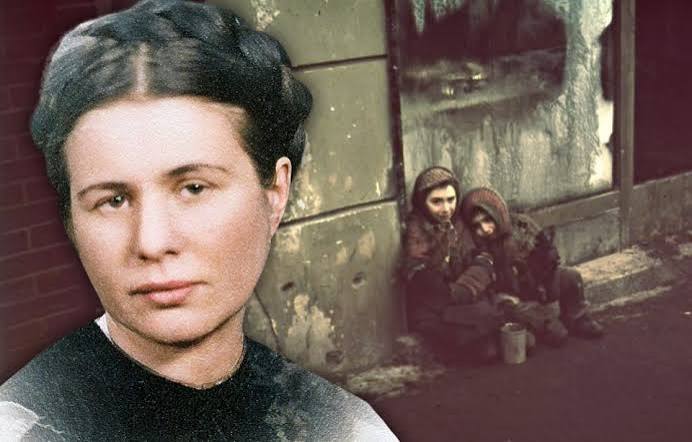
In the autumn of 1943, a young Polish social worker named Irena Sendler was arrested by the Gestapo. For months, she had been smuggling Jewish children out of the Warsaw Ghetto, hiding them in ambulances, toolboxes, and even coffins. Now, the Nazis wanted to know where the children were. They broke her legs and feet, but she refused to talk. Sentenced to death, she was saved at the last moment by a bribe and she went right back to work.
Sendler’s story is not a simple tale of a solitary hero. It is a story of a network of women, a secret council, and a radical act of record-keeping: burying the names of 2,500 children in glass jars so that one day, they might find their families again. This is how she did it.
A Childhood Shaped by Loss
Irena Sendler was born on February 15, 1910, in Warsaw, then part of the Russian Empire. She grew up in Otwock, a town outside the city, where her father, Dr. Stanisław Krzyżanowski, ran a clinic. He treated poor patients regardless of their religion, and when a typhus epidemic swept through the Jewish community in 1917, he went to help—even though other doctors refused. He caught the disease and died, leaving seven-year-old Irena with a lesson she never forgot: “If you see a person drowning, you must jump in and save them, even if you don’t know how to swim.”
That lesson guided her through university, where she studied law and social work. She openly opposed the “ghetto benches”—segregated seating for Jewish students—and was suspended for her protests. By the time Germany invaded Poland in 1939, she was a senior administrator in the Warsaw Social Welfare Department, a position that would give her cover for the most dangerous work of her life.
Inside the Walls of Despair
When the Warsaw Ghetto was sealed in November 1940, more than 400,000 Jews were crammed into an area of 1.3 square miles. Disease and starvation were rampant. Sendler, using her credentials as a sanitary worker, obtained a pass to enter the ghetto legally, ostensibly to check for typhus outbreaks. But she used every visit to carry out a different mission: smuggling children out.
The logistics were harrowing. Babies were hidden in ambulances, sometimes sedated to keep them quiet. Older children were placed in burlap sacks, toolboxes, or even under stretchers in dog carts. Some escaped through sewers and underground passages, guided by the Polish underground. Each rescue required split-second timing and absolute secrecy.
But the hardest part was convincing parents to let their children go. Sendler later recalled the anguish in their eyes: they knew that sending a child away meant they might never see them again. Yet they also knew that staying meant almost certain death. It was a cruel choice, and Sendler bore the weight of it.
The Jars Under the Apple Tree
Once a child was out, they needed a new identity. Sendler and her network—about 30 core members, mostly women—placed children in Catholic convents, orphanages, and Polish families. They were given Christian names, taught Catholic prayers, and told to forget their past. For their safety, no one wrote anything down—except Sendler.
She kept meticulous records on thin tissue paper, listing each child’s real name, their new identity, and the location where they were hidden. She coded these lists and buried them in two glass jars under an apple tree in a friend’s garden. The jars were her way of fighting back against the Nazi attempt to erase an entire people: if the children survived, she wanted them to find their families again.
This act of record-keeping was itself a form of resistance. The Nazis kept their own meticulous records—of deportations, murders, and theft. Sendler’s jars were an antidote to that bureaucracy of death.
Arrest, Torture, and a Narrow Escape
In October 1943, the Gestapo arrested Sendler. They tortured her, breaking her legs and feet, but she revealed nothing. Sentenced to death by firing squad, she was saved by Żegota—the Council to Aid Jews, a clandestine organization funded by the Polish government-in-exile. They bribed a German officer, and Sendler escaped during her supposed execution.
She went into hiding, but she did not stop. She continued her work under the alias “Jolanta,” though she was now a hunted woman. The war ended in 1945, and she dug up the jars, hoping to reunite children with their families. The task was heartbreaking: most parents had been murdered in Treblinka or other camps. Of the 2,500 children she saved, only a fraction found any surviving relatives.
A Life of Quiet Courage
After the war, Sendler’s story was suppressed. The communist regime persecuted her for her ties to the Polish government-in-exile. She was interrogated by the secret police, and her wartime work was largely ignored. She lived quietly in Warsaw, working as a social worker, raising a family, and rarely speaking of her past.
It was not until 1965 that Yad Vashem honored her as Righteous Among the Nations—an honor she accepted only after the Israeli government finally tracked her down in 1983. In 2003, Poland awarded her the Order of the White Eagle, its highest civilian honor. She was nominated for the Nobel Peace Prize, though she never won it, and she dismissed the idea of being called a hero. “I was taught,” she said, “that if someone is drowning, you must jump in to save them.”
Irena Sendler died on May 12, 2008, at the age of 98. Her story might have been lost to history, except for a group of Kansas schoolgirls who wrote a play about her in 1999, sparking a global search for the woman they called “the female Oskar Schindler.” She found them in Warsaw, and they found her—a small, frail woman with a profound legacy.
Irena Sendler’s rescue of 2,500 children was not a solo act. It was a coordinated effort that involved the Catholic Church, the Polish underground, and dozens of ordinary Poles who risked their lives daily. Her jars were more than a record—they were a promise that the children would not be forgotten. Today, her story reminds us that courage is not the absence of fear, but the determination to act despite it. And that sometimes, the greatest act of resistance is simply to write down a name.
Summary
- Irena Sendler, a Polish social worker, smuggled approximately 2,500 Jewish children out of the Warsaw Ghetto during World War II.
- She used creative methods: hiding children in ambulances, toolboxes, coffins, and even under stretchers in dog carts.
- She kept coded records of each child’s real and assumed names, buried in jars in a friend’s garden, to reunite families after the war.
- Arrested by the Gestapo in 1943, she was tortured but refused to reveal any information, and escaped execution with help from Żegota.
- Honored as Righteous Among the Nations in 1965 and with Poland’s Order of the White Eagle in 2003, she died in 2008 at age 98.
FAQ
Q: How many children did Irena Sendler save?
A: The widely cited figure is 2,500, but this is an estimate. The exact number is unverifiable due to the secrecy of the operation, and some sources suggest it could be higher or lower.
Q: How did she smuggle children out of the ghetto?
A: She used a variety of methods, including ambulances, trams, coffins, sacks, toolboxes, and even under stretchers in dog carts. Some children escaped through sewers and underground passages.
Q: Why did she bury records in jars?
A: She wanted to reunite children with their families after the war. The coded lists contained real names, new identities, and hiding places, which she buried under an apple tree to keep them safe from the Nazis.
Q: Was she caught by the Nazis?
A: Yes, she was arrested in October 1943 and tortured, but she revealed nothing. She was sentenced to death, but Żegota bribed a German officer, and she escaped during her execution.
Q: What happened to the children after the war?
A: Sadly, most of their parents had been killed in the Holocaust. Sendler dug up the jars and tried to find surviving relatives, but only a small number of children were reunited with family members.