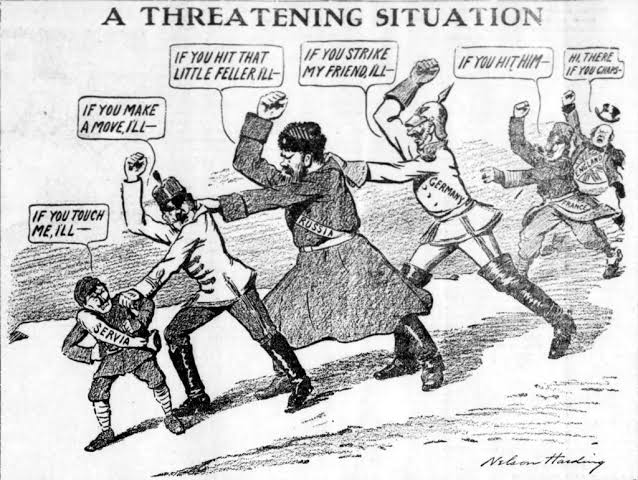
On June 28, 1914, a teenage nationalist fired two shots in Sarajevo, killing Archduke Franz Ferdinand and his wife. Within five weeks, the great powers of Europe were at war. The standard explanation? A web of alliances dragged them in. But was the alliance system truly the main culprit, or did it merely provide the scaffolding for a tragedy built on deeper faults?
The alliance system did not cause the assassination, nor did it create the nationalist fervor, imperial rivalries, or military planning that made war thinkable. But it did determine the war’s terrifying speed and scope. This article examines the evidence, weighing the role of alliances against other long-term factors, and asks whether the system was a cause or a catalyst.
The Machinery of Alliances
By 1914, Europe was divided into two blocs. The Triple Alliance—Germany, Austria-Hungary, and Italy—had existed since 1882, originally as a defensive pact. On the other side, the Triple Entente—France, Russia, and Britain—was a looser diplomatic understanding, formalized by 1907. These alliances were not born of aggression; Bismarck had designed his earlier system to isolate France and preserve peace. Yet they created a dangerous dynamic: each power assumed its allies would back it, encouraging risk-taking.
The July Crisis illustrates this. Austria-Hungary, determined to punish Serbia, sought Germany’s support. On July 5, Kaiser Wilhelm II offered the “blank cheque”—unconditional backing. Emboldened, Austria issued an ultimatum to Serbia on July 23, deliberately harsh. Serbia accepted most terms, but Austria declared war on July 28. Russia, Serbia’s Slavic protector, mobilized. Germany, bound to Austria and fearing Russia’s growing strength, declared war on Russia on August 1. Two days later, Germany declared war on France and invaded Belgium, bringing Britain into the conflict on August 4.
The cascade was swift and almost mechanical, following alliance lines. Without these commitments, the war might have remained a localized Balkan affair, as had happened in 1912 and 1913. The alliance system, in this view, was the main cause—it transformed a bilateral dispute into a continental war.
The Deeper Faults
But alliances alone do not explain why Europe was so ready to fight. Nationalism had been simmering for decades. Pan-Slavism drove Russia to support Serbia; French revanchism yearned to reclaim Alsace-Lorraine; Austria-Hungary’s multi-ethnic empire was threatened by nationalist movements. Imperialism had created colonial frictions, from the Morocco crises of 1905 and 1911 to the Balkan Wars. Militarism fueled an arms race—Britain and Germany competed in dreadnoughts, while armies expanded and planning became rigid.
Most critically, the Schlieffen Plan made war almost inevitable once Russia mobilized. Germany’s only strategy for a two-front war required a swift invasion of France through Belgium. This meant that German mobilization was not a defensive act but a trigger for war. As historian Fritz Fischer argued, Germany’s leaders actively sought war in 1914, using the crisis as an opportunity. The alliance system was a vehicle, not the driver.
The Verdict: Necessary but Not Sufficient
Could the war have been avoided without alliances? Possibly, but only if the underlying tensions—nationalism, imperialism, militarism—had been resolved, which seems unlikely. The alliances were a necessary condition: without them, the war would not have escalated as it did. But they were not sufficient. The assassination, the blank cheque, and the decisions of leaders like Kaiser Wilhelm II and Tsar Nicholas II were all crucial. The alliance system was like a powder keg’s fuse—it made the explosion possible, but the powder was already there.
Perhaps the most compelling evidence for alliances as the main cause is the speed of escalation. In just over a week, Europe went from peace to world war. This was not a slow build-up but a chain reaction. Yet that chain reaction was set off by human choices, not just structural obligations. Austria-Hungary chose to issue an ultimatum; Germany chose to give the blank cheque; Russia chose to mobilize; Germany chose to invade Belgium. The alliances set the stage, but the actors chose the play.
The alliance system was a critical mechanism that turned a regional crisis into a world war, but it was not the root cause. Nationalism, imperialism, militarism, and the failures of diplomacy created the conditions for war. Alliances amplified these forces, making escalation rapid and nearly automatic. To blame alliances alone is to ignore the deeper currents of history. Yet to dismiss their role is to miss how structure and choice combined in July 1914. The war was not inevitable, but the alliances made it far more likely.
Summary
- The alliance system (Triple Alliance vs. Triple Entente) turned a localized conflict into a continental war within a week.
- Alliances were originally defensive, but they encouraged risk-taking, as seen in Germany’s ‘blank cheque’ to Austria-Hungary.
- Long-term causes—nationalism, imperialism, militarism—created a powder keg; the assassination was the spark.
- The Schlieffen Plan made mobilization a trigger for war, forcing Germany to attack France upon Russian mobilization.
- Alliances were necessary but not sufficient; human decisions during the July Crisis were equally crucial.
FAQ
Q: Was the Triple Entente a formal military alliance?
A: No, the Triple Entente was an informal diplomatic understanding between France, Russia, and Britain, with no binding military obligations. The Triple Alliance, by contrast, was a formal defensive pact, but Italy’s commitment was conditional and it stayed neutral in 1914.
Q: How did the alliance system contribute to the outbreak of war?
A: Alliances created a chain reaction: Austria-Hungary’s war on Serbia led Russia to mobilize, which triggered Germany’s declaration of war on Russia and France, and then Britain’s entry due to Belgium’s invasion. This cascade was possible because each power had obligations to its allies.
Q: Could the war have been avoided without alliances?
A: Possibly, but only if the deeper tensions—nationalism, imperialism, militarism—had been managed. The Balkan Wars of 1912–1913 remained localized because no great power intervened; in 1914, alliances ensured they did.
Q: What was the ‘blank cheque’?
A: On July 5–6, 1914, Germany gave Austria-Hungary unconditional support for any action against Serbia. This emboldened Austria to issue a harsh ultimatum and declare war, knowing Germany would back it.
Q: Did the Schlieffen Plan make war inevitable?
A: The plan assumed a two-front war and required a rapid attack on France via Belgium. Once Russia mobilized, Germany had no alternative plan, so it immediately declared war on France and invaded Belgium, making escalation almost mechanical.