Tag: Canada

  • The Whisky War: How a Barren Arctic Rock Became a Diplomatic Toast

    The Whisky War: How a Barren Arctic Rock Became a Diplomatic Toast

    At the top of the world, between Canada’s Ellesmere Island and Greenland, lies a slab of rock barely a kilometer wide. For 50 years, it was the subject of a quirky Cold War between two of the most peaceful nations on Earth. They called it the Whisky War.

    The island, named Hans Island (or Tartupaluk in Greenlandic), has no vegetation, no fresh water, and no strategic value. Yet from 1973 to 2022, Canada and Denmark traded flags and spirits on its barren shores. What began as a diplomatic headache ended with a toast that split the island in two—and created a brand-new international border.

    This is the story of how a bottle of whisky and a bottle of schnapps turned a territorial dispute into a model for peaceful resolution.

    A Rock Worth Fighting For? Not Quite

    Hans Island sits in the Nares Strait, a narrow channel separating Ellesmere Island from Greenland. At roughly 1.3 square kilometers—about the size of 12 football fields—it is entirely rocky, with no vegetation, fresh water, or minerals of commercial value. It has no permanent inhabitants and offers no strategic military advantage.

    Yet for half a century, Canada and Denmark claimed it. The dispute began in 1973 when the two nations negotiated a maritime boundary treaty for the continental shelf between Greenland and Canada. They successfully delimited about 3,000 kilometers of boundary but left a gap of roughly 1,000 meters around Hans Island. Both sides asserted sovereignty, and negotiations stalled.

    The Island’s Namesake

    The island is named after Hans Hendrik, a Greenlandic Inuit hunter and interpreter who accompanied Arctic expeditions in the 1850s and 1870s. He was part of American and British missions searching for the lost Franklin expedition. The island was first mapped during the 1871–1873 Polaris Expedition led by American explorer Charles Francis Hall.

    Neither Canada nor Denmark had a strong historical claim. Both based their sovereignty on proximity and occasional use. The island’s value was entirely symbolic—a marker of Arctic sovereignty and a precedent for future territorial questions in the region.

    The Whisky War Begins

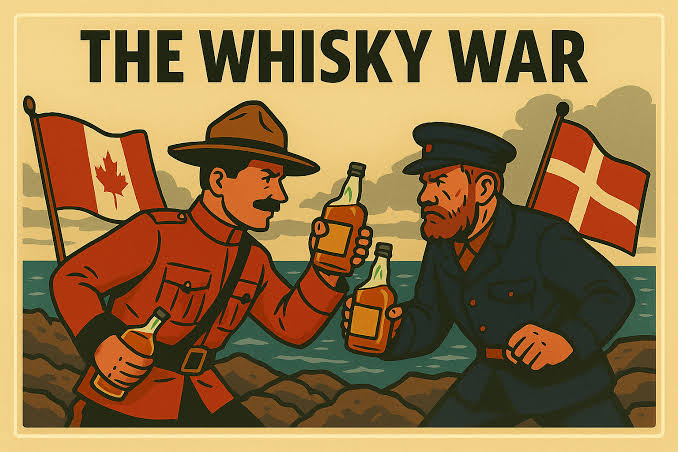
    The nickname “Whisky War” came from the unusual tactics both nations employed. In 1984, Danish Minister for Greenland Tom Høyem visited the island, planted the Danish flag, buried a bottle of cognac, and left a note: “Welcome to the Danish island.”

    Canadian officials responded by planting their own flag and leaving a bottle of Crown Royal Canadian whisky with a note like “Keep up the good work.” Over the following decades, periodic visits—often during Arctic sovereignty patrols—saw each side replace the other’s flag and swap whisky for Danish schnapps (Gammel Dansk), always in a good-natured spirit.

    One notable escalation occurred in 2005 when Canadian Defence Minister Bill Graham visited the island, prompting a formal protest from Denmark. But even that flap was resolved diplomatically. The exchanges were so friendly that the dispute became a running joke in international relations circles.

    Why Did It Matter?

    Despite the island’s worthlessness, the dispute carried weight. As Arctic ice recedes due to climate change, new shipping lanes and seabed resources are becoming accessible. Under the UN Convention on the Law of the Sea (UNCLOS), islands can generate exclusive economic zones (EEZs). While Hans Island is too small to sustain human habitation—thus not generating a full EEZ under Article 121—the dispute was seen as precedent-setting for other Arctic territorial questions.

    Canada and Denmark are both NATO allies, and the dispute was a rare point of friction between them. Managing it without escalating to real conflict was a test of diplomatic skill.

    The Path to Resolution

    In 2018, Canada and Denmark established a joint task force to resolve the Hans Island question. After years of negotiation, they agreed to partition the island roughly in half along a natural fracture line running north-south. Canada received the larger portion (about 60%), and Denmark/Greenland the remainder.

    On June 14, 2022, officials from both nations signed a historic agreement in a ceremony where they toasted with whisky and schnapps. The treaty created the world’s first land border between Canada and the European Union (via Denmark and Greenland). Canada ratified the agreement in June 2022, and Denmark’s parliament ratified it in May 2023.

    The Distillery Connection

    No distillery exists on Hans Island, and none is planned. The phrase “ended with a distillery” is metaphorical: the spirits that lubricated diplomacy became the symbol of the resolution. The agreement was celebrated as a triumph of “whisky diplomacy,” a reminder that even the most absurd territorial disputes can be resolved with mutual respect and a shared drink.

    The island now stands as a monument to peaceful negotiation—a stark contrast to other unresolved territorial conflicts around the world.

    The Whisky War ended not with a bang, but with a sip. Hans Island, once a source of diplomatic friction, is now divided between two friendly nations. It serves as proof that even the most trivial disputes can be resolved when both sides approach them with humor and goodwill. The next time you raise a glass of whisky, you might think of that barren rock in the high Arctic—and the unlikely peace it inspired.

    Summary

    • Hans Island is a barren, uninhabited rock in the Nares Strait between Canada and Greenland, about the size of 12 football fields.
    • Canada and Denmark disputed sovereignty over the island for nearly 50 years (1973–2022).
    • The “Whisky War” involved officials planting flags and leaving bottles of Canadian whisky or Danish schnapps as good-natured taunts.
    • In June 2022, the two nations agreed to partition the island roughly 60/40 along a natural fracture line, creating the first land border between Canada and the EU.
    • No distillery exists on the island; the “distillery” is a metaphor for the role of spirits in the diplomatic resolution.

    FAQ

    Q: Where is Hans Island?
    A: Hans Island (Tartupaluk in Greenlandic, Hans Ø in Danish) is located in the Nares Strait between Ellesmere Island (Nunavut, Canada) and Greenland (Denmark), at approximately 80°49′N, 66°27′W.

    Q: Why was the dispute called the Whisky War?
    A: Because officials from Canada and Denmark visited the island to plant their flags and left bottles of Canadian whisky (Crown Royal) or Danish schnapps (Gammel Dansk) for the other side, with friendly notes.

    Q: How was the dispute resolved?
    A: In June 2022, Canada and Denmark signed an agreement to partition the island roughly in half along a natural fracture line, with Canada receiving about 60% and Denmark/Greenland the rest. The treaty was ratified by Canada in 2022 and Denmark in 2023.

    Q: Is there actually a distillery on Hans Island?
    A: No. The phrase “ended with a distillery” is metaphorical, referring to the role of whisky and schnapps in the diplomatic process and the celebratory toast at the signing.

    Q: Why did the island matter if it had no resources?
    A: It was symbolically important for Arctic sovereignty and as a precedent for other territorial disputes as Arctic ice recedes and new shipping routes and resources become accessible.

  • Trump’s ‘Art of the Deal’ Means Reneging on Them. That’s Why Canada Can’t Capitulate

    Trump’s ‘Art of the Deal’ Means Reneging on Them. That’s Why Canada Can’t Capitulate

    Donald Trump’s 1987 book The Art of the Deal is often cited as a blueprint for negotiation. But its actual practice, as seen in trade deals, climate accords, and nuclear agreements, reveals a different pattern: agreements are not final, they are starting points for further demands. For Canada, facing a 25% tariff threat and a looming USMCA review, the lesson is clear: capitulation will not buy stability; it will invite the next demand.

    The Myth of the ‘Deal’ in Trump’s Playbook

    Trump’s book famously claims that “the best deal is one where both sides walk away happy.” Yet his real-world negotiating record tells a different story. Treaties and contracts under his signature have been treated as provisional, subject to re-opening whenever he sees an advantage.

    Consider the Paris Climate Accord. Trump withdrew the U.S. in 2017, re-entered under Biden, and then withdrew again in 2025. The Iran Nuclear Deal, a multilateral agreement with U.S. signature, was unilaterally abandoned in 2018. Even the Taliban Agreement of 2020 was later modified and disavowed in parts. The pattern is consistent: agreements are not sacred;

    they are tools to be used as leverage.

    NAFTA to USMCA: The Same Old Story

    The North American Free Trade Agreement, in place since 1994, was a cornerstone of continental trade. Trump renegotiated it under threat of withdrawal, producing the USMCA in 2020. But no sooner was it signed than he began criticizing it, and during the 2024 campaign he threatened to re-open it. The mandated joint review in July 2026 is now a looming deadline that Trump is already using to extract concessions.

    This is not an anomaly. Trump’s approach to the trade ceasefire with China followed the same arc: “Phase One” deal signed, then allowed to lapse as tariffs escalated. The Hanoi summit with North Korea ended with Trump walking away, declaring “no deal better than a bad deal.” For Trump, a deal is not a conclusion; it is a lull in an ongoing negotiation.

    Why Canada’s Capitulation Would Backfire

    Canada shares the world’s largest bilateral trade relationship with the U.S., approximately $1.3 trillion CAD annually. About 75% of Canadian exports go south of the border. This dependency is precisely why Trump’s pressure tactics bite, but it is also why capitulation would be a mistake.

    If Canada yields to Trump’s current demands whether on dairy, defense spending, or border enforcement it would set a precedent. Trump would interpret it as evidence that pressure works, and he would return with new demands. The USMCA was supposed to end the trade disputes; instead, Trump immediately threatened to re-open it. Concessions do not buy stability with a negotiator who sees every agreement as a stepping stone.

    Canada has leverage, too. The U.S. relies on Canadian energy, critical minerals, lumber, aluminum, and potash. Canada is the top export destination for 36 U.S. states. Retaliatory tariffs on U.S. goods—from bourbon to motorcycles—have already been deployed. The political cost of harming American consumers and workers is a real constraint on Trump’s escalation.

    The Historical Precedent: Quiet Concessions Haven’t Worked

    Canada has a history of making quiet concessions to avoid escalation, particularly in softwood lumber disputes. But this approach has not produced lasting stability; it has merely postponed the next confrontation. Trump’s transactional view of alliances treats security guarantees and trade preferences as “paying for protection.” Canada’s willingness to accommodate could be seen as validation of that worldview.

    Public opinion in Canada strongly opposes capitulation. The idea of Canada becoming a “51st state,” floated by Trump, is widely rejected. Capitulation would undermine Canadian sovereignty and set a dangerous precedent for other U.S. allies.

    A Firm Stance Is the Only Viable Path

    The evidence is clear: Trump’s “art of the deal” means treating agreements as temporary. Canada cannot capitulate because concessions will not bring stability. Instead, Canada must hold firm, use its own leverage, and prepare for the 2026 USMCA review as a negotiation, not a surrender. The rules-based order that Canada has relied on may be frayed, but abandoning it would be worse.

    Trump’s negotiation philosophy treats deals as perpetual, not final. Canada’s best response is to recognize this pattern and refuse to capitulate. Standing firm, using leverage, and preparing for the 2026 review is the only way to protect Canadian interests and avoid a cycle of endless concessions.

    Summary

    • Trump’s negotiation record shows a pattern of reneging on agreements, from the Paris Accord to the Iran Deal to USMCA.
    • Concessions do not buy stability with Trump; they invite further demands.
    • Canada’s leverage—energy, minerals, and political cost—makes a firm stance viable.
    • The 2026 USMCA review is a looming deadline; Canada must approach it as a negotiation, not a surrender.

    FAQ

    Q: Has Trump actually reneged on trade deals?
    A: Yes, he renegotiated NAFTA, then threatened to re-open the replacement USMCA. He also let the Phase One trade deal with China lapse.

    Q: Why would capitulation be counterproductive?
    A: Because Trump treats agreements as starting points, not final. Concessions would signal weakness and invite further demands.

    Q: What leverage does Canada have?
    A: Canada supplies the U.S. with energy, critical minerals, lumber, and other goods. Retaliatory tariffs on U.S. products can also be escalated.

    Q: What is the 2026 USMCA review?
    A: It is a mandated joint review of the trade agreement, which Trump may use to extract concessions from Canada.

  • Canada Quietly Signs UN Cybercrime Treaty: A Surveillance Pact in Disguise?

    Canada Quietly Signs UN Cybercrime Treaty: A Surveillance Pact in Disguise?

    In late 2025, Canada quietly signed the United Nations Convention on Cybercrime, a treaty that aims to harmonize cybercrime laws globally. But critics warn that beneath its crime-fighting surface, the treaty contains provisions that could enable mass surveillance and undermine civil liberties. The signing, which occurred with little public debate or parliamentary scrutiny, has raised alarms among privacy advocates who see it as a backdoor to expanded state powers.

    This article unpacks what the treaty actually says, why Canada signed it, and what it could mean for your digital rights. We’ll explore the fine print on data collection, the vague ‘prevention’ clause, and the geopolitical chess game that led to this moment. By the end, you’ll understand why this seemingly technical treaty is anything but mundane.

    What Is the UN Cybercrime Convention?

    Formally known as the ‘United Nations Convention on Countering the Use of Information and Communications Technologies for Criminal Purposes,’ this treaty was adopted by the UN General Assembly in December 2024. It’s a broad agreement that requires signatories to criminalize a range of cyber offenses—from illegal access to data interference, fraud, and child sexual abuse material. It also sets up frameworks for international cooperation, including mutual legal assistance and extradition.

    But the treaty goes beyond simple crime-fighting. It includes provisions for real-time collection of traffic data and preservation of electronic evidence. These are tools that law enforcement agencies love, but they come with significant privacy implications. The treaty also has a controversial ‘prevention’ clause that critics argue could be used to justify broad surveillance or content moderation mandates.

    The Quiet Signing: Why No One Noticed

    Canada signed this treaty in 2025–2026 with almost no public fanfare. There were no major press conferences, no parliamentary debates, and no consultations with civil society. This is a stark contrast to how Canada typically handles major international agreements. The government’s silence has led to accusations that it’s trying to sneak a surveillance-friendly treaty past the public.

    Why the secrecy? One possibility is that the government knows the treaty is controversial. Another is that it’s part of a broader strategy to engage with the UN process to counter Russian and Chinese influence. But whatever the reason, the lack of transparency is troubling for a treaty that could affect the digital rights of every Canadian.

    The Surveillance Provisions: What’s in the Fine Print?

    Let’s break down the most concerning parts of the treaty. First, there’s the real-time collection of traffic data. This means that internet service providers (ISPs) could be required to hand over information about who you’re communicating with, when, and from where—in real time. This is different from wiretapping, which captures the content of communications. Traffic data is metadata, and it can reveal a lot about your life, even if the content of your messages remains private.

    Second, the treaty requires signatories to preserve electronic evidence. This sounds benign, but it can mean that companies must store data for long periods, even if there’s no ongoing investigation. This could lead to data retention mandates that force companies to keep logs of your online activities for months or years.

    Third, the ‘prevention’ clause is vague. It says that countries should take measures to prevent cybercrime, but it doesn’t define what those measures are. This could be interpreted to require ISPs and platforms to monitor content for illegal activity, which would be a form of mass surveillance. It could also be used to pressure companies to weaken encryption, which would make everyone less secure.

    The Budapest Convention: A Better Alternative?

    Canada is already a party to the Budapest Convention on Cybercrime, which has been the gold standard for international cybercrime cooperation since 2001. The Budapest Convention has strong human rights protections and requires that any data collection be subject to due process. The UN treaty, in contrast, has weaker safeguards, which is why many experts see it as a step backward.

    Why would Canada sign a weaker treaty when it already has a better one? The answer may lie in geopolitics. The UN treaty was a Russian-led initiative, and by signing it, Canada can have a seat at the table when the rules are being written. But critics argue that this legitimizes a treaty that could be used by authoritarian states to justify surveillance of dissidents and journalists.

    What Does This Mean for Canadians?

    If Canada ratifies the treaty, it will need to update its laws to comply. This could mean changes to the Criminal Code and the Privacy Act. The government might argue that existing laws already meet the treaty’s requirements, but the treaty’s vague language could be used to push for more expansive surveillance powers.

    For ordinary Canadians, the most immediate impact could be on your online privacy. If ISPs are required to collect and store traffic data, that information could be accessed by law enforcement without a warrant in some cases. The treaty also creates a framework for sharing evidence across borders, which could make it easier for foreign governments to request data about Canadians.

    The Geopolitical Angle: Why Canada Signed

    Canada’s decision to sign is not just about cybercrime; it’s about international relations. The UN treaty was adopted with support from many Global South countries, who see it as a way to get technical assistance and capacity building. By signing, Canada can help shape how the treaty is implemented, potentially pushing for stronger human rights protections.

    But there’s a risk: by signing, Canada lends legitimacy to a treaty that could be used to justify authoritarian surveillance. Some argue that boycotting the treaty would be worse, as it would leave the field open to Russia and China to define the norms. It’s a delicate balance, and the Canadian government seems to be betting that it can influence the treaty from within.

    The Path to Ratification: Still a Chance for Debate

    Signing is just the first step. The treaty will only enter into force after 40 countries ratify it, and as of early 2026, fewer than 20 have done so. In Canada, ratification requires parliamentary approval, which means there’s still time for public debate. Civil society groups are already calling for hearings and consultations, and it’s possible that the government will face pressure to add reservations or interpretative declarations to protect Canadians’ rights.

    If you’re concerned about this treaty, now is the time to speak up. Contact your MP, join privacy advocacy groups, and demand that the government be transparent about its intentions. The treaty may have been signed quietly, but its impact could be loud and lasting.

    Canada’s quiet signing of the UN Cybercrime Convention is a wake-up call for anyone who cares about digital rights. The treaty’s surveillance-friendly provisions, combined with the lack of public debate, make it a dangerous precedent. While signing doesn’t mean immediate ratification, it sets the stage for a potential erosion of privacy protections. Canadians must demand transparency and accountability before this treaty moves any further.

    Summary

    • Canada signed the UN Cybercrime Convention in 2025–2026 with little public or parliamentary scrutiny.
    • The treaty includes provisions for real-time traffic data collection and electronic evidence preservation, which could enable mass surveillance.
    • The vague ‘prevention’ clause could be used to justify content monitoring or weakened encryption.
    • Canada is already a party to the stronger Budapest Convention, raising questions about why it signed a weaker treaty.
    • The treaty is not yet ratified; there is still time for public debate and parliamentary oversight.

    FAQ

    Q: What is the UN Cybercrime Convention?
    A: It’s a UN treaty adopted in December 2024 that requires countries to criminalize cybercrimes and cooperate internationally. It includes provisions for data collection and evidence sharing that worry privacy advocates.

    Q: Why is Canada’s signing controversial?
    A: Because it happened quietly, without public debate, and the treaty’s provisions could be used to justify surveillance and data retention that infringe on privacy rights.

    Q: How does this treaty differ from the Budapest Convention?
    A: The Budapest Convention has stronger human rights protections and due process requirements. The UN treaty is seen as weaker, with vaguer language that could be exploited by authoritarian governments.

    Q: What can I do to stop it?
    A: Contact your Member of Parliament, support privacy advocacy groups, and demand that the government hold public consultations before ratification.

    Q: Will this affect my online privacy?
    A: If ratified, it could lead to laws requiring ISPs to collect and store traffic data, which law enforcement could access. This could make it easier for authorities to track your online activities.