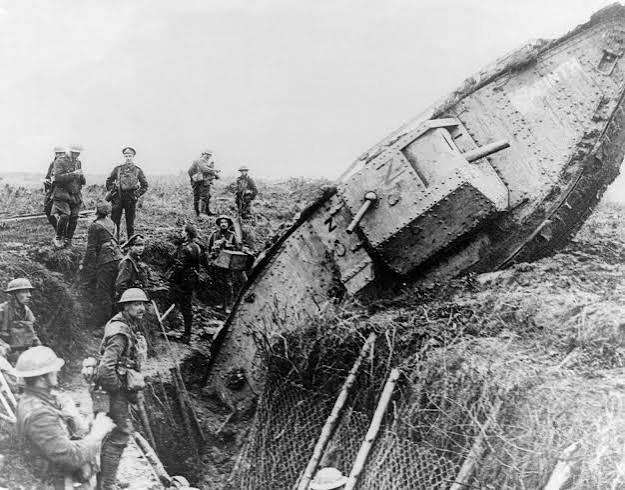
At 6:20 AM on November 20, 1917, the ground near Cambrai, France, trembled. Not from an earthquake, but from the roar of nearly 476 Mark IV tanks—the largest concentration of armored vehicles ever assembled at that time. Their mission: smash through the seemingly impenetrable Hindenburg Line without a single preliminary artillery shell. It was a gamble that would either prove tanks as war-winning weapons or consign them to the scrapheap of failed experiments.
For years, the Western Front had been a bloody stalemate. Soldiers huddled in muddy trenches, and offensives gained yards at the cost of thousands of lives. The tank, introduced in 1916, had sputtered and stalled in small numbers, but at Cambrai, the British deployed them en masse, in a coordinated attack that combined armor, artillery, and infantry in a way never seen before. The result was a dramatic breakthrough that changed military thinking forever—even though the battle itself ended in a bitter stalemate.
The Road to Cambrai: Why Tanks Had to Prove Themselves
By 1917, the tank was not a new invention. The British had first used them at Flers-Courcelette in September 1916, and again at Messines in June 1917. But those deployments were small-scale, plagued by mechanical breakdowns, and often bogged down in mud. Skeptics called them unreliable behemoths. Even their supporters admitted they were slow, clumsy, and prone to breaking down.
However, the Mark IV tank was an improvement. It boasted better armor, a steering system that was slightly less temperamental, and came in two versions: “male” tanks with 6-pounder cannons, and “female” tanks with only machine guns. The Tank Corps, led by the flamboyant Brigadier-General Hugh Elles, was desperate for a chance to prove their worth on a grand scale.
They found an unlikely ally in an artillery officer, Brigadier-General Henry Tudor. Tudor had developed a new technique called “predicted fire,” which allowed artillery to target enemy positions using map coordinates and sound ranging, rather than firing a few sighting shots first. This meant the guns could open fire at the exact moment of attack, without warning the enemy. No preliminary bombardment—a radical departure from standard practice.
The Plan: Tanks, Fascines, and a Surprise Assault
The Cambrai sector was chosen for its firm chalk soil, which was ideal for tanks. The plan was audacious: tanks would crush the barbed wire, cross the wide trenches using bundles of brushwood called fascines (dropped into the trenches as makeshift bridges), and then infantry would follow to mop up. Cavalry, still considered a decisive arm, would then ride through the gap and capture Cambrai, a vital rail hub.
The attack began at dawn, with no warning. The tanks lumbered forward, their engines roaring, and the infantry followed. The German defenders, manning the formidable Hindenburg Line, were taken completely by surprise. In a few hours, the British had broken through, gaining up to five miles in some places. Church bells rang in Britain to celebrate the victory.
The Breakthrough: A Glimpse of the Future
The initial success was stunning. The Hindenburg Line, thought to be unbreachable, had been pierced. In the village of Bourlon Wood and at Fontaine-Notre-Dame, bitter fighting raged, but the tank had proven its worth as a weapon of shock and awe. The German soldiers, many of whom had never seen a tank, were terrified. The sheer mass of armor, crushing wire and crossing trenches, was demoralizing.
But the breakthrough was not exploited. The cavalry, which had been waiting to charge through, found the ground churned up and the enemy quickly reinforcing. There were not enough reserves to push deeper. The tanks, too, were suffering. Of the 476 that started, about 180 were knocked out by the end of the battle—many from mechanical failure or bogging down in the soft ground, not from enemy fire.
The German Counteroffensive: A Lesson in Defense
The Germans were not idle. Under General Georg von der Marwitz, they launched a counteroffensive on November 30, using stormtrooper infiltration tactics—small, elite units that bypassed strongpoints and struck at command centers. They recaptured most of the ground the British had taken, and the battle ended in a stalemate on December 7.
The casualties were heavy: about 45,000 British and 50,000 German killed, wounded, or missing. For the British, it was a bitter pill—a victory that had turned into a defeat. But for military theorists, it was a revelation. The tank, used in mass, had created a breakthrough that was unprecedented. It was a forerunner of the Blitzkrieg tactics of World War II.
The Aftermath: What Cambrai Really Proved
Cambrai was not the first use of tanks, but it was the first time they were used in mass, in a coordinated assault. It proved that tanks could overcome trench warfare, at least temporarily. It also proved that they could be stopped—by anti-tank guns, by mud, and by determined infantry.
The battle had a profound impact on the Germans. They quickly developed anti-tank tactics, including armor-piercing ammunition and wider trenches. The British, meanwhile, learned that a breakthrough needed to be exploited with reserves and that tanks needed better reliability.
Historians still debate whether Cambrai was a revolution in warfare. Some argue it was an evolutionary step, building on earlier experiments. But most agree that it marked a turning point: the tank had moved from the sidelines to the center of military planning. The age of armored warfare had begun.
The Human Cost and the Human Experience
Beyond the tactics and technology, Cambrai was a brutal struggle. Soldiers in the tank crews described the terror of being inside a metal box, the heat, the fumes, and the fear of being burned alive. For the infantry, the sight of tanks crushing through wire and trenches was awe-inspiring, but the close-quarters fighting in villages like Bourlon Wood was savage.
The battle also highlighted the obsolescence of cavalry. The horse-mounted troops, who had been waiting for the gap to open, were unable to exploit it. They were misused, perhaps, but their failure symbolized the end of an era.
Conclusion: The Battle That Changed Warfare
Cambrai was not a decisive victory for either side. But it was a decisive moment in the history of warfare. It showed that tanks, used in mass and in coordination with artillery and infantry, could break the stalemate of the trenches. It also showed the importance of reserves and the dangers of overreach. The lessons of Cambrai echoed through the next century, from the blitzkrieg of 1940 to the armored warfare of today. The tank had arrived, and the rules of war would never be the same.
In the annals of military history, the Battle of Cambrai stands as a paradox: a breakthrough that failed, yet transformed warfare. It was the first major use of tanks, and it proved that armor could be a decisive weapon. Though the battle ended in a stalemate, its lessons shaped the future of combat. Cambrai was not the end of the story—it was the beginning of a new one.
Summary
- The Battle of Cambrai (Nov 20–Dec 7, 1917) was the first large-scale use of tanks in warfare, with ~476 Mark IV tanks.
- The attack used a surprise assault without a preliminary bombardment, breaking the Hindenburg Line initially.
- Despite the breakthrough, a German counteroffensive recaptured most ground, ending in a stalemate.
- The battle demonstrated the potential of combined arms (tanks, artillery, infantry) and the obsolescence of cavalry.
- Casualties were heavy: ~45,000 British and ~50,000 German.
- Cambrai is often seen as a forerunner of Blitzkrieg and a turning point in armored warfare.
FAQ
Q: Was Cambrai the first battle to use tanks?
A: No. Tanks were first used at Flers-Courcelette in September 1916 and at Messines in June 1917. Cambrai was the first massed use of tanks (hundreds at once) in a surprise assault without a preliminary bombardment.
Q: Why was Cambrai considered a success if it ended in a stalemate?
A: The initial breakthrough was a success, proving that tanks could break trench defenses. But the Germans counterattacked and recaptured most ground. The battle is seen as a tactical success but a strategic failure, yet it demonstrated the future of armored warfare.
Q: What was the ‘predicted fire’ technique?
A: It was an artillery method using map coordinates and sound ranging to target enemy positions without prior registration, allowing for a surprise barrage at the moment of attack. This was a key innovation at Cambrai.
Q: How many tanks were used and how many were lost?
A: About 476 British tanks were initially committed. Around 180 were knocked out, many due to mechanical failure or bogging down, not just enemy fire.
Q: What was the German response to the tanks?
A: The Germans were impressed but developed anti-tank tactics, including field guns with armor-piercing ammunition and wider trenches. Their counteroffensive used stormtrooper infiltration tactics to reverse the British gains.