In March 1942, the British Empire suffered its longest retreat in history. Outnumbered and outmaneuvered, Allied forces trudged over 1,000 miles from Rangoon back to India, leaving Burma to the Japanese. The monsoon rains turned the roads to mud, and disease cut down more men than enemy fire. For the soldiers who survived, it was a humiliating low point of the war.
Yet within two years, the same force now rebuilt and renamed the Fourteenth Army would shatter the Japanese Army at Imphal and Kohima, a battle often called the ‘Stalingrad of the East.’ This is the story of how a forgotten army, composed mostly of Indian soldiers, stopped the Japanese advance and reclaimed Burma.
The Fall of Burma: A Disaster in the Jungle
Japan’s invasion of Burma began in January 1942, just weeks after the attack on Pearl Harbor. The British forces in Burma were woefully unprepared. They lacked jungle training, had no air cover, and their commanders dismissed tanks as useless in the dense terrain. The RAF was outnumbered ten to one. Within months, Rangoon fell, and the British began a desperate retreat.
The retreat was a humanitarian catastrophe. Thousands of civilians British, Anglo-Indian, and Indian fled on foot over the mountains, carrying what they could. Many died of starvation, disease, or exhaustion. The army itself lost most of its equipment and morale. By the time the survivors reached India, they were a shattered remnant.
The Birth of the Fourteenth Army
In 1943, General William Slim took command of the newly formed Fourteenth Army. He faced a daunting task: rebuild a demoralized force, train it for jungle warfare, and do it all with minimal resources. Burma was a secondary theater; the priority was Europe and the Pacific.
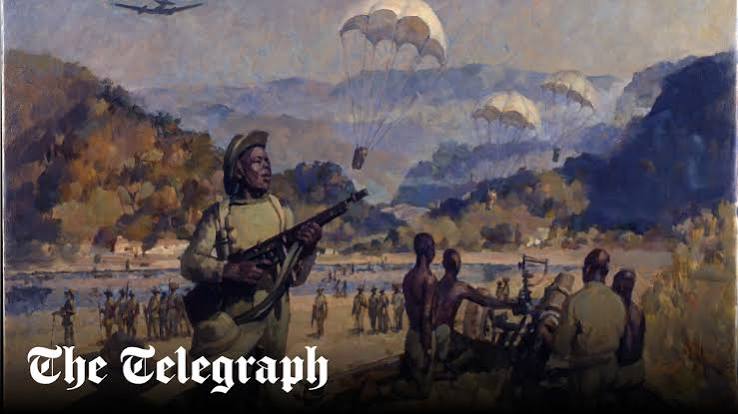
Slim’s solution was revolutionary. He emphasized air supply using transport planes to drop food, ammunition, and medicine to troops deep in the jungle. This freed the army from vulnerable ground supply lines. He also insisted on aggressive patrolling and sent his men to jungle training schools. Morale slowly improved as soldiers gained confidence in their ability to fight in the terrain that had once seemed impenetrable.
The Fourteenth Army grew into the largest Commonwealth army of the war, peaking at over one million men. The backbone was the Indian Army, which had expanded from 200,000 in 1939 to over 2.5 million by 1945. These were volunteers Hindus, Muslims, Sikhs, and Gurkhas who fought for the British Empire while their homeland was under colonial rule.
The Battle of the Admin Box: A New Way of Fighting
In February 1944, the Japanese launched a local offensive in the Arakan region, aiming to cut off Allied supply lines. They surrounded a division at a position called the Admin Box. In previous battles, encirclement meant disaster. But this time, the Allies held their ground.
Supplied entirely by air, the troops inside the box fought off repeated Japanese attacks. The Japanese, accustomed to surrounding and destroying isolated units, found themselves facing a determined defense that refused to break. After two weeks, the Japanese withdrew, having suffered heavy losses. The Battle of the Admin Box proved that the Allies could defeat the Japanese at their own game—if they had the right tactics and logistics.
Imphal and Kohima: The Turning Point
In March 1944, the Japanese launched Operation U-Go, a major offensive aimed at invading India and sparking a rebellion against British rule. Their target was the town of Imphal, the gateway to India. The plan was bold: cross the Chindwin River, cut off the Allied supply lines, and force a decisive battle.
The Japanese were confident. They had a new ally: Subhas Chandra Bose and the Indian National Army (INA), composed of Indian prisoners of war who had switched sides to fight for Indian independence. For the British Indian Army, this created a moral dilemma—they were fighting their own countrymen who wanted the same thing they did: freedom from colonial rule.
But the INA was poorly equipped and never fully integrated into Japanese strategy. The Japanese also underestimated the Allied air supply. When they surrounded Imphal and the nearby town of Kohima, they expected the Allies to starve. Instead, the Allies flew in supplies and reinforcements, sustaining a defense that ground the Japanese down.
The fighting was brutal. At Kohima, the battle raged around the tennis court of the Deputy Commissioner’s bungalow, with the front line shifting back and forth for weeks. By July 1944, the Japanese offensive had collapsed. They retreated in disarray, losing an estimated 50,000 men—many to starvation and disease. The Allies reaped a decisive victory, and the initiative passed permanently to them.
The Reconquest of Burma
With the Japanese broken, Slim’s army surged forward. They crossed the Irrawaddy River and fought a series of battles to capture Mandalay in March 1945. The Japanese, cut off from supplies and reinforcements, fell back in chaos. Rangoon was taken in May, just as the monsoon broke.
The campaign was not without cost. The Japanese lost over 150,000 men, many from disease and starvation during their retreat. Allied casualties were lower—around 30,000 to 40,000—but every death was felt. The Burmese civilian population suffered immensely, caught between two armies and subjected to Allied bombing and Japanese repression.
The Aftermath: A Complex Legacy
The Burma Campaign ended in August 1945 with Japan’s surrender. But the war had sown the seeds of change. The Indian soldiers who had fought so bravely returned to a country that was on the brink of independence. The trials of INA officers in Delhi in 1945-46 sparked massive protests, accelerating the end of British rule.
In Burma, Aung San—who had initially collaborated with the Japanese—switched sides in March 1945 and helped the Allies. He would later negotiate Burma’s independence in 1948. The British return to Burma was brief; they had neither the will nor the resources to re-impose colonial rule.
The Fourteenth Army was disbanded, its soldiers returning to their homes. For decades, their achievements were overshadowed by other theaters of war. But the campaign was a testament to the courage and resilience of the ordinary soldier—especially the Indian soldier—who fought in a forgotten corner of the world and helped stop the Japanese tide.
The Burma Campaign was a brutal struggle fought in the shadow of more famous battles. But it was here that the Japanese Army was first broken on land, and it was here that the British Empire demonstrated its ability to adapt and fight back. The story of the Fourteenth Army is not just one of military victory, but of human endurance—of soldiers who overcame disease, terrain, and despair to achieve what seemed impossible. Their legacy lives on in the independent nations of India, Burma, and the Commonwealth, and in the memory of a war that changed the world.
Summary
- The Burma Campaign (1942-1945) began with the fall of Rangoon and the longest retreat in British military history.
- General William Slim rebuilt the defeated army into the Fourteenth Army, using air supply and jungle training to transform its fortunes.
- The Battles of Imphal and Kohima (1944) were the turning point, breaking the Japanese offensive and forcing a disastrous retreat.
- The Fourteenth Army was the largest Commonwealth army of the war, with over 1 million men, mostly Indian soldiers.
- The campaign had far-reaching consequences, including the weakening of British colonial rule in India and Burma.
FAQ
Q: Why is the Burma Campaign called the ‘Forgotten Army’?
A: The Fourteenth Army fought in a secondary theater, with resources going to Europe and the Pacific. Its soldiers felt forgotten by the rest of the world, and later by history.
Q: What was the Battle of the Admin Box?
A: It was a February 1944 battle where Allied troops, supplied by air, held a defensive position against Japanese encirclement, proving that the Allies could beat the Japanese at their own tactics.
Q: Who was Subhas Chandra Bose and what was the Indian National Army?
A: Bose was an Indian nationalist who led the INA, formed from Indian prisoners of war who switched sides to fight for Indian independence. They fought alongside the Japanese against the British.
Q: What was the role of the Indian Army in the Burma Campaign?
A: The Indian Army was the backbone of the Fourteenth Army, providing over a million soldiers who fought bravely in the jungle. Their contributions were crucial to the Allied victory.
Q: How did the campaign end and what was its impact?
A: The Allies reconquered Burma in 1945, but the war weakened British colonial power and accelerated the independence of India and Burma. The INA trials sparked protests that led to India’s independence.