Every loaf of bread is a quiet mathematical event. From the stretch of gluten proteins to the burst of gas in the oven, baking is governed by numbers, thresholds, and kinetic equations that most bakers never see. Yet these invisible forces determine whether your crust cracks, your crumb is airy, or your dough turns to glue.
Understanding the mathematics behind bread isn’t about turning baking into a lab experiment it’s about gaining a practical edge. When you know why a dough relaxes, why proofing slows down, or why oven spring happens, you can troubleshoot failures and push your baking to new heights. This is the hidden science that separates a good loaf from a great one.
The Gluten Network: A Protein Matrix Built on Cross-Links
Gluten is not a single protein but a partnership between two groups: glutenin and gliadin. Glutenin polymers form long chains that give dough its strength and elasticity, while gliadin acts as a viscous filler, providing extensibility. When flour meets water and is mixed, these proteins align and bond, creating a viscoelastic network that can trap gas and hold shape.
The mathematics of this network comes from percolation theory. Imagine protein molecules as dots randomly scattered in water. As you mix, they connect into chains and clusters. The moment a continuous web spans the entire dough—the percolation threshold—is when the mixture transforms from a slurry into a cohesive dough. Below that threshold, you have a mess; above it, you have bread potential.
Bread flour typically contains 12–14% protein by weight, which is enough to exceed the percolation threshold. The resulting gluten matrix can stretch up to 1,000% of its original length before breaking. For perspective, natural rubber stretches only about 600%. That extraordinary extensibility is why dough can inflate like a balloon during proofing and baking.
The ratio of glutenin to gliadin matters too. Optimal bread doughs have a ratio of roughly 1:1 to 1:1.5. Too much glutenin makes dough stiff and hard to shape—think of a tight rubber band. Too much gliadin yields a sticky, weak dough that spreads into a puddle. Commercial bakers adjust this ratio by blending flours, but home bakers can feel the difference when switching from bread flour to all-purpose.
Fermentation Kinetics: The Yeast Equation in Action
Yeast—Saccharomyces cerevisiae—is a sugar-eating machine. It consumes glucose and maltose and excretes carbon dioxide and ethanol. The rate of CO2 production follows Michaelis-Menten kinetics: v = V_max × [S] / (K_m + [S]), where [S] is sugar concentration. In plain terms, the reaction starts fast when sugar is abundant, then slows as sugar runs low.
But yeast populations don’t grow linearly. They multiply exponentially at first, then plateau as nutrients deplete and ethanol accumulates. The practical result: gas production peaks and then declines. This is why proofing times are not linear—a dough that doubles in one hour might take two hours to double again, and eventually it stops rising altogether.
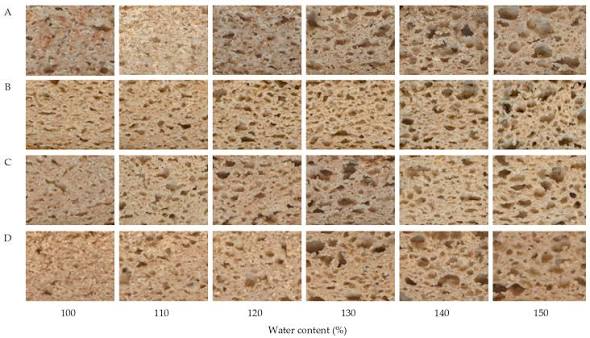
The single most important variable in bread is hydration percentage—water weight divided by flour weight, times 100. Typical bread doughs range from 60% to 75% hydration. Lower hydration yields a tight, dense crumb like a bagel. Higher hydration—80% and up—produces larger, more open crumb structures, as seen in ciabatta and sourdough. High-hydration doughs also ferment faster because water facilitates enzyme activity and sugar mobility, but they require more time to develop structure.
Baker’s math extends beyond hydration. Bakers express all ingredients as percentages of flour weight. For a 70% hydration dough, that means 70 grams of water per 100 grams of flour. Salt is typically 2%, yeast 1–2%, and fat or sugar vary by recipe. This system allows scaling recipes precisely and predicting how changes affect fermentation.
The Oven Spring: A Phase Transition You Can See
The most dramatic moment in baking is oven spring—the rapid expansion of dough in the first 10–15 minutes inside a hot oven. It’s not magic; it’s physics. Three processes combine simultaneously. First, carbon dioxide expands as temperature rises, following Charles’s Law (V ∝ T). Second, ethanol, which boils at 78°C, vaporizes, adding gas volume. Third, water vaporizes, creating steam.
But oven spring stops abruptly when the dough’s internal temperature hits around 55°C. That’s the kill zone for yeast. Once the biological gas production halts, only physical expansion continues. Then, at 60–70°C, starch gelatinizes—starch granules absorb water and swell, setting the crumb structure. At 70–80°C, proteins denature and coagulate, locking the shape permanently.
This phase transition is why an underbaked loaf collapses: the structure hasn’t set enough to hold the gas. And it’s why slashing the dough before baking matters—it creates weak points where expanding gas can escape, preventing random cracks and directing the oven spring into a beautiful ear.
Sourdough: A Microbial Ecosystem with Its Own Math
Sourdough isn’t just yeast; it’s a symbiotic culture of lactic acid bacteria (LAB) and wild yeast. LAB produce lactic and acetic acids, lowering the pH to around 3.5–4.5, which inhibits spoilage organisms and gives sourdough its characteristic tang. The ratio of LAB to yeast in a mature starter is roughly 100:1—a staggering imbalance that shapes the entire process.
The acids also modify gluten proteins through proteolysis, breaking some bonds and making the dough more extensible. That’s why sourdough often feels softer and is easier to shape than commercial yeast doughs. But the acids slow yeast activity, which is why sourdough ferments more slowly and requires a longer proofing time.
Sourdough starters follow a predictable mathematical pattern. When you feed a starter, the microbial population grows exponentially until it exhausts the fresh flour. If you feed at the right intervals—typically every 12–24 hours—you maintain a steady-state culture. Wait too long, and the population crashes; feed too often, and you dilute the acids and change the flavor balance.
The Mathematics of Dough Rheology
Dough is a viscoelastic material—it behaves like a solid on short timescales and a liquid on long timescales. This dual nature is why dough springs back when you poke it, but slowly relaxes and spreads when left alone. The science of dough rheology uses instruments like the Chopin alveograph and the Farinograph to measure resistance, extensibility, and water absorption—numbers that predict baking performance.
Recent research, including work from Harvard’s applied math lab, has modeled gluten networks using fractal geometry and network theory. The finding: dough structure is scale-invariant. The same branching patterns appear at the microscopic level of protein chains and the macroscopic level of crumb structure. This means a tender, airy loaf mirrors the same architecture as the gluten network that supports it.
For the home baker, rheology translates into practical rules. A short rest after mixing allows glutens to relax, making dough easier to shape. A long, slow fermentation—like Jim Lahey’s no-knead method—uses time to develop gluten instead of mechanical kneading. That’s a direct swap of fermentation kinetics for mixing energy.
Historical and Social Context
Bread has been around for about 14,000 years, with the first leavened loaves likely arising from accidental wild yeast contamination in Egypt around 4,000–6,000 years ago. The industrial revolution standardized milling and introduced commercial yeast, developed from Louis Pasteur’s work in the 1850s–60s, turning bread from a variable local product into a consistent commodity.
The COVID-19 pandemic sparked a global sourdough boom, bringing fermentation science into millions of kitchens. Books like On Food and Cooking by Harold McGee, The Bread Baker’s Apprentice by Peter Reinhart, and Flour Water Salt Yeast by Ken Forkish have made the science accessible. Today, when you bake a loaf, you’re participating in a tradition that now includes enzyme kinetics, percolation theory, and microbial ecology—even if you don’t think about it while you knead.
Bread is more than flour, water, salt, and yeast. It’s a dynamic system of proteins, gases, and microorganisms, all governed by mathematical principles that have been refined over millennia. The next time your dough rises, remember the percolation threshold that made it cohesive, the Michaelis-Menten kinetics that drove its fermentation, and the phase transition that gave it structure in the oven. Understanding these hidden mathematics doesn’t just satisfy curiosity—it makes you a better baker.
Summary
- Gluten is a network of glutenin and gliadin proteins, and percolation theory explains the threshold where dough becomes cohesive.
- Bread flour’s 12–14% protein content allows the gluten network to stretch up to 1,000% of its original length.
- Fermentation follows Michaelis-Menten kinetics, meaning gas production peaks and declines—proofing times are not linear.
- Hydration percentage is the most critical variable; higher hydration yields more open crumb but requires more fermentation time.
- Oven spring results from gas expansion, ethanol vaporization, and steam, stopping when yeast dies at 55°C and structure sets above 70°C.
FAQ
Q: Why does my dough tear when I shape it?
A: Tearing usually means the gluten network is too tight or underdeveloped. This can happen if the dough has too much glutenin (high protein flour) or if it wasn’t rested enough. Letting the dough relax for 10–15 minutes before shaping allows the gluten to loosen, making it easier to stretch without breaking.
Q: Why does my dough stop rising during proofing?
A: Yeast activity slows due to substrate depletion and ethanol accumulation. If the dough hasn’t doubled in size within expected time, it may have over-proofed—the gluten network has relaxed too much, and gas production has declined. Or the dough may be under-proofed if it’s still cold. Check the dough’s volume and poke it gently: if it springs back slowly and leaves an indentation, it’s ready.
Q: What’s the ideal hydration for a beginner?
A: Start with 65–70% hydration. This range gives you a dough that’s workable by hand and produces a nice crumb. Higher hydration (75%+) requires more technique and patience, as the dough is very sticky and needs folds to develop strength.
Q: Why does sourdough take longer to rise than commercial yeast bread?
A: Sourdough contains lactic acid bacteria that produce acids, which slow down yeast activity. The pH drop also modifies gluten proteins. So sourdough ferments more slowly, but the acids contribute to flavor and help preserve the bread.
Q: Can I use the math to adjust a recipe?
A: Yes. Baker’s percentages allow you to scale ingredients proportionally. If you want a wetter dough, increase the water percentage and expect longer proofing. If you want a chewier crumb, increase the protein content by using bread flour or adding vital wheat gluten.