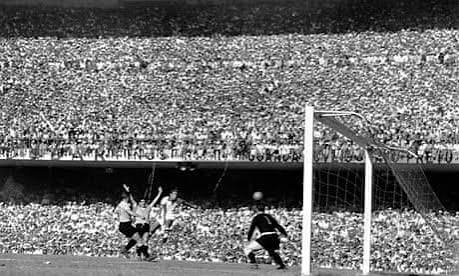
On July 16, 1950, an estimated 173,850 people packed the Maracanã Stadium in Rio de Janeiro, expecting to witness Brazil’s coronation as world champions. The hosts had already dismantled Sweden 7-1 and Spain 6-1 in the final round-robin group; a draw against Uruguay would suffice. What unfolded instead was one of the most seismic upsets in sports history—a 2-1 Uruguayan victory that plunged a nation into mourning and, in the collective memory, overshadowed the champions themselves.
For decades, the story of that day has been told through Brazilian tears: the scapegoated goalkeeper Barbosa, the ‘national catastrophe,’ the psychological scar that supposedly haunted Brazilian football until 1958. Yet the victors a team from a country of just over two million people have often been relegated to a footnote in someone else’s tragedy. This is the tale of Uruguay’s second World Cup title, a triumph of resilience and tactical wit that deserves its own spotlight.
The Weight of History: A Tournament Reborn from War
The 1950 World Cup was the first in twelve years, a phoenix rising from the ashes of World War II. The 1942 and 1946 editions had been cancelled, and the football world was eager for renewal. Brazil, untouched by the war’s worst devastation, saw hosting as its coming-of-age party. The government poured resources into the Maracanã, a colossal stadium meant to symbolize the nation’s modernity and ambition. Brazil’s squad, featuring tournament top scorer Ademir (9 goals) and the elegant Zizinho, was the overwhelming favorite. They had already thrashed Sweden and Spain in the final group stage, and the title seemed a mere formality.
Yet Uruguay was no minnow. Despite a population of roughly 2.2 million, they had won Olympic gold in 1924 and 1928—then considered world championships—and had taken the inaugural World Cup in 1930. Their pedigree was authentic, but on that July afternoon in Rio, they were cast as sacrificial lambs. The narrative was set: Brazil would win, and the Maracanã would erupt in joy.
The Maracanazo: A Match of Two Halves
The decisive match was not a traditional final but the last game of a round-robin group. Brazil needed only a draw; Uruguay needed a win. The pressure was asymmetric, yet both teams felt the weight of expectation. Brazil’s coach Flávio Costa fielded an attacking lineup, confident that sheer talent would break through. Uruguay’s captain, Obdulio Varela, had other plans.
The first half was tense but goalless. Brazil’s skill was evident, but Uruguay’s defense, marshaled by Varela, held firm. Then, in the 47th minute, Friaça put Brazil ahead, and the Maracanã exploded. The title was within reach. But Varela, a midfield general with a lion’s heart, refused to let his team crumble. He slowed the game, contested the referee, and rallied his teammates. His psychological warfare was deliberate—he knew that Brazil’s nerves, not their skills, were the true enemy.
In the 66th minute, Juan Alberto Schiaffino equalized, silencing the crowd. Thirteen minutes later, Alcides Ghiggia scored the winner, cutting in from the right and firing past Barbosa at his near post. The silence was deafening. Uruguay, against all odds, had won their second World Cup. Ghiggia later remarked, “Only three people have silenced the Maracanã: Frank Sinatra, the Pope, and me.”
Varela and Ghiggia: The Unsung Architects
Obdulio Varela is a cult hero in Montevideo but virtually unknown globally. His performance in that match was a masterclass in leadership. He understood that Brazil, playing with the weight of a nation, could be undone by their own anxiety. By slowing the tempo and engaging in gamesmanship, he disrupted Brazil’s rhythm. His teammates fed off his courage; the comeback was as much psychological as technical.
Alcides Ghiggia, the 23-year-old winger who scored the winner, lived until 2015, the last surviving player from the match. His goal was a product of audacity—he had been instructed to cross, but he shot instead, catching Barbosa off guard. The goalkeeper, unfairly scapegoated for decades, once said, “The maximum penalty in Brazil for a crime is 30 years, but I have served 50.” Ghiggia’s death revived global attention to the Maracanazo, but for too long, the scorer’s name was overshadowed by the loser’s tragedy.
The Aftermath: A Nation’s Trauma, A Champion’s Pride
Brazil’s defeat plunged the country into mourning. The loss was dubbed ‘a nossa catástrofe,’ a national trauma that would shape Brazilian football culture for years. Some argue it fueled their obsessive pursuit of the ‘beautiful game’ as a form of redemption—a quest that culminated in the 1958 triumph and the era of Pelé. But for Uruguay, the victory was a source of immense pride, a proof that a small nation could topple a giant on its own soil.
The Maracanazo is still celebrated in Uruguay as a defining moment of national identity. It was not merely a football match; it was a testament to the power of collective spirit over individual brilliance. The win also carried historical weight: it was the last great triumph of Uruguay’s ‘golden era,’ a period when they dominated world football despite their size.
The Stadium’s Silent Witness
The Maracanã itself has become a character in this story. Its history is often told from Brazil’s perspective—the site of their greatest footballing joy and heartbreak. But the stadium also bore witness to Uruguay’s finest hour. The counter-narrative is rarely explored: for Uruguayans, the Maracanã is not a place of tears but of triumph. The 1950 victory is a reminder that even in the heart of the enemy, glory can be seized.
Why the Unsung Hero Narrative Matters
The term ‘unsung hero’ fits Uruguay’s 1950 campaign in multiple layers. As a team, they are often reduced to a footnote in Brazil’s tragedy. Individually, Varela’s leadership and Ghiggia’s goal are overshadowed by Barbosa’s mistake. Even the stadium’s history is incomplete without acknowledging the Uruguayan perspective. By revisiting this match through the eyes of the winners, we gain a fuller understanding of football’s capacity for drama and its power to shape national identities—both in triumph and in defeat.
The Maracanazo endures not because Brazil lost, but because Uruguay won against all expectations. Their second World Cup title was a masterpiece of resilience, a story that deserves to be told beyond the shadow of Brazilian grief. As we remember the 1950 World Cup, let us honor the heroes of the day—Varela, Schiaffino, Ghiggia, and the entire Uruguayan squad—who silenced a stadium and carved their names into football immortality.
Summary
- Uruguay won the 1950 World Cup by defeating Brazil 2-1 in the decisive final group match at the Maracanã, despite Brazil needing only a draw.
- Captain Obdulio Varela’s leadership and psychological tactics were crucial in rallying Uruguay after Brazil’s early goal.
- Alcides Ghiggia scored the winning goal in the 79th minute, a strike that became legendary; he was the last surviving player from the match until his death in 2015.
- The defeat caused national mourning in Brazil and led to the scapegoating of goalkeeper Barbosa, while Uruguay celebrated a historic triumph for a small nation.
- The match’s legacy is often told from Brazil’s perspective, but Uruguay’s achievement represents a story of grit and collective spirit that deserves equal recognition.
FAQ
Q: What was the format of the 1950 World Cup?
A: The 1950 World Cup used a group stage followed by a round-robin final group of four teams (Brazil, Uruguay, Spain, Sweden). The team with the best record in the final group won the title, so the Brazil-Uruguay match was effectively the final.
Q: Why was the Maracanazo so traumatic for Brazil?
A: Brazil had hosted the tournament as a symbol of national pride and was heavily favored to win. The loss to Uruguay in front of a massive home crowd was seen as a national catastrophe, leading to decades of psychological impact and the scapegoating of goalkeeper Barbosa.
Q: Who were the key Uruguayan players in the 1950 final?
A: Captain Obdulio Varela provided leadership and tactical discipline, Juan Alberto Schiaffino scored the equalizer, and Alcides Ghiggia scored the winning goal. These players are celebrated in Uruguay but are less known internationally compared to Brazil’s stars like Ademir and Zizinho.
Q: How did Uruguay’s population of about 2.2 million manage to win the World Cup?
A: Uruguay had a strong football pedigree, having won Olympic gold in 1924 and 1928 and the inaugural World Cup in 1930. Their success was built on collective spirit, tactical discipline, and psychological resilience, which they displayed against Brazil.
Q: What happened to Brazilian goalkeeper Barbosa after the match?
A: Barbosa was unfairly blamed for Ghiggia’s goal and was ostracized from Brazilian football for decades. He was not invited to national team events and died in 2000, having famously said that the maximum prison sentence in Brazil is 30 years, but he had served 50.