Tag: Blues

  • From Minstrelsy to Motown: The Hidden African Roots of American Popular Music

    From Minstrelsy to Motown: The Hidden African Roots of American Popular Music

    When Berry Gordy founded Motown Records in 1959, he called it ‘The Sound of Young America.’ The label’s polished pop hits ‘My Girl,’ ‘Stop! In the Name of Love’—topped charts and crossed racial lines. But the rhythmic engine driving those records, the call-and-response between lead and background vocals, the bent blue notes in the melodies none of that started in Detroit. It traces back centuries, across the Atlantic, to West and Central Africa.

    This is a story that standard music histories often miss. Jazz gets called ‘America’s classical music,’ rock is framed as teenage rebellion, and Motown is treated as a pop phenomenon. Each genre is severed from its deeper roots. Yet the musical DNA of nearly everything we listen to—from blues to hip-hop—carries the unmistakable fingerprints of African performance traditions. Understanding that lineage changes how we hear familiar songs.

    The Journey: From Africa to the Americas

    The transatlantic slave trade brought over 12 million Africans to the Americas between the 16th and 19th centuries. They came from diverse regions—Senegambia, the Gold Coast, Angola, Congo—each with distinct musical systems. But despite this diversity, shared structural features allowed a pan-African musical sensibility to survive the Middle Passage and recombine on American soil.

    These features included rhythmic complexity, communal participation, and the integration of music into every aspect of life. In many African cultures, music wasn’t a separate art form; it was woven into work, worship, and celebration. This holistic approach traveled with enslaved people.

    The drum, central to African music, was often banned in slave societies. After the 1739 Stono Rebellion in South Carolina, for example, drums were prohibited for fear they could be used to coordinate uprisings. So enslaved Africans transferred rhythmic expression to their bodies—hand-clapping, foot-stomping, and a practice called “patting juba.” They also channeled rhythm into vocal forms: field hollers, work songs, and spirituals. These became the foundation of later American music.

    Minstrelsy: The First Pop Culture Paradox

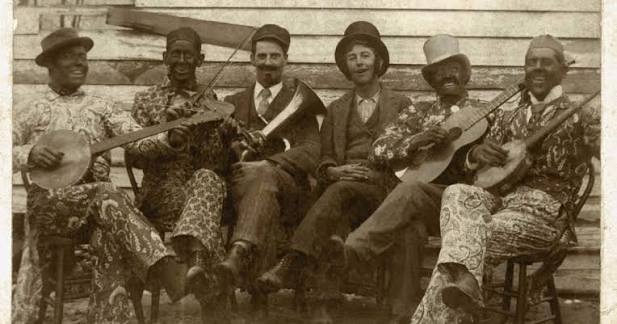
    In 1843, the Virginia Minstrels formalized blackface minstrelsy, the first distinctly American mass entertainment form. White men darkened their faces with burnt cork and performed caricatured imitations of Black speech, dance, and song. It was brutal, racist, and wildly popular.

    But here’s the paradox: minstrelsy was also the conduit through which white audiences first encountered—albeit distorted—Black musical elements. The banjo, an African-derived instrument, became a minstrel staple. Syncopated rhythms and dance steps like the cakewalk filtered into mainstream entertainment. This set a recurring pattern: Black innovation, white mediation, mainstream success, and erasure of Black authorship.

    This pattern would repeat for over a century. White artists like Elvis Presley and the Beatles achieved massive success covering or adapting Black R&B, often receiving greater credit and compensation. The music was loved, but its creators were marginalized.

    Ragtime, Blues, and the Birth of Commercial Black Music

    By the 1890s, Black musical forms began moving into published, commercially viable territory. Scott Joplin’s ragtime compositions, with their syncopated “ragged” rhythms, became piano sheet music sensations. W.C. Handy, “Father of the Blues,” published “Memphis Blues” in 1912, bringing the blues to a broader audience.

    The blues, with its “blue notes”—flattened 3rd, 5th, and 7th scale degrees—drew directly on African pitch traditions that didn’t map neatly onto Western equal temperament. These bent or “worried” notes conveyed emotional depth and were a signature of African-derived vocal styles.

    In the 1920s, “race records” marketed Black music to Black audiences. Ma Rainey and Bessie Smith sold millions of records. Jazz, led by Louis Armstrong and Duke Ellington, became a national phenomenon. Improvisation, a core African performance principle, became jazz’s defining feature. Musicians didn’t just play written notes; they created in the moment, treating each performance as a living, participatory event.

    The Sound of Young America: Motown and the Mainstream Crossover

    Berry Gordy’s Motown Records represented a deliberate strategy to bring Black artistry to mainstream pop. He crafted a polished sound—tight harmonies, catchy hooks, and a steady backbeat—that appealed to white and Black audiences alike. But the African roots were always there: the call-and-response between lead and background vocals, the syncopated bass lines, the gospel-inflected vocal embellishments.

    Motown wasn’t a break from the lineage; it was a continuation. The label’s artists—Smokey Robinson, Marvin Gaye, Stevie Wonder—drew directly from blues, gospel, and R&B traditions that had been evolving for a century. By presenting Black music in a pop-friendly package, Motown made African-derived aesthetics mainstream without disguising their origins.

    The Legacy: From James Brown to Hip-Hop

    The lineage continued into funk and soul. James Brown’s “funky drummer” beat, with its emphasis on the downbeat and polyrhythmic layering, was a direct descendant of West African drumming patterns. Sister Rosetta Rosetta Tharpe, a queer Black woman, pioneered rock guitar techniques in the 1940s and 1950s, earning her the title “Godmother of Rock.”

    In the 1970s, hip-hop emerged in the Bronx, built on breakbeats and sampling. DJ Kool Herc, a Jamaican immigrant, extended the instrumental breaks of funk records, creating a new rhythmic foundation for MCs to rap over. Sampling itself is a form of communal reclamation—taking existing music and recontextualizing it, much like African musicians who recombine traditional rhythms in new ways.

    Why This History Is Hidden

    Standard genre histories often treat jazz, rock, R&B, and hip-hop as discrete American inventions. The African lineage is obscured for several reasons:

    • Segregation of music history: Jazz is taught as “America’s classical music,” rock as youth rebellion, Motown as pop—each severed from African roots.
    • The Great Migration narrative: Black Southerners moving north (1910–1970) brought blues and gospel to Chicago, Detroit, and New York, but histories emphasize geography (Delta → Chicago) over deeper African structural inheritance.
    • Commercial erasure: White artists who covered Black music often received more credit, and the originators were pushed into the background.

    Understanding the full lineage changes how we hear everything. The backbeat in a Taylor Swift song, the call-and-response in a gospel choir, the blue notes in a rock guitar solo—all carry echoes of Africa. This isn’t about diminution; it’s about recognition. American popular music is a rich, complex tapestry woven from African threads, and the pattern is clearer when we look closely.

    From minstrelsy’s distorted borrowings to Motown’s polished crossover, American popular music has never been far from its African roots. The elements—syncopation, call-and-response, blue notes, improvisation—are not just stylistic quirks; they’re the structural DNA of the music we love. Recognizing this heritage isn’t about rewriting history; it’s about completing it. The next time you tap your foot to a backbeat, you’re participating in a tradition that survived the Middle Passage, defied bans, and continues to evolve. That’s a story worth hearing.

    Summary

    • American popular music is deeply rooted in African musical traditions, including polyrhythms, call-and-response, blue notes, and improvisation.
    • Blackface minstrelsy was the first mass entertainment form, both a vehicle for racist stereotypes and a distorted conduit for Black musical elements.
    • Ragtime, blues, jazz, R&B, soul, funk, and hip-hop all trace their lineage to African performance practices.
    • Motown’s crossover success brought African-derived aesthetics to mainstream pop without disguising their origins.
    • Standard genre histories often obscure this lineage, but recognizing it changes how we understand and appreciate the music.

    FAQ

    Q: What is a ‘blue note’?
    A: A blue note is a flattened 3rd, 5th, or 7th scale degree, often bent or ‘worried’ in pitch. It comes from African scales that don’t map neatly onto Western equal temperament, and it gives blues and jazz their distinctive emotional quality.

    Q: How did the banjo get to America?
    A: The banjo is derived from West African stringed instruments like the akonting. Enslaved Africans brought the instrument and its playing techniques to the Americas, where it became a staple of American folk and minstrel music.

    Q: Why is Motown considered part of the African musical lineage?
    A: Motown’s sound relied on syncopated bass lines, call-and-response vocals, and gospel-inflected embellishments—all African-derived elements. Berry Gordy packaged these in a polished pop format, but the roots remained.

    Q: What is call-and-response?
    A: Call-and-response is a conversational structure where a soloist makes a musical statement (‘call’) and the ensemble or audience responds. It’s present in African ritual music, spirituals, blues, gospel, jazz, and hip-hop.

    Q: How did drums get banned during slavery?
    A: After the 1739 Stono Rebellion in South Carolina, authorities banned drums on plantations because they could be used to coordinate uprisings. Enslaved people adapted by using body percussion and vocal rhythms instead.

  • The Forgotten Heroines of Blues: How Ma Rainey and Bessie Smith Paved the Way for Rock and Roll

    Ma Rainey and Bessie Smith Forged a Powerful Friendship That Helped Bring Blues to the Mainstream

    Before Elvis shook his hips, before Chuck Berry duck-walked across a stage, and before Little Richard pounded the piano with manic glee, there were two women who defined what it meant to command an audience. Ma Rainey and Bessie Smith weren’t just blues singers—they were architects of a performance style that rock and roll would later claim as its own. Their stories, often overshadowed by the male bluesmen who came after, reveal a crucial chapter in music history that deserves a spotlight.

    When we trace rock’s roots, we usually point to Delta bluesmen like Robert Johnson or electric pioneers like Muddy Waters. But the real foundation was laid in the 1920s by a group of bold, theatrical women who turned the blues into a national phenomenon. They were the first to sell records by the hundreds of thousands, the first to blend vaudeville showmanship with raw emotional power, and the first to make Black women’s voices a force in American music. This is their story—and why it matters for rock and roll.

    The Mother of the Blues: Ma Rainey’s Rise

    Gertrude Pridgett was born in Columbus, Georgia, in 1886. She started performing as a teenager in minstrel shows and vaudeville, absorbing the theatrical traditions that would define her career. By the time she took the stage name Ma Rainey, she had already spent years honing her craft. When she first recorded for Paramount Records in 1923, she was nearly 40 years old—an age when many performers were winding down. Instead, she launched a recording career that would produce over 100 songs, including classics like “Bo-Weavil Blues,” “See See Rider,” and the bold “Prove It on Me Blues,” which openly referenced her attraction to women.

    Rainey’s stage presence was legendary. She wore gold teeth, sequined gowns, and feather boas, transforming each performance into a spectacle. She didn’t just sing the blues—she acted them out, using her voice and body to convey every ounce of pain and joy in a song. This theatrical approach was a direct bridge between the vaudeville tradition and the raw emotionalism of the blues. It was also a template that rock performers would later adopt: think of Little Richard’s pompadour and wild piano, or James Brown’s cape routine. Rainey built that playbook decades earlier.

    The Empress of the Blues: Bessie Smith’s Reign

    If Rainey was the mother, Bessie Smith was the crown jewel. Born in Chattanooga, Tennessee, in 1894, Smith was orphaned young and began singing on street corners with her brother. She learned the ropes touring with Rainey’s troupe in the early 1910s, but she soon surpassed her mentor in commercial success. In 1923, Smith signed with Columbia Records and released her debut, “Down Hearted Blues.” It sold over 800,000 copies in six months—a staggering figure for the era, proving that Black audiences were hungry for blues records.

    Smith’s voice was a force of nature: powerful, precise, and emotionally devastating. She recorded with jazz luminaries like Louis Armstrong, Fletcher Henderson, and James P. Johnson. Her 1925 recording of “St. Louis Blues” with Armstrong is still considered a landmark of the genre. At her peak, Smith earned up to $2,000 a week—equivalent to over $30,000 today—making her one of the highest-paid Black performers of the 1920s. She was a businesswoman and a star, commanding respect on and off stage.

    The Blues-to-Rock Connection: A Direct Line

    Rock and roll didn’t emerge from a vacuum. Its DNA includes the 12-bar blues structure, call-and-response vocals, and bent-note guitar techniques that first became popular in the 1920s. But more than that, rock inherited a performance ethic from the classic blues women. They proved that music could be both deeply personal and wildly entertaining, that a singer could be vulnerable and commanding at the same time. That duality is at the heart of rock performance.

    Early rock pioneers openly cited blues singers as influences. Elvis Presley, Chuck Berry, Little Richard, and Jerry Lee Lewis all grew up listening to blues records, and they carried that emotional directness into their own music. But while male bluesmen like Robert Johnson get much of the credit, the women who preceded them—Rainey, Smith, and others—were the ones who built the commercial foundation. They were the first to sell blues records to a national Black audience, creating a market that later labels like Chess, Sun, and Atlantic would exploit for rock and roll.

    Why They Were Left Out of the Story

    The “forgotten” part of this story is no accident. Rock history has largely been written as a male lineage: bluesmen to rockers. The classic blues women are often reduced to footnotes, mentioned in passing but never given the central role they deserve. There are a few reasons for this. First, the Great Depression and the rise of talkies in the 1930s devastated the vaudeville circuits and record sales, ending the classic blues era. The center of blues shifted to male electric blues in Chicago, which directly fed into rock and roll. So the narrative naturally focused on those men.

    Second, there’s a gender bias in how music history is remembered. The “authentic” blues is often framed as rural, male, and acoustic, while the classic blues women are seen as more theatrical and commercial. But that’s a false distinction. Rainey and Smith were just as authentic—they simply came from a different tradition, one that embraced showmanship as much as sorrow. Their contributions didn’t just influence jazz and R&B vocalists like Billie Holiday and Etta James; they set the template for rock’s most electrifying performers.

    The Queer Angle: Another Layer of Erasure

    Both Rainey and Smith were open about their bisexuality, which adds another layer to their erasure. Rainey’s “Prove It on Me Blues” is one of the earliest examples of queer expression in popular music. For two Black women in the 1920s to sing about loving other women was revolutionary—and it made them even less palatable to a mainstream that preferred its idols neat and digestible. Their queerness wasn’t hidden; it was part of their persona. But that, too, got written out of the history books.

    A Legacy That Deserves the Spotlight

    Ma Rainey died in 1939, just a few years after retiring to Georgia to run a theater. Bessie Smith died in 1937 in a car accident in Mississippi, her career already fading. But their influence didn’t die with them. Every time a rock star struts across a stage, every time a singer pours raw emotion into a microphone, they’re channeling the spirit of Rainey and Smith. They were the first to show that the blues could be both personal and spectacular, and that a Black woman’s voice could command the world’s attention.

    The next time you hear a rock anthem or see a performer work a crowd, remember the women who started it all. Ma Rainey and Bessie Smith didn’t just sing the blues—they built a stage where raw emotion and dazzling showmanship could coexist. They paved the way, and it’s time we gave them their due.

    Summary

    • Ma Rainey, “Mother of the Blues,” was one of the first professional blues singers recorded, with over 100 songs and a theatrical stage presence that bridged vaudeville and blues.
    • Bessie Smith, “Empress of the Blues,” sold 800,000 copies of her debut in six months and became one of the highest-paid Black performers of the 1920s.
    • Both women established the vocal power and performance style that rock and roll later adopted, influencing pioneers like Elvis and Little Richard.
    • Rock history has often overlooked them due to gender bias and the shift to male electric blues, but their impact on the music industry is undeniable.
    • Their queerness added another layer of erasure, but songs like “Prove It on Me Blues” show their boldness in expressing their identities.

    FAQ

    Q: Why are Ma Rainey and Bessie Smith considered “forgotten” heroines?
    A: They are often overshadowed by male bluesmen in rock history, even though they pioneered the commercial blues market and the performance style that rock adopted.

    Q: How did they influence rock and roll?
    A: Their emotional vocal delivery, call-and-response patterns, and theatrical stage presence became essential elements of rock performance, inspiring early rock pioneers.

    Q: What was the “classic blues” era?
    A: A 1920s phenomenon where female singers like Rainey and Smith, rooted in vaudeville, recorded blues for a national Black audience, creating the first major blues record market.

    Q: Were they really queer?
    A: Yes, both were known to be bisexual, and Rainey’s “Prove It on Me Blues” is an early example of queer expression in pop music.

    Q: Why did their careers decline?
    A: The Great Depression devastated record sales, and the rise of sound films killed vaudeville touring, ending the classic blues era by the mid-1930s.