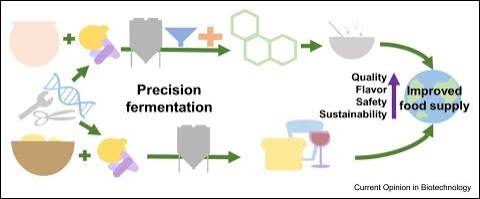
Imagine cheese made without a single cow, egg whites without hens, or honey without bees. This isn’t science fiction it’s precision fermentation, a process that uses engineered microbes as miniature factories to produce the exact proteins, fats, and flavors we love, minus the environmental footprint of traditional farming.
For decades, we’ve relied on animals and plants to create the ingredients in our food. But as the global population grows and climate change pressures our agricultural systems, a new approach is emerging: brew these ingredients in steel tanks, using yeast and bacteria. This isn’t about lab-grown meat (that’s cellular agriculture); it’s about using fermentation to produce the building blocks of food proteins, enzymes, and more in a way that’s efficient, scalable, and kinder to the planet.
What Is Precision Fermentation?
Precision fermentation is a method of biomanufacturing where scientists program microorganisms like yeast, fungi, or bacteria to produce specific ingredients. Think of these microbes as tiny breweries, but instead of beer, they churn out proteins like whey, casein, or egg albumin.
The process starts with identifying the DNA sequence that codes for a desired protein. That sequence is inserted into a host microbe, commonly Komagataella phaffii or Saccharomyces cerevisiae (brewer’s yeast). The microbe is then placed in a large fermentation tank, fed with sugars or starches, and as it multiplies, it secretes the desired protein. After a few days, the protein is harvested, purified, and turned into a powder or liquid ingredient ready for food production.
This is different from traditional fermentation, like brewing beer or making yogurt, where the microbe itself transforms raw ingredients. In precision fermentation, the microbe is just a tool it’s not the final product. It’s also different from cultivated meat, which grows actual animal cells. Here, we’re growing proteins, not animals.
A Proven Technology with a New Mission
Precision fermentation isn’t new. Since the 1980s, it’s been used to produce rennet, an enzyme traditionally sourced from calf stomachs, for cheese-making. Today, an estimated 80–90% of hard cheese in the US and UK uses fermentation-derived rennet. This was the first FDA-approved food ingredient from a genetically engineered organism—a milestone that proved the technology’s safety and viability.
Since then, precision fermentation has given us insulin, vitamins like B2 and B12, and enzymes used in food processing. But the current buzz is about animal proteins—the ones that are hardest to replicate without animals.
Why Now? The Environmental Case
Animal agriculture is a major driver of climate change, responsible for about 14.5% of global greenhouse gas emissions. Dairy alone contributes 3–4%. It’s also land- and water-intensive. Cows need pasture, feed, and huge amounts of water. Precision fermentation offers a way to produce the same proteins with a fraction of the resources.
For example, Perfect Day, a US company, produces whey and casein through precision fermentation. Their animal-free dairy ice cream hit the market in 2021. Since then, they’ve expanded into other dairy products, all without a single cow. Remilk, an Israeli company, received FDA approval in 2023 for its whey protein. The EVERY Company produces egg proteins—no chickens involved.
The Cost Trajectory: From Pricey to Practical
One of the biggest hurdles has been cost. In 2019, Perfect Day’s whey cost around $100 per kilogram. By 2024, that had dropped to an estimated $10–20 per kilogram, with targets of under $5. At that price, precision-fermented proteins could undercut traditional dairy—whey typically sells for $8–12 per kilogram.
This mirrors the trajectory of rennet, which was initially expensive but became cheap as production scaled. The same pattern is likely for other proteins, as companies optimize their processes and build larger fermentation facilities.
What’s on the Market or Coming Soon
Several companies are leading the charge:
- Perfect Day (US): Whey and casein; first to market with animal-free ice cream.
- Remilk (Israel): Whey protein; FDA approval in 2023.
- The EVERY Company (US): Egg proteins (ovalbumin, ovomucoid).
- Impossible Foods (US): Uses precision-fermented soy leghemoglobin (heme) for its plant-based burgers—this is what gives them the meaty flavor and color.
- MeliBio (US): Produces real honey proteins via fermentation—bee-free honey.
- Formo (Germany): Casein for cheese.
- Change Foods (US/Israel): Casein for cheese.
These companies are targeting dairy, eggs, meat flavors, and even honey—ingredients that are difficult to replace with plant-based alternatives but are perfect for precision fermentation.
Regulatory Status: What’s Approved Where
The regulatory landscape is evolving. In the US, the FDA regulates the final ingredient, not the process. Several precision-fermented products have received GRAS (Generally Recognized as Safe) status or ‘no questions’ letters, meaning they’re considered safe for consumption. The EU, however, requires pre-market authorization under the Novel Food Regulation. As of early 2025, no precision-fermented animal proteins have been approved for sale in the EU, though applications are pending. Singapore was the first to approve cultivated meat in 2020 and has also approved precision-fermented products. Israel has an active regulatory pathway, and the UK’s Food Standards Agency has signaled openness.
The Bigger Picture: A Third Wave of Fermentation
The term ‘precision fermentation’ gained traction around 2019–2020 thanks to the Good Food Institute and RethinkX, who distinguished it as the ‘third wave’ of fermentation, after traditional and biomass fermentation. This framing highlights its potential to transform food production.
But it’s not just about food. The same technology is used to produce medicines, like insulin, and other valuable compounds. The infrastructure and science are interchangeable, so advances in one area benefit the other.
Challenges and Considerations
Precision fermentation isn’t a silver bullet. There are challenges:
- Scaling up: Moving from lab-scale to commercial-scale fermentation requires significant investment. Building large bioreactors is costly.
- Consumer acceptance: Some people are wary of genetically engineered organisms, even if the final product is identical to the traditional one. Clear labeling and education are crucial.
- Regulatory hurdles: In some regions, like the EU, the approval process is slow, which delays market entry.
However, the technology has a proven track record—rennet and insulin have been used safely for decades. As more products gain approval and companies scale up, costs will likely continue to drop, making these ingredients more accessible.
Precision fermentation is not a distant dream; it’s a technology that’s already in our food supply. From rennet in cheese to insulin in medicine, it’s been quietly working behind the scenes for 40 years. Now, it’s poised to tackle one of the biggest challenges of our time: feeding a growing population sustainably. By ‘brewing’ proteins and other ingredients in labs, we can reduce the pressure on agriculture, cut emissions, and still enjoy the foods we love. The future of food might just be brewed in a steel tank.
Summary
- Precision fermentation uses engineered microbes (yeast, fungi, bacteria) to produce specific proteins, fats, and other ingredients.
- It’s been used since the 1980s for rennet in cheese and insulin for diabetes.
- Current applications include dairy proteins (whey, casein), egg proteins, and heme for plant-based meat.
- Environmental benefits: lower greenhouse gas emissions, land and water use compared to animal agriculture.
- Costs are falling, with companies like Perfect Day targeting <$5/kg for whey, potentially undercutting dairy prices.
- Regulatory approvals are growing, with FDA and Singapore leading the way, while the EU is still reviewing.
FAQ
Q: Is precision fermentation the same as lab-grown meat?
A: No. Lab-grown meat (cellular agriculture) grows actual animal cells. Precision fermentation uses microbes to produce specific proteins, like whey or egg white, which are then used as ingredients. The microbes are not the final product.
Q: Are precision-fermented foods safe to eat?
A: Yes. The FDA and other regulatory bodies have approved several products, and the technology has been used safely for decades. For example, fermentation-derived rennet has been in cheese since the 1980s.
Q: How does precision fermentation help the environment?
A: It requires significantly less land, water, and energy than traditional animal agriculture. For instance, producing dairy proteins via fermentation emits far fewer greenhouse gases than raising cows.
Q: Will precision-fermented products taste the same?
A: The goal is to create proteins that are identical to those from animals, so the taste, texture, and nutrition are the same. Many consumers have reported that animal-free dairy and egg products are indistinguishable from the real thing.
Q: When can I buy products made with precision fermentation?
A: Some products are already on the market, like Perfect Day’s ice cream and Impossible Foods’ burgers. Others, like cheese from Formo or Change Foods, are in development and awaiting regulatory approval in some regions.