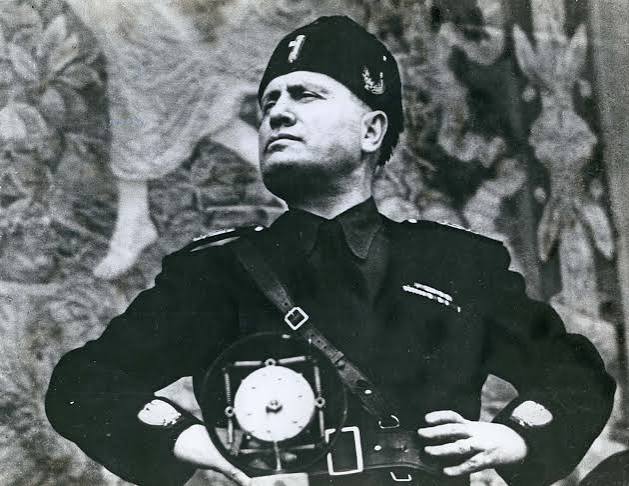
On October 28, 1922, Benito Mussolini arrived in Rome by overnight train from Milan. He had not marched with his Blackshirts most were stuck in the rain outside the city but King Victor Emmanuel III, fearing civil war, refused to sign martial law and instead handed him the government. Mussolini was 39 years old, and within four years he would dismantle democracy and turn Italy into the world’s first fascist state.
His rise was not a sudden coup but a slow, legal creep punctuated by violence. He called himself “Il Duce” the Leader and he gave the world a new word for a new kind of tyranny. Today, “fascism” is used loosely, but its inventor had a specific playbook: nationalism, anti-socialism, paramilitary terror, and a cult of personality built on radio and mass rallies.
From Blacksmith’s Son to Revolutionary
Mussolini was born in 1883 in Predappio, a small town in Italy’s Romagna region. His father Alessandro was a blacksmith and a revolutionary socialist; his mother Rosa was a schoolteacher. The household was poor but politically charged. Young Benito was named after Benito Juárez, the Mexican reformer, and Amilcare Cipriani, an Italian patriot names that signaled his parents’ radical hopes.
He became a schoolteacher and journalist. In 1902, he fled to Switzerland to avoid military service, where he was arrested for vagrancy and spent time with exiled anarchists and socialists. Back in Italy, he rose quickly in the Socialist Party, editing its newspaper Avanti!. He was a gifted writer and a ferocious orator, but he was also impatient with party discipline.
World War I broke his allegiance. The Socialists opposed the war; Mussolini, suddenly, demanded Italy join. Expelled from the party in 1914, he founded his own paper, Il Popolo d’Italia, funded partly by French and Italian industrialists who wanted intervention. He had found his new faith: nationalism.
The Birth of the Fasci
After the war, Italy was a tinderbox. Veterans returned to unemployment and inflation. The government had promised land and glory; it delivered a “mutilated victory” Italy got less than it wanted from the peace treaties. In the factories and fields, workers were striking, and many landowners and industrialists feared a Bolshevik-style revolution.
In 1919, Mussolini gathered a small band of veterans and radicals in Milan’s Piazza San Sepolcro. They called themselves the Fasci Italiani di Combattimento the fasces being the ancient Roman symbol of bundled rods, meaning strength through unity. At first they were a fringe group, winning no seats in the 1919 election. But they had a weapon the Socialists didn’t: violence.
The Blackshirts squadristi roamed the countryside, beating up socialists, breaking up strikes, and occupying town halls. Local authorities often looked the other way or even welcomed them. In 1921, Mussolini formalized the movement into the National Fascist Party. By 1922, the Fascists were strong enough to threaten power, and the March on Rome was launched.
The Dictator Who Made Trains Run on Time (Sometimes)
Once in power, Mussolini moved carefully. He formed a coalition government, but within months he demanded and got the power to rule by decree. The murder of socialist deputy Giacomo Matteotti in 1924, after he dared to denounce Fascist violence in parliament, marked the point of no return. Mussolini took responsibility, and by 1926, he had banned all other parties, censored the press, and created a secret police.
He called his state “totalitarian” a word he embraced. “Everything within the state, nothing outside the state, nothing against the state,” he declared. He controlled schools, youth groups, sports, and even spare time. The Dopolavoro (After Work) organization ran clubs and holidays. The Opera Nazionale Balilla turned children into little soldiers, teaching them to march and to worship Il Duce.
Was there a positive side? Yes, and it’s often exaggerated. The regime drained the Pontine Marshes and built autostrade (highways). The “Battle for Grain” increased wheat production, but it pushed Italy toward inefficient autarky. The famous “trains running on time” was a myth the trains ran on time for tourists, but the economy was increasingly rigid and corrupt. The corporate state, which claimed to mediate between workers and employers, actually just suppressed unions and set wages from above.
The Lateran Treaty: An Unholy Alliance
One of Mussolini’s biggest successes was with the Vatican. In 1929, he signed the Lateran Treaty, recognizing the Pope’s sovereignty over a tiny Vatican City state and paying the Church for its lost territories. In return, the Church recognized the Italian state. The agreement ended 60 years of tension and won Mussolini crucial Catholic support. For a dictator, it was a masterpiece of political theater pictures of him walking with the Pope’s emissary appeared in every newspaper.
But the peace with the Church didn’t last. In 1938, Mussolini, now aligned with Hitler, passed antisemitic racial laws. Italian Jews were expelled from schools, professions, and public life. This was partly to please Germany, but also to create a “pure” Italian race—a concept that had no basis in history or science.
The Road to Disaster: Ethiopia, Spain, and the Axis
Mussolini wanted an empire. In 1935, he invaded Ethiopia, using poison gas and bombing cities. The League of Nations condemned him, but he didn’t care. He had his empire, and he called it “a place in the sun” for Italy’s surplus population.
He then intervened in the Spanish Civil War, sending troops and planes to help General Franco. The war drained Italy’s resources, but it brought Mussolini closer to Hitler. In 1936, he announced the Rome–Berlin Axis—a pact that would eventually seal his fate.
Hitler, at first, admired Mussolini and copied his style. But by 1940, the roles had reversed. Mussolini, watching Hitler’s blitzkrieg sweep across Europe, felt Italy must join the war to grab spoils. He declared war on France and Britain in June 1940, announcing from his balcony that Italy had “broken its chains.” It was a fatal miscalculation. The Italian army was poorly equipped, and its defeats in Greece and North Africa quickly exposed the regime’s weakness.
Downfall and Death
By July 1943, the Allies had landed in Sicily. The Grand Council of Fascism—the very body Mussolini had created—voted him out of power. The King had him arrested. But the Germans, still occupying Italy’s north, rescued him in a dramatic glider raid. They installed him as head of the Italian Social Republic, a puppet state in the north, based in the town of Salò. There, he returned to his early radicalism, “socializing” industry, but he was merely a figurehead. The real power was German.
In April 1945, as the Allies advanced, Mussolini tried to flee to Switzerland disguised as a German soldier. He was caught by partisans near Lake Como, along with his mistress Clara Petacci. The next day, they were executed. Their bodies were taken to Milan and hung upside down in Piazzale Loreto—the same square where partisans had been executed by Fascists months earlier. The crowd spat and threw stones.
The Legacy of the First Fascist
Mussolini invented a political system that outlived him. His innovations—the cult of personality, the use of propaganda, the corporate state, the alliance of nationalism and anti-socialism—were copied by Hitler and Franco. But his regime also left Italy with a lasting scar. When the war ended, Italy had to rebuild not just its cities but its democracy, which had been so easily discarded.
His legacy is still contested. Some Italians remember the public works and the order; others remember the fear and the millions of dead. In 2017, a far-right group called CasaPound even tried to build a memorial in his hometown, but it was blocked. History doesn’t repeat itself, but its warnings are clear.
Benito Mussolini rose to power by exploiting fear and division, then held onto it by dismantling every institution that could check him. His rule ended in ruin, but his invention—fascism—remains a dangerous idea that has never fully disappeared. Understanding his story is not about excusing it; it’s about recognizing the patterns, so they can be resisted wherever they appear again.
Summary
- Mussolini was the inventor of fascism, coining the term from the Latin ‘fasces’ and building a totalitarian state in Italy from 1922 to 1943.
- He rose to power through a combination of legal maneuvering, paramilitary violence (the Blackshirts), and the March on Rome in 1922.
- His regime mixed public works and propaganda with severe repression, including the murder of opponents, press censorship, and, from 1938, antisemitic racial laws.
- His foreign policy led to the invasion of Ethiopia, intervention in the Spanish Civil War, and an alliance with Hitler that drew Italy into World War II.
- Mussolini was ousted in 1943, rescued by Germans, and finally captured and executed by Italian partisans in April 1945.
FAQ
Q: Was Mussolini responsible for the murder of Giacomo Matteotti?
A: Yes. Matteotti, a socialist deputy, was kidnapped and killed in 1924 after giving a speech denouncing Fascist violence. Though the killers were hired thugs, Mussolini took responsibility in a speech, effectively acknowledging his role, and used the crisis to tighten his grip on power.
Q: Did Mussolini really make the trains run on time?
A: The claim is a myth. The Fascist regime did invest in railways, but the “on-time trains” were often propaganda, prioritizing high-profile routes. The broader economy suffered from inefficiency and corruption, and the “miracle” was largely a public relations invention.
Q: What was the Lateran Treaty?
A: The Lateran Treaty was signed in 1929 between Mussolini and the Vatican. It recognized the Pope’s sovereignty over Vatican City and made Catholicism the state religion, in exchange for the Church’s recognition of the Italian state and a financial settlement. It ended 60 years of conflict between Italy and the papacy.
Q: Why did Mussolini pass antisemitic laws in 1938?
A: Mussolini passed the racial laws to align Italy with Nazi Germany and to create a sense of a “pure” Italian race. The laws expelled Jews from schools, professions, and public life, and were a stark departure from Italy’s earlier record, where Jews were generally integrated.
Q: How did Mussolini die?
A: On April 28, 1945, Mussolini was captured by Italian partisans near Lake Como while trying to flee to Switzerland. He and his mistress Clara Petacci were executed the same day. Their bodies were then hung upside down in Milan’s Piazzale Loreto, where a crowd gathered to spit on them.