Inside a dark hive, a honeybee performs a figure-eight dance that tells her sisters exactly where to find food. This dance, called the waggle dance, was decoded by Karl von Frisch in the 1940s, earning him a share of the 1973 Nobel Prize. It’s a remarkable example of symbolic communication in the animal kingdom, conveying distance and direction with surprising precision.
But how does a bee ‘read’ a dance she can’t see? The answer lies in touch and vibration. Follower bees press their antennae against the dancer, feeling her movements and the vibrations she sends through the comb. This article breaks down the mechanics of the waggle dance, the information it encodes, and the scientific debate that once questioned its very existence.
The Dance Floor: Where and How It Happens
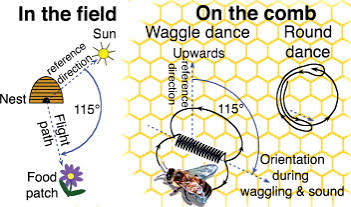
The waggle dance takes place on the vertical surface of the honeycomb, inside the pitch-dark hive. The dancer, a forager bee, moves in a figure-eight pattern. The straight part of the figure is called the ‘waggle run,’ where she vibrates her abdomen side-to-side. Then she loops back to the starting point, alternating left and right. This run is the key: its angle and duration carry the essential information.
Decoding the Message: Direction and Distance
Direction: The angle of the waggle run relative to vertical tells followers the angle of the food source relative to the sun’s position. If the bee waggles straight up, the food is in the same direction as the sun. If she waggles 45 degrees to the right of vertical, the food is 45 degrees to the right of the sun. This works because bees have an internal clock that compensates for the sun’s movement across the sky.
Distance: The duration of the waggle run correlates with the distance to the food. Roughly 75 milliseconds of waggle run equals about 1 kilometer. So a longer waggle means a farther food source. Bees can communicate distances from about 50 meters to over 10 kilometers, though accuracy decreases with distance.
Beyond the Basics: Quality and Scent
A bee doesn’t just give directions; she also indicates how good the food is. The vigor of the dance—how many runs she performs, how fast she moves, how long she dances—reflects the quality of the food source, such as sugar concentration and nectar volume. Followers can also smell the floral scent on the dancer’s body, providing an olfactory cue about the specific flowers. And they may taste a drop of nectar from her mouthparts to assess quality directly.
The Round Dance: A Shortcut for Nearby Food
For food sources very close to the hive (less than about 50 meters), bees perform a ’round dance’—a looping pattern without a distinct waggle run. This just says ‘nearby’ without giving precise direction. It’s a graded system, not a binary one, showing the dance’s flexibility.
How Followers ‘Hear’ the Dance: Touch and Vibration
In the dark hive, visual cues are useless. Instead, follower bees position themselves behind the dancer and touch her with their antennae. They track her movements through these mechanosensory contacts. The dancer also produces vibrations at about 200–300 Hz, transmitted through the comb. These vibrations, generated by the waggle itself (at about 13–15 Hz) and by a brief thoracic pulse, are critical for recruiting followers. Recent research by James Nieh and others suggests the vibration signal may also encode information about food profitability, adding another layer to the message.
The Controversy: Is It Really a Language?
The waggle dance’s status as a true language wasn’t always accepted. In the 1960s and 70s, biologist Adrian Wenner argued that scent cues alone could explain how bees found food, and the dance was just a byproduct. This sparked a heated debate. But experiments by James Gould in the 1970s settled it: using robotic bees and misdirection experiments, Gould showed that bees could locate a specific place based solely on the dance’s information, even when scent was controlled. The dance is real, but it’s not the only channel—bees use a combination of dance, scent, and vibration to make decisions.
The Bigger Picture: Swarm Intelligence
Thomas Seeley at Cornell has shown that the waggle dance is part of a decentralized decision-making system. When a hive needs a new nest site, scout bees dance to advertise different options. The intensity of each dance acts like a vote, and the colony eventually chooses the best site through a democratic process. The dance is thus not just about foraging; it’s a key component of the hive’s collective intelligence.
How a Bee’s Tiny Brain Handles This
Given that a bee has only about a million neurons, how does it translate a dance into a flight vector? Research suggests that bees use optic flow—the apparent movement of the environment as they fly—to measure distance, and they may compare the dance’s instructions with their own flight experience. The exact neural mechanisms are still being studied, but the bee’s ability to extract and use this information is a testament to the power of small brains.
The Evolution of the Dance
Not all bees dance the same way. The dwarf honeybee Apis florea, for instance, dances on a horizontal surface, using the sun’s actual direction rather than a vertical abstraction. Stingless bees use simpler recruitment methods like scent trails. This suggests the waggle dance evolved as a derived trait within the honeybee lineage, becoming more sophisticated over time.
Conclusion: A Small Dance, a Big Message
The waggle dance is a remarkable example of symbolic communication in animals. It conveys precise information about direction, distance, and quality, all through vibrations in the dark. It’s a system that has evolved to meet the complex needs of a eusocial colony, and it continues to fascinate scientists and laypeople alike. Next time you see a bee buzzing around, remember there’s a whole language hidden in those wiggles.
The waggle dance is a vivid reminder that communication doesn’t require sound or sight. Through touch and vibration, honeybees pass along directions that can lead their sisters to food kilometers away. This tiny dance carries a big message, and it’s one of nature’s most impressive feats of information transfer.
Summary
- The waggle dance is a figure-eight movement performed by forager bees on the vertical honeycomb surface.
- The angle of the waggle run indicates direction relative to the sun; the duration indicates distance (~75 ms per km).
- Dance vigor and scent convey food quality.
- Followers perceive the dance through touch (antennae) and vibration (~200–300 Hz).
- The dance was decoded by Karl von Frisch (Nobel Prize 1973) and confirmed by experiments like James Gould’s robotic bees.
FAQ
Q: What is the waggle dance?
A: It’s a figure-eight dance performed by honeybees to communicate the location of food sources.
Q: How do bees know the direction from the dance?
A: The angle of the waggle run relative to vertical corresponds to the angle of the food source relative to the sun.
Q: How do bees communicate distance?
A: The duration of the waggle run is proportional to distance; longer waggles mean farther food.
Q: Do bees use the dance for anything else?
A: Yes, they also use it to choose nest sites, with each dance acting as a vote in a collective decision.
Q: Can bees see the dance?
A: No, they feel it with their antennae and sense vibrations through the comb.