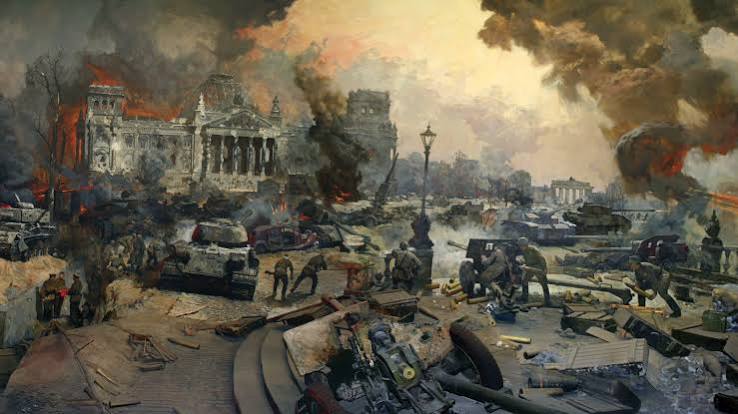
On April 16, 1945, the roar of over 41,000 Soviet artillery pieces shattered the pre-dawn silence along the Oder River. Marshal Georgy Zhukov had ordered the largest artillery barrage in history, using 143 searchlights to blind the German defenders. But the first assault on the Seelow Heights stalled, costing thousands of lives in hours. This was the beginning of a battle that would consume Berlin block by block, end with Hitler’s suicide, and seal the fate of Nazi Germany.
The Strategic Trap: Why Berlin Became Inevitable
By early 1945, the Red Army stood 60 kilometers from Berlin, having swept across Poland in the Vistula-Oder Offensive. The Western Allies had crossed the Rhine in March, and a race for the German capital seemed possible. But General Dwight Eisenhower made a controversial decision: he halted the Western advance at the Elbe River, prioritizing the encirclement of the Ruhr and a push south. This was driven by military pragmatism—avoiding a costly urban fight—and the Yalta Agreement, which had already divided post-war Germany into occupation zones. Churchill protested, seeing Berlin as a political prize, but Stalin, suspicious of Western intentions, accelerated his offensive. The city was to be taken by the Soviets, and Stalin wanted it before the West could change the calculus.
The Seelow Heights: A Bloody Gateway
The first major obstacle was the Seelow Heights, a plateau about 70 kilometers east of Berlin. Zhukov’s 1st Belorussian Front attacked head-on, expecting a quick breakthrough. Instead, the Germans, under General Gotthard Heinrici, had anticipated the assault and pulled back from the first line. The Soviet advance was met with concentrated fire, and the initial attack faltered. For three days, the battle raged. Soviet artillery and numbers eventually overwhelmed the defenders, but the cost was staggering: roughly 30,000 to 33,000 Soviet soldiers died in this single engagement. The breakthrough came on April 19, opening the road to Berlin.
While Zhukov battered the Seelow Heights, Marshal Ivan Konev’s 1st Ukrainian Front attacked from the south, crossing the Neisse River and pushing toward Berlin. The two fronts converged in a giant pincer, encircling the city by April 25. The same day, American and Soviet troops met at Torgau on the Elbe, symbolically linking the two fronts. Berlin was now cut off, but the defenders had no intention of surrendering.
The Führerbunker: A Fantasy of Resistance
Inside Berlin, Hitler had retreated to the Führerbunker, a concrete complex beneath the Reich Chancellery. He refused to consider surrender, ordering impossible counterattacks. One such order sent General Walther Wenck’s 12th Army, which was actually fighting on the Western Front, to relieve Berlin. Wenck’s army never reached the city. Hitler declared that Berlin would be defended to the last man, and the defenders were a desperate mix: regular Wehrmacht soldiers, SS units, police, Volkssturm (old men and boys), and Hitler Youth. They numbered roughly 766,000 to 1 million, but they were short on fuel, ammunition, and morale. Many were fighting with captured weapons or Panzerfausts, while Soviet tanks prowled the streets.
The city itself was a fortress of rubble. The Soviets, having learned from Stalingrad, used small assault groups—infantry supported by tanks, heavy guns, and flamethrowers—to clear buildings block by block. The fighting was vicious and intimate. Civilians huddled in cellars, and the constant bombardment made the city a hellscape.
The Fall of the Reichstag and Hitler’s End
On April 30, Soviet troops stormed the Reichstag, the symbolic heart of Nazi power. After hours of close-quarters combat, they raised the Red Flag over the building—a moment captured in an iconic photograph taken on May 2, though the first flag was raised on April 30. That same day, Hitler married Eva Braun in the bunker and then committed suicide. His body was burned in the courtyard. Joseph Goebbels, the propaganda minister, and his wife killed their children and then themselves on May 1. With the leadership dead and the city in ruins, General Helmuth Weidling, the commander of the Berlin Defense Area, surrendered the city on May 2.
The battle was over, but the cost was immense. Soviet official records list 81,116 killed or missing and 280,251 wounded, though some historians estimate higher. German military casualties were around 92,000 to 100,000 killed, with 220,000 wounded and 480,000 captured. Civilian deaths in Berlin remain uncertain, with estimates ranging from 22,000 to over 100,000, including those who died in the fighting, from starvation, or in the wave of suicides that swept the city—an estimated 3,000 to 4,000 people took their own lives as the Red Army approached.
The Aftermath: A City Divided, A War Ended
The Battle of Berlin was not just a military victory; it was the final unraveling of the Nazi regime. The formal German surrender followed on May 8/9, ending the war in Europe. But the human cost lingered. For the Soviets, the victory was a just retribution for the atrocities of the Eastern Front, celebrated annually on May 9. For Germans, it was a catastrophe of their own making, marked by civilian suffering and the trauma of mass rape by Soviet troops—a dark chapter that remained largely unspoken for decades. For the West, it was a strategic decision that shaped the Cold War, with Berlin becoming a divided city and a flashpoint for the next half-century.
The story of the Battle of Berlin is a study in extremes: the immense scale of the Soviet war machine, the desperation of a collapsing regime, and the human cost of fanaticism. It was a battle where history’s largest artillery barrage met a city reduced to rubble, and where a dictator’s refusal to surrender sealed the fate of millions.
The Battle of Berlin ended with the Red Army’s victory and Hitler’s suicide, but its legacy is complex. It was a brutal finale to a war that had consumed Europe, a moment of triumph for the Soviets, and a tragedy for the civilians caught in the crossfire. The decisions made in those weeks—Eisenhower’s halt, Stalin’s rush, Hitler’s defiance—reverberated long after the guns fell silent, shaping the post-war world and the Cold War divisions that followed.
Summary
- The Battle of Berlin (April 16 – May 2, 1945) was the final major offensive of World War II in Europe, involving approximately 2.5 million Soviet troops against a German force of roughly 766,000–1 million.
- The Soviet plan was a massive double envelopment, with Zhukov attacking from the east and Konev from the south, encircling the city by April 25.
- The battle was characterized by brutal urban warfare, with heavy casualties on both sides and catastrophic civilian suffering, including an estimated 3,000–4,000 suicides in Berlin.
- Hitler committed suicide on April 30, and the city surrendered on May 2, leading to the formal German surrender on May 8/9.
- The battle’s outcome was shaped by Eisenhower’s decision to halt at the Elbe, leaving Berlin to the Soviets, a choice with lasting Cold War implications.
FAQ
Q: Why did the Western Allies not take Berlin?
A: General Eisenhower halted the Western advance at the Elbe River, citing military pragmatism (avoiding a costly urban battle) and the Yalta Agreement’s division of post-war Germany into occupation zones, which placed Berlin within the Soviet zone.
Q: How many Soviet soldiers died in the Battle of Berlin?
A: Official Soviet records list 81,116 killed or missing, with some estimates higher. The battle for the Seelow Heights alone cost roughly 30,000–33,000 Soviet lives.
Q: What was the role of the Volkssturm in the defense of Berlin?
A: The Volkssturm was a militia of old men and boys, often poorly armed and trained, conscripted in the final months of the war. They were part of the improvised defense force, alongside Hitler Youth and police units.
Q: When was the Red Flag raised over the Reichstag?
A: The first flag was raised on April 30, 1945, though the famous photograph was taken on May 2. The Reichstag was captured after heavy fighting.
Q: How did the Battle of Berlin affect German civilians?
A: Civilians suffered greatly: an estimated 22,000 to over 100,000 died, including from fighting, starvation, and suicides. Many also endured the trauma of mass rape by Soviet troops, a painful legacy that was largely unspoken for decades.