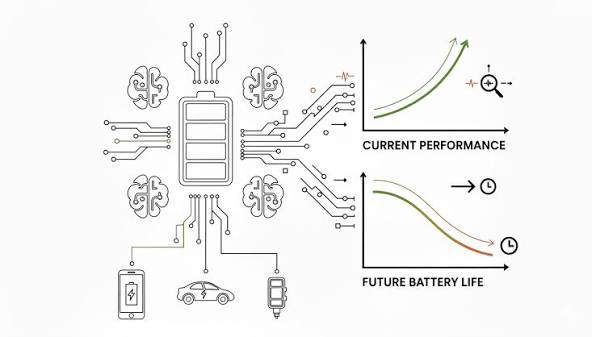
The Humane AI Pin was supposed to replace your phone. Instead, it spends most of its day plugged into a charger. Early adopters report that the $699 pin lasts just 3–4 hours of active use barely enough for a morning of errands before the dreaded low-battery chime. The Rabbit R1, a $199 handheld AI gadget, fares little better under heavy use. The promise of an always-on, hands-free AI companion collides with a stubborn physical reality: batteries haven’t kept pace with the demands of artificial intelligence.
This isn’t a minor design flaw; it’s the central challenge facing the entire category of AI wearables. Every feature that makes these devices magical—continuous listening, visual recognition, on-device language models—devours power. Meanwhile, the tiny batteries inside a pin, a pair of glasses, or a ring hold a fraction of the energy of your smartphone. Understanding why this happens, and what engineers are doing about it, reveals the true trade-offs behind the hype.
The Power Budget Squeeze
Think of a wearable’s battery as a monthly salary, and each component as a bill. A typical smartphone battery holds 3,000–5,000 milliamp-hours (mAh). An AI pin or a pair of smart glasses squeezes by with 300–700 mAh—roughly a tenth of that. Yet the AI features demand comparable compute to a phone. It’s like trying to run a desktop PC on a pocket calculator’s power supply.
Modern large language models, like the ones powering ChatGPT, require 5–15 watts of sustained power just to run on a device. A wearable’s entire budget—including the screen, sensors, and wireless radios—is often just 1–2 watts. Running a full model on-device is physically impossible for more than a few minutes. So most AI wearables offload the heavy lifting to the cloud. Your voice gets recorded, compressed, and sent to a server, which processes it and sends back an answer. That constant two-way streaming is why even a light AI interaction drains the battery far faster than a traditional smartwatch.
The Cloud Compromise
Offloading to the cloud is a clever workaround, but it comes with a hidden cost. Every time you ask a question or take a photo, the device fires up its cellular or Wi-Fi radio, transmits data, and waits for a response. Radios are power-hungry components—especially when they’re constantly searching for a signal. The result: a device that might last a full day on paper but dies in hours of real-world use.
The Rabbit R1, for example, claims a day of light use but drains in hours if you’re actively chatting with its AI. The Meta Ray-Ban Smart Glasses offer around 4 hours of continuous recording—enough for a short vlog, not a day out. Even the Apple Watch, which has the advantage of years of optimization, manages only 18–40 hours, and its AI features are carefully throttled to preserve battery.
Why Bigger Batteries Aren’t the Answer
You might think the solution is simple: just put a bigger battery in. But wearables have to be small and light. A pin that weighs 200 grams isn’t a wearable; it’s a paperweight. Adding battery capacity also generates heat, and AI compute is already a thermal challenge. Engineers are caught in a triangle of trade-offs: size, battery life, and AI capability. You can pick two, but not all three.
That’s why you see hybrid approaches emerging. Instead of trying to run a full AI model on-device, companies are using tiny, specialized chips for always-on tasks like wake-word detection. When you say “Hey, assistant,” a low-power chip wakes the main processor, which then streams your request to the cloud. This is the same trick your phone uses, but on a much smaller scale.
The Road Ahead: New Chips and Smarter AI
Chipmakers are racing to close the gap. Qualcomm’s Snapdragon Wear platforms are designed specifically for low-power AI, with dedicated neural processing units that handle simple tasks at a fraction of the power draw of a full CPU. Arm’s Cortex-M series is even more efficient, though it’s too weak for serious AI. The real hope lies in new architectures that can run small, distilled models—versions of LLMs trimmed down to 1–3 billion parameters—directly on the device. These models are less capable than their full-size cousins, but they use a fraction of the power.
Power gating is another key technique. By shutting down non-essential sensors when the device is idle, engineers can stretch battery life significantly. A smart ring like the Oura or Whoop lasts 4–7 days because it does almost all processing on the phone, leaving only a simple Bluetooth connection active. The trade-off is that they can’t do real-time AI; they just collect data.
The User Experience: Charging Anxiety 2.0
Early adopters of AI wearables report a familiar feeling: charging anxiety. Unlike a phone, which you can top up with a universal USB-C cable, many AI wearables use proprietary pucks or cases. A pin that dies by 2 PM is a hard sell when you’re paying $24 a month for its AI subscription on top of the $699 device. The most useful AI features—ambient listening, visual context—are precisely the ones that drain the battery fastest. So you’re left with a device that’s either useless or constantly tethered to a power source.
This is why smartwatches have succeeded where standalone AI wearables have struggled. Apple and Samsung treat AI as a feature, not the whole product. Your watch is still a timepiece and a fitness tracker even if Siri is slow. A dedicated AI pin has no such fallback. If its battery dies, it’s just a piece of metal with a laser.
A Sustainability Angle
There’s also an environmental cost. Short battery life means frequent charging, which degrades lithium-ion cells faster. And because the batteries in many AI wearables are proprietary and hard to replace, a device that could last five years is often discarded after two. The cloud processing behind AI also has an energy footprint—every query you make consumes server power. When you add it all up, the convenience of an AI wearable comes with a hefty hidden price tag.
What Would Make It Work?
For AI wearables to break through, three things need to happen. First, chips must get more efficient—not just slightly, but by an order of magnitude. Second, AI models need to get smaller without losing too much capability. Third, and perhaps most importantly, designers need to accept that the “always-on” dream is unrealistic. The most practical devices will be those that use AI sparingly, like a smartwatch that listens only when you raise your wrist, or glasses that only record when you tap a button.
The race isn’t over. New battery chemistries like solid-state are promising, but they’re years away from being commercially viable. Until then, the AI wearables that succeed will be the ones that respect the physics of small batteries. The rest will end up in a drawer, next to the other gadgets that promised the future but couldn’t last until dinner.
Battery life is the silent bottleneck of the AI wearable revolution. No amount of software magic can overcome the fact that these devices are trying to do a phone’s job on a fraction of a phone’s energy. The companies that acknowledge this reality—by designing hybrid architectures, using low-power chips, and setting realistic user expectations—will be the ones that survive. For now, if you’re considering an AI wearable, the most important spec isn’t the AI model; it’s the battery capacity.
Summary
- AI wearables have tiny batteries (300–700 mAh) vs. smartphones (3,000–5,000 mAh), yet run power-hungry AI features.
- Cloud offloading helps but drains battery via constant wireless streaming; devices like Humane AI Pin last only 3–4 hours of active use.
- Bigger batteries aren’t a simple fix due to size, weight, and heat constraints.
- Solutions include low-power chips, smaller on-device models, power gating, and hybrid local/cloud processing.
- Smartwatches succeed by making AI a feature, not the device’s sole purpose; standalone AI wearables lack a fallback when battery dies.
FAQ
Q: Why do AI wearables have such short battery life?
A: AI features like continuous listening and visual recognition require significant compute power, which drains small batteries quickly. Most devices offload heavy processing to the cloud, but constant wireless streaming also consumes energy.
Q: How long do current AI wearables last?
A: The Humane AI Pin lasts 3–4 hours of active use, the Rabbit R1 about a day of light use, and Meta Ray-Ban Smart Glasses around 4 hours of continuous recording. Smartwatches like the Apple Watch last 18–40 hours, but they use AI more conservatively.
Q: Can’t they just use bigger batteries?
A: Not easily. Larger batteries add weight and bulk, defeating the purpose of a wearable. They also generate more heat, which is already a problem with AI compute.
Q: What are manufacturers doing to improve battery life?
A: They’re using more efficient chips, running smaller AI models on-device for simple tasks, and implementing power gating to shut down unused sensors. Hybrid architectures that use local processing for basic functions and cloud for complex queries are also common.
Q: Should I buy an AI wearable now?
A: It depends on your use case. If you need all-day reliability, current AI wearables may not meet your needs. Consider whether the features justify the charging hassle and subscription costs.