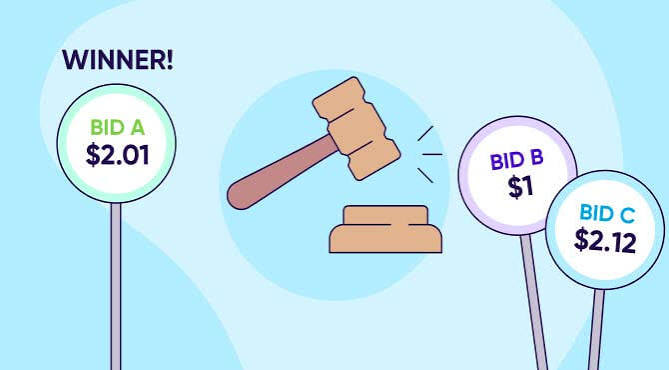
Imagine a world where you only pay for a car advertisement if the viewer actually buys the car not just clicks the ad or visits the showroom. That’s the promise of outcome-based auctions (OBAs), a new advertising model that’s shifting the focus from keyword bids to delivering life outcomes. Instead of paying for clicks or impressions, advertisers now bid on the value of a completed job application, a booked doctor’s appointment, a signed mortgage, or a finished online course. This article explains how OBAs work, why they’ve emerged now, and what they mean for advertisers and platforms.
The Evolution of Ad Auctions: From Impressions to Outcomes
To understand outcome-based auctions, let’s look at how online advertising has evolved. In the 1990s, advertisers paid for impressions (CPM) they paid just to have their ad seen, regardless of whether anyone clicked or cared. Then, in the 2000s, Google AdWords popularized pay-per-click (CPC), where you paid only when someone clicked your ad. This was a big step because it tied cost to user interest.
In the 2010s, advertisers started optimizing for conversions actions like purchases or sign-ups—using tracking pixels. Bidding became algorithmic with Smart Bidding and target CPA (cost-per-acquisition). But these conversions were still website events. Now, with outcome-based auctions, the focus shifts even further: to real-world outcomes that happen offline or later in time, like a loan approval, a completed degree, or a patient actually showing up for surgery.
How Outcome-Based Auctions Work
In an outcome-based auction, the advertiser specifies a desired outcome say, a booked appointment and sets a target cost per acquisition (tCPA) or target return on ad spend (tROAS). The ad platform uses machine learning to predict the probability that a given user will complete that outcome. The auction then happens in real time, but the payment is triggered only when the outcome is achieved (or when the platform’s algorithm decides it’s highly likely).
For example, consider a dental clinic that wants to fill its appointment schedule. With traditional CPC, they’d bid on keywords like “dentist near me” and pay for every click, even if the visitor never books. With an outcome-based auction, they’d set a tCPA of, say, $50 per booked appointment. The platform then shows their ads to users most likely to book, and the clinic pays only when an appointment is actually made.
This model relies heavily on machine learning. The platform’s algorithms analyze vast amounts of data user behavior, device, time of day, past conversions to predict outcome probabilities. The advertiser doesn’t need to manage keywords or placements; they just set their target and let the system optimize.
Why Now? The Perfect Storm of Privacy, AI, and Advertiser Fatigue
Several factors have converged to make outcome-based auctions the new default. First, privacy regulations like GDPR and CCPA, along with the phasing out of third-party cookies, have made it harder to track individual users. Outcome-based models depend less on identifying specific users and more on aggregate prediction, making them more privacy-resilient.
Second, machine learning has matured dramatically. Deep learning models can now predict long-term outcomes from sparse, noisy signals—like a user’s browsing history or app usage—with impressive accuracy.
Third, advertisers are tired of vanity metrics. Clicks and impressions don’t correlate well with business results. CFOs demand ROI tied to revenue or lifetime value, not just traffic. Outcome-based auctions align spend directly with business results, eliminating wasted spend on clicks that don’t convert.
Finally, brands are collecting their own first-party data—CRM data, offline sales, app usage—and feeding it back into ad platforms. This creates a closed loop where outcomes can be measured and optimized.
Who’s Leading the Charge?
Google, Meta, and Amazon are all moving aggressively toward outcome-based bidding. Google’s Performance Max campaigns automatically allocate budget across channels to optimize for conversions, which can be defined as outcomes like purchases or lead forms. Meta offers Advantage+ Shopping Campaigns and Conversions API, which feed offline and online outcome data back into the auction. Amazon uses Cost-per-Purchase (CPP) bidding for sponsored products, where advertisers pay only when a purchase occurs.
Retail media networks like Walmart Connect, Target, and Kroger are also building closed-loop measurement systems where the outcome is a verified in-store or online purchase. Emerging platforms like TikTok and Pinterest are adopting outcome-based bidding as their default as well.
The scale is significant: over 80% of advertisers now use automated bidding strategies (which are outcome-optimized) for at least some campaigns.
The Upside for Advertisers
For advertisers, the biggest advantage is alignment with business results. You’re no longer paying for clicks that don’t convert; you’re paying for outcomes that matter. This reduces wasted spend and simplifies campaign management—no more manual bid adjustments or keyword research.
Outcome-based auctions also level the playing field. Smaller advertisers can compete with large brands by focusing on outcome efficiency rather than outbidding on keywords. If your conversion rate is better, you can win auctions at a lower cost.
The Caveats and Challenges
But there are downsides. The “black box” problem is real: advertisers often can’t see or control which keywords, placements, or audiences trigger their ads. You’re trusting the platform’s algorithm to make the right calls. If the algorithm is wrong, you might waste budget.
Data quality is critical. Outcomes must be accurately tracked and fed back to the platform. If your tracking is broken, the algorithm will optimize for the wrong things. For example, if a conversion is counted when someone just visits a thank-you page rather than actually completing a purchase, you’ll get poor results.
Long sales cycles pose another challenge. For high-consideration outcomes like buying a house, the delay between ad exposure and outcome makes attribution difficult. The platform may not be able to connect the dots, leading to under-optimization.
The Platform Perspective: Risk and Reward
For platforms, outcome-based auctions offer a way to increase revenue. They can charge a premium for “guaranteed” outcomes and algorithmic bidding increases competition. But they also bear more risk—if the outcome doesn’t happen, they don’t get paid. Platforms mitigate this by using sophisticated prediction models to ensure they only charge when the outcome is highly likely.
The Future: Moving Beyond Website Conversions
The next step is moving beyond website conversions to real-world outcomes. For example, a university might bid on “enrolled student” rather than “application submitted.” A hospital might bid on “patient completed treatment” rather than “appointment scheduled.” This requires integrating offline data, which is already happening through platforms like Google’s offline conversion tracking and Amazon’s attribution tools.
What Advertisers Should Do Now
If you’re an advertiser, the time to embrace outcome-based auctions is now. Start by defining the outcomes that matter most to your business—not just clicks or conversions, but actual business results. Ensure your tracking is robust, using first-party data and conversion APIs to feed accurate outcome data to the platforms. Then, test outcome-based bidding strategies like tCPA or tROAS, and be prepared to give up some control in exchange for efficiency.
As privacy regulations tighten and machine learning improves, outcome-based auctions will likely become the standard. Advertisers who adapt early will gain a competitive advantage; those who cling to outdated models may find themselves left behind.
Outcome-based auctions represent a fundamental shift in how advertising is bought and sold. By tying payment to real-world outcomes, they align advertising spend with business results, reduce waste, and leverage AI to predict and deliver value. While challenges like data quality and loss of control remain, the trend is clear: the future of advertising is outcomes, not clicks. Advertisers who embrace this model now will be better positioned to thrive in a privacy-first, AI-driven world.
Summary
- Outcome-based auctions (OBAs) tie payment to measurable life outcomes (e.g., booked appointments, completed purchases) rather than clicks or impressions.
- OBAs rely on machine learning to predict outcome probabilities, with bidding expressed as target CPA or ROAS.
- The shift is driven by privacy regulations, cookie deprecation, AI maturity, and advertiser demand for ROI.
- Major platforms like Google, Meta, and Amazon have adopted outcome-based bidding as default.
- Advertisers benefit from alignment with business results and reduced waste, but face challenges like the “black box” problem and data quality requirements.
FAQ
Q: What is an outcome-based auction?
A: An outcome-based auction is an advertising model where the auction and payment are tied to a specific, measurable lifecycle event—like a completed purchase, a booked appointment, or a signed contract—rather than an intermediate signal like a click or impression. Advertisers bid on the value of that outcome, and the platform uses machine learning to predict and optimize for it.
Q: How is an outcome-based auction different from cost-per-click (CPC) or cost-per-acquisition (CPA)?
A: With CPC, you pay for each click regardless of whether it leads to a sale. With CPA, you pay for a conversion event that happens on your website, like a form submission. With OBA, the outcome can be an offline or delayed event, such as a loan approval or a patient showing up for surgery, and you only pay when that outcome occurs.
Q: What are some examples of outcome-based bidding?
A: Google’s Performance Max, Meta’s Advantage+ Shopping Campaigns, and Amazon’s Cost-per-Purchase bidding are all examples. For instance, a dental clinic could use tCPA bidding to pay only when a patient books an appointment, not just when they click an ad.
Q: What are the main benefits for advertisers?
A: The main benefits are aligning ad spend with business results, reducing wasted spend on non-converting clicks, simplifying campaign management, and enabling smaller advertisers to compete based on efficiency rather than budget size.
Q: What are the challenges of outcome-based auctions?
A: Challenges include the loss of control over keywords and placements (the “black box” problem), the need for accurate outcome tracking and data quality, and difficulties with long sales cycles where attribution becomes harder.