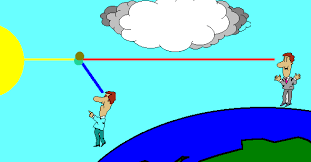
Have you ever wondered why the sky is blue on a clear day, yet painted with brilliant reds and oranges at sunset? The answer lies in the way sunlight interacts with the air around us, a phenomenon called Rayleigh scattering. This article explains the physics behind this everyday wonder without any complex math, using simple analogies and clear explanations.
Imagine you’re at a concert, and the singer’s voice reaches you directly, while the echoes from the walls arrive slightly later and softer. Light behaves similarly when it hits tiny air molecules. Instead of echoing sound, the molecules scatter light in all directions, and the amount of scattering depends on the color of the light.
The Nature of Sunlight and the Atmosphere
Sunlight appears white, but it’s actually a mixture of all the colors of the rainbow, from violet to red. Each color corresponds to a specific wavelength of light, with blue and violet having shorter wavelengths (around 400–450 nanometers) and red having longer wavelengths (around 650–700 nanometers).
As sunlight passes through Earth’s atmosphere, it encounters billions of tiny gas molecules, primarily nitrogen and oxygen. These molecules are much smaller than the wavelengths of visible light, and they interact with the light in a process called Rayleigh scattering.
Think of light waves as ocean waves. When they encounter a small rock in the water, the waves are scattered in all directions, but smaller waves (shorter wavelengths) are disrupted more than larger waves. Similarly, air molecules scatter shorter wavelengths (blue and violet) much more effectively than longer wavelengths (red and orange).
Why the Sky Is Blue
When the sun is overhead, its light travels through the least amount of atmosphere—just one “air mass.” During this relatively short journey, blue light is scattered in all directions by air molecules. As you look up, your eyes receive this scattered blue light from all parts of the sky, making it appear blue.
But what about violet? Violet light has an even shorter wavelength than blue, so it should scatter even more. Yet the sky isn’t violet. Why? There are three reasons:
1. Sunlight contains less violet light than blue at the top of the atmosphere.
2. Our eyes are more sensitive to blue than to violet.
3. Some violet and ultraviolet light is absorbed by the ozone layer before it reaches the lower atmosphere.
So, even though violet scatters more, we see a blue sky because that’s the color our eyes and the sun’s spectrum favor.
The sun itself appears slightly yellow when overhead. That’s because some blue light has been scattered away from the direct beam, leaving a hint of yellow (the complementary color) in the sunlight that reaches us directly.
Why Sunsets Are Red
At sunrise and sunset, the sun is low on the horizon, so its light has to travel through a much thicker slice of the atmosphere—up to 10 to 20 times the distance compared to noon. This longer path means the sunlight encounters many more air molecules, and each one scatters away a bit more blue and green light.
By the time the remaining light reaches your eyes, almost all of the short wavelengths have been scattered away, leaving only the longer wavelengths—the oranges and reds. This is why the sun appears red or orange near the horizon.
But why does the entire sky around the sun glow red during a sunset? That’s because the clouds and sky are illuminated by this already-filtered reddish light. The clouds act like screens, reflecting the reddened sunlight back to you, so you see a red sky.
The same physics explains the classic proverb, “Red sky at night, shepherd’s delight; red sky in morning, shepherd’s warning.” A red sky at night often means that the setting sun’s light is passing through clear, high-pressure air to the west, which typically brings good weather. A red sky in the morning indicates that the clear area is to the east, and a storm may be approaching from the west.
Variations: Why Some Sunsets Are More Vivid
Have you noticed that some sunsets are more dramatic than others? That’s because the atmosphere isn’t always the same. Particles like dust, water droplets, and pollutants can cause a different type of scattering, called Mie scattering, which affects all colors more equally.
When volcanic eruptions or wildfires inject large amounts of aerosols into the atmosphere, they enhance the red and orange hues of sunsets, making them appear deeper and more vibrant. Similarly, pollution can add particles that scatter light in ways that intensify the reds. On the other hand, clean, dry air produces crisp blue skies but less dramatic sunsets.
Clouds also play a role. At sunset, clouds high in the sky can catch the reddened sunlight and glow with brilliant colors, while lower clouds might block the view. The presence of clouds can turn an ordinary sunset into a spectacular display.
A Historical Perspective
Humans have pondered the sky’s color for centuries. Leonardo da Vinci speculated about it in the 15th century, but it wasn’t until the 1860s that John Tyndall demonstrated blue scattering in a lab using colloids. A decade later, Lord Rayleigh (John William Strutt) published the definitive theory, showing that scattering intensity is inversely proportional to the fourth power of the wavelength—meaning blue light scatters about 5 to 10 times more than red light.
This simple relationship explains not only why the sky is blue but also why sunsets are red. It’s a beautiful example of how a fundamental physical principle can explain a familiar everyday phenomenon.
A Final Thought: The Moon and Other Worlds
If you’ve ever seen pictures from the Moon, you’ll notice the sky is black, even in the daytime. That’s because the Moon has no atmosphere to scatter sunlight. On Earth, the atmosphere is the painter, creating the blue canvas of day and the crimson masterpieces of dusk.
Next time you see a red sunset, remember that you’re witnessing the same physics that colors the midday sky. The only difference is the path the light takes through the air. It’s a daily reminder of the intricate dance between sunlight and the thin layer of gas that makes our planet so special.
The blue sky and red sunsets are two sides of the same coin—both are results of Rayleigh scattering, where shorter wavelengths are scattered more strongly by air molecules. The path length through the atmosphere determines which colors reach your eyes. Overhead, we see scattered blue light; at the horizon, we see the transmitted red light. Understanding this simple principle deepens our appreciation for the natural beauty above us.
Summary
- The sky is blue because air molecules scatter blue light (shorter wavelengths) much more than red light.
- At sunset, the sun’s light travels through more atmosphere, scattering away most blue and green, leaving reds and oranges.
- Violet scatters more than blue, but we see blue because the sun emits less violet, our eyes are less sensitive to it, and ozone absorbs some.
- Particles like dust and pollutants can enhance sunsets by adding Mie scattering.
- The Moon has no atmosphere, so its sky is black—proving the atmosphere is responsible for Earth’s blue sky.
FAQ
Q: Why is the sky not violet, even though violet light scatters more than blue?
A: Sunlight contains less violet light, our eyes are less sensitive to violet, and the ozone layer absorbs some violet, so the overall effect is a blue sky.
Q: Why does the sun look yellow at noon but red at sunset?
A: At noon, the sunlight has a short path through the atmosphere, so only a little blue is scattered, leaving a yellow tint. At sunset, the longer path scatters away most blue and green, leaving red.
Q: Why do clouds look white, not blue?
A: Clouds are made of water droplets that are much larger than air molecules, causing Mie scattering, which scatters all colors almost equally, so they appear white.
Q: Can pollution or smoke make sunsets redder?
A: Yes, particles from pollution or smoke can cause Mie scattering, which enhances the red and orange colors, making sunsets appear more vivid.
Q: Does the sky look blue on other planets?
A: Only if the planet has an atmosphere that scatters light similarly to Earth’s. On Mars, the sky is reddish due to different particle sizes, and on the Moon, it’s black because there’s no atmosphere.